Killer Constable

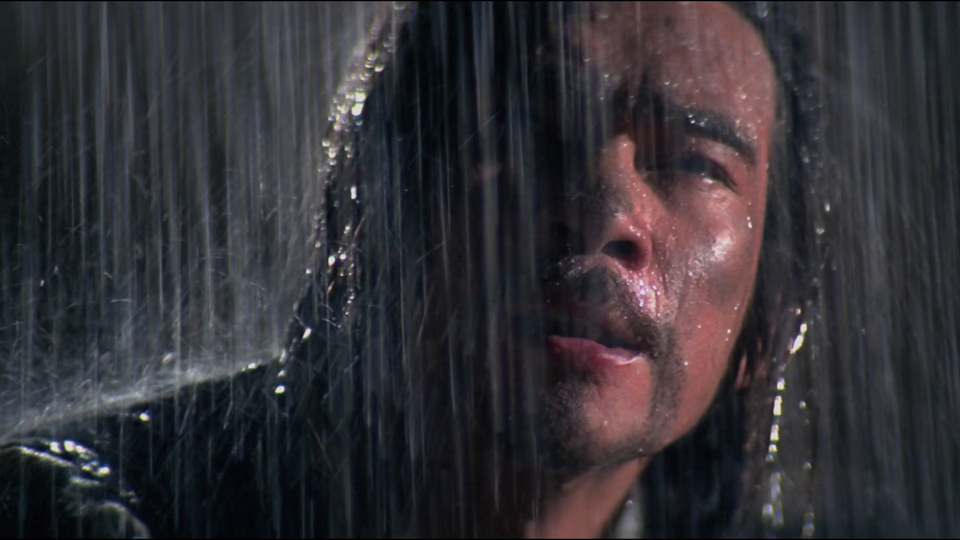
You must endure the first ten minutes.
Trust me, it’s worth it.
Kuei Chih-Hung’s Killer Constable opens with stiff court politics played on what look like the familiar Shaw Brothers sets, but once Chen Kuan-Tai arrives at a bank robbery and drops through a thatched ceiling like some Qing Dynasty Batman, you understand you are in different hands.
Chen plays Leng Tian-Ying, who is chief constable to the Empress Dowager Cixi. He has earned his titular nickname by bringing home heads instead of prisoners.
The story is a men-on-a-mission picture. Leng Tian-Ying is dispatched to recover two million taels of gold stolen from the Royal Treasury. He assembles a small squad and they set out. The men who volunteer include the usual sacrificial types—the one who’s too old, the one about to be married. We know these men are doomed. Kuei knows we know. He doesn’t milk it. He just lets them saddle up and go to work.
What startles most is the light, or the lack of it. A raid on a watermill plays almost entirely in darkness. Inside, a bandit huddles with his wife and crying children. The lights go out. Moonlight through the doorway becomes the only illumination, and the violence that follows is rendered in silhouette and shadow. It is beautiful and horrible at the same time.
Later, assassins creep into a ruined building where Leng Tian-Ying sleeps. Moonlight pours through tall windows. Dust motes swirl in the air. A blade catches the light for one bright instant before the fighters vanish back into blackness. I found myself wondering where this cinematography had been hiding for the previous decade of Shaw productions.
Kuei also uses landscape with real intelligence. A fight along a rocky coastal path is staged so the crashing waves are not mere backdrop but setup. Leng Tian-Ying later lures a skilled fighter into the ocean itself, neutralizing the man’s kicking technique. The surf is not polite about it, either. Waves knock both men sideways. You can see the actors bracing against the undertow. No studio tank could produce this.
The camera, too, has been let off its leash. In a penultimate duel, Leng Tian-Ying and his opponent circle each other while the camera orbits them in the opposite direction. It is a small touch that creates a disorienting, almost sickening sense of two men locked in a spiral with only one exit. Most Shaw productions bolt the camera to the floor and zoom. This one prowls.
The film falters once. A wounded Leng Tian-Ying encounters a blind woman, the daughter of the bandit chief. Yau Chui-Ling plays the role with total sincerity as violins weep on the soundtrack, which is precisely the problem. She belongs in a different, more earnest movie. Kuei is reaching for something like the blind hermit scene in Bride of Frankenstein, but James Whale had a wicked sense of humor threading through his sentiment. Kuei plays it straight, and the tonal whiplash is nearly comic. The film recovers, though, and the blind woman’s final appearance carries a weight that almost justifies the miscalculation. Almost.
The finale is grim and inevitable. Killer Constable is finally about a man who serves a corrupt system with methods that mirror its corruption, and who discovers this too late for it to matter. There is a through-line here to Duel to the Death, my favorite wuxia, in the way both films examine warriors clinging to codes that the world around them has already abandoned. That Kuei Chih-Hung wraps this melancholy in some of the most thrilling action sequences Shaw Brothers ever produced is the real trick.
I didn’t know they had it in them.