Killer Clans

Chor Yuen’s Killer Clans opens on a bridge at night. Two men face each other. One of them will not walk away. It is a simple scene, but it announces something: this will not be another Shaw Brothers picture shot entirely on recycled soundstages under flat lighting. Yuen has plans.
The story is a labyrinth of loyalty and betrayal. An assassin named Meng Sheng-hun is hired to kill Sun Yu, the beloved leader of the Lung Men Society. Meanwhile, a clan war erupts between Lung Men and the rival Roc Society. Bodies accumulate. Alliances shift. Double crosses multiply. If you lose track of who is stabbing whom in the back, don’t worry. The film has already moved on to the next stabbing.
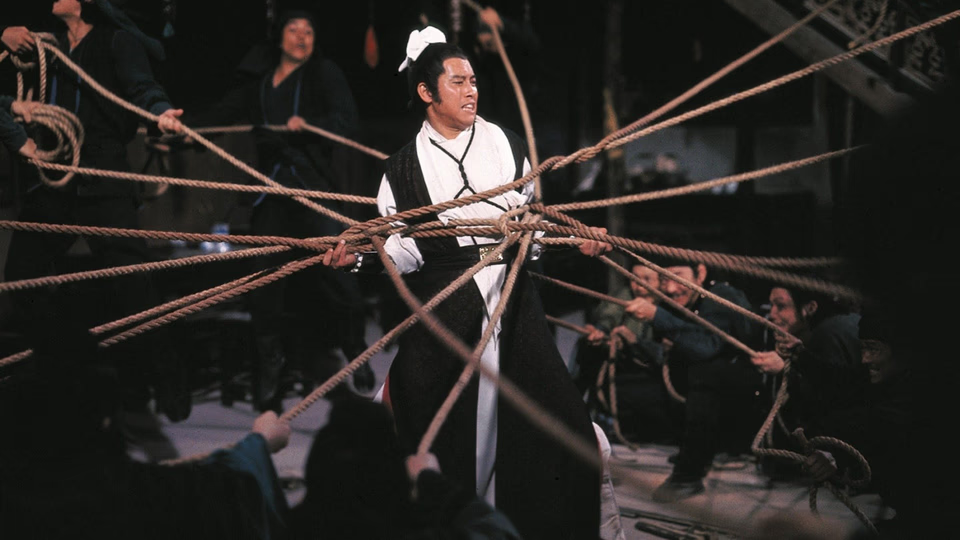
Yuen previously explored similar territory in Jade Tiger, another tale of intrigue boiling over from clan politics. This is the better film. The budget appears larger, the visuals more ambitious. Yuen stages a memorable riverside battle and finds fresh angles even when he’s forced back onto the familiar Shaw Brothers sets. There is a scene in the Tea House—a two-level stage used in so many productions it should collect residuals—where Yuen doesn’t bother with preamble. A dozen men spring from the upper floor trailing ropes, trap their target in a huge knot, and hoist him into a makeshift spider’s web. Yuen cuts wide to show the assailants leaping in slow motion as the ropes crisscross the screen. It is a genuinely inventive piece of action choreography, and it happens in a room we’ve seen a hundred times before.
The script earns its complications by raising the emotional stakes along with the narrative ones. You expect the third act to soften into a love story. It refuses. Instead it doubles down on sacrifice, on what people will destroy—including themselves—in the name of loyalty.
Near the end, Sun Yu, critically wounded, flees through a secret passage to an underground canal. A man is waiting there with a boat. In most films I would call this a convenient plot hole. How long was that guy down there? Is canal duty a full-time position? But then Sun Yu tells us: the man waited fifteen years. Fifteen years in a dark canal on the chance his leader might need him. He is not an anomaly. He is the film’s thesis statement.
Shaw Brothers was adjusting to the exploitation market in the mid-seventies, and Killer Clans reflects that transition. There is nudity, introduced early enough that it sets the tone rather than disrupting it. There is blood. Neither is excessive by the standards the studio would later embrace, but both announce that the old wuxia formulas were being renegotiated.
The film’s greatest weakness is its enthusiasm for complication. Some betrayals arrive only in flashback. Others involve characters introduced so late you haven’t learned their names before they switch sides. The twists outnumber the movie’s ability to make each one land. But the core emotions—greed, love, loyalty—remain legible throughout the chaos. You may lose a subplot, but you never lose the film.
Three and a half stars. The guy in the canal would give it four.