Enter the Dragon

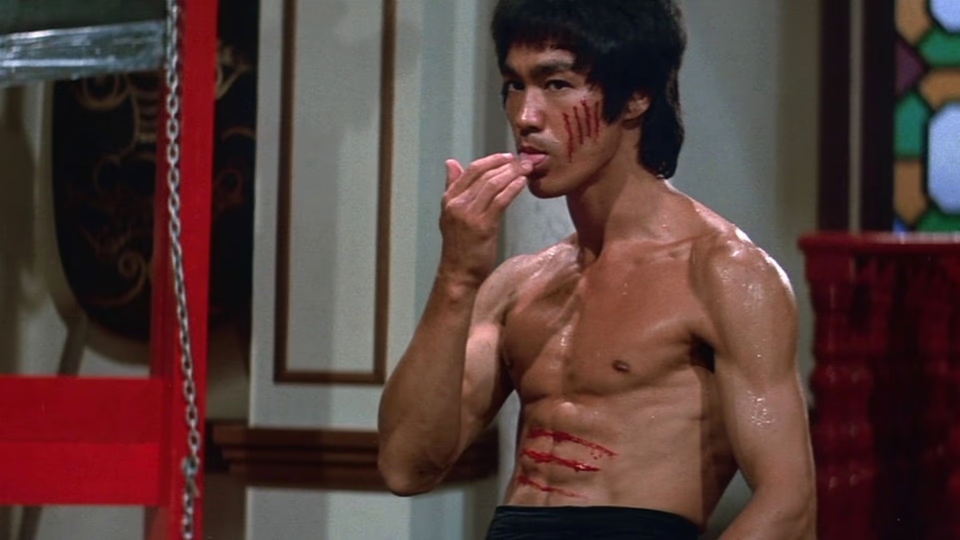
Bruce Lee doesn’t walk into a room. He arrives. There’s a difference. In Enter the Dragon, he arrives in scene after scene with the coiled stillness of a man who knows exactly what his body can do and is politely waiting for you to find out.
The setup is pure Bond. British Intelligence recruits Lee, a Shaolin martial artist, to infiltrate a tournament on the private island of a villain named Han. Han runs opium and traffics in women. Han also has an artificial hand he swaps out for claws and blades, which places him squarely in the Ian Fleming tradition of villains whose bodies advertise their villainy. He even has the underground lair. All he’s missing is a white cat. Oh wait—he has that too.
But this isn’t just Bond with roundhouse kicks. The film operates at the intersection of three genres that had no business working together and somehow do. There is the espionage thriller in the script. There is the kung-fu picture choreographed by Lee. And there is blaxploitation, embodied by Jim Kelly.
Kelly is a revelation. He struts into the movie like he’s doing it a favor, but his laid-back attitude evokes a man amused by his situation. When Kelly tells Han, “Man, you come right out of a comic book,” he’s right, and the film is smart enough to know it.
Gluing it all together is John Saxon as Roper, a lovable rogue who opens the picture as Kelly’s old army buddy and closes it fighting beside Lee. Saxon does something tricky here: he makes you like a man whose main talent is looking out for himself.
All three leads had genuine martial arts backgrounds, and it shows—not just in the fights, but in the way they carry themselves. There is a quiet physical confidence that no amount of choreography can fake.
Lee has the charisma to carry a film but he doesn’t have the warmth. Saxon and Kelly are the ones you’d want to grab a beer with afterward. Lee’s character doesn’t drink, which tells you everything. He is the best fighter on that island. He may also be the loneliest person on it. Bond indeed.
And like any Bond film, the plot will not survive scrutiny. Don’t give it any. The movie doesn’t care about its plot, and after a while, neither do you. That said, a lead is killed off in a way that feels like it belongs in a different, meaner film, and the tonal whiplash is real.
But not fatal.
Enter the Dragon effectively kicked down the door for kung fu in mainstream American cinema. Shaw Brothers and Golden Harvest had scored on the exploitation circuit, but this was a Hollywood production with a Hollywood budget and Hollywood distribution. The grafting of Western spy tropes onto martial arts storytelling created a template that’s still in use today. It may not be the greatest kung fu film ever made, but it is almost certainly the most important one.