Charley Varrick

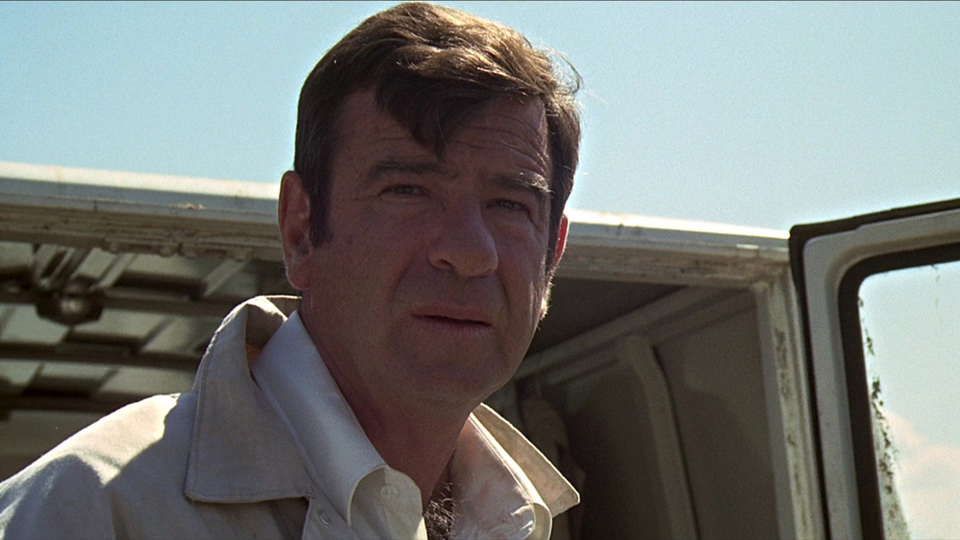
Walter Matthau has the face of a man who’s been losing slowly for a long time and has gotten very good at it. It hangs in folds, it apologizes in advance, and Hollywood spent fifteen years using it to get laughs. In Charley Varrick, Don Siegel uses it and never once asks it to be funny. What comes back is the portrait of a man who could have been somebody if two or three things had broken his way. But they didn’t.
First a stunt pilot, then a crop duster, Charley Varrick is now the head of a very small criminal organization consisting of himself, his wife, and two hired hands. They hit a bank in a New Mexico town so minor the sheriff probably also drives the fire truck. The job curdles fast. A cop dies. So do two of the four robbers, one of them Varrick’s wife.
What’s left is Varrick, a kid named Harman, and a satchel they figured for maybe a few thousand. Inside sits three-quarters of a million.
Varrick understands what that means before the counting is done. Banks out in the sagebrush don’t sit on that kind of cash unless somebody is laundering it there. Harman understands nothing and wants a Cadillac.
The mob dispatches a man named Molly to find out what happened. Joe Don Baker plays him with a big slow body and eyes that never stop working, and Siegel has made the essential decision of the picture: Molly is not stupid. He is patient, methodical, cheerfully cruel, and he will find you. The only question is when. You don’t need chases to generate suspense. Siegel supplies a few anyway, and the last one involves a biplane.
That’s the pleasure of the picture. A smart man against another smart man, with no idiots on the board. Siegel and screenwriter Howard Rodman have imagined a syndicate that operates like a regional utility, with vice presidents and cash-flow problems and a branch office above a dusty bar. Pair it with The Outfit, out earlier in 1973, also with Baker, and you get the year’s second good argument that organized crime is mostly just organized.
The supporting people are dead right. Andrew Robinson gives Harman a pair of eyes that never settle on anything, so you know he’s going to talk to a woman he shouldn’t. John Vernon, as a bank executive with laundered hands, has that smooth, funeral-parlor menace. And Norman Fell turns up as a tired investigator, completely convincing as a man doing an ugly job on a per diem.
Siegel trusts his material to an extent that has become unfashionable. There’s a scene midway through the film where Vernon and the small-town bank manager stand talking on an empty stretch of prairie. The camera simply watches while Vernon calmly explains that the manager should run, and what their employers will do with a pair of pliers and a blowtorch if he doesn’t. Two supporting players, no cutting, no music to speak of. It doesn’t drag for a second. Instead it tightens every screw in the picture.
I have one complaint. Somewhere in the third act Varrick beds a woman who has no earthly reason to want him, in a scene that could be lifted out with tweezers, leaving no scar. It’s the moment the movie forgets who it cast. You can smell an earlier draft written for Eastwood, or McQueen, or Marvin, all of whom would have made this a lesser film. A heavy in this part turns the story into a contest of nerve, and we’ve all seen that. Matthau can’t outrun anybody. He can’t intimidate anybody. He has his wits, and his wits have to be enough.
They are. The last twenty minutes deliver everything the drive-in crowd came for, and Siegel gets there without insulting a single member of the audience.
I went in expecting a decent programmer and came out feeling I’d been handed something better: a crime picture made by professionals for grownups, with an actor at its center doing some of the best work of his career while wearing a face like a mattress somebody dragged into the yard.