The Viking Queen

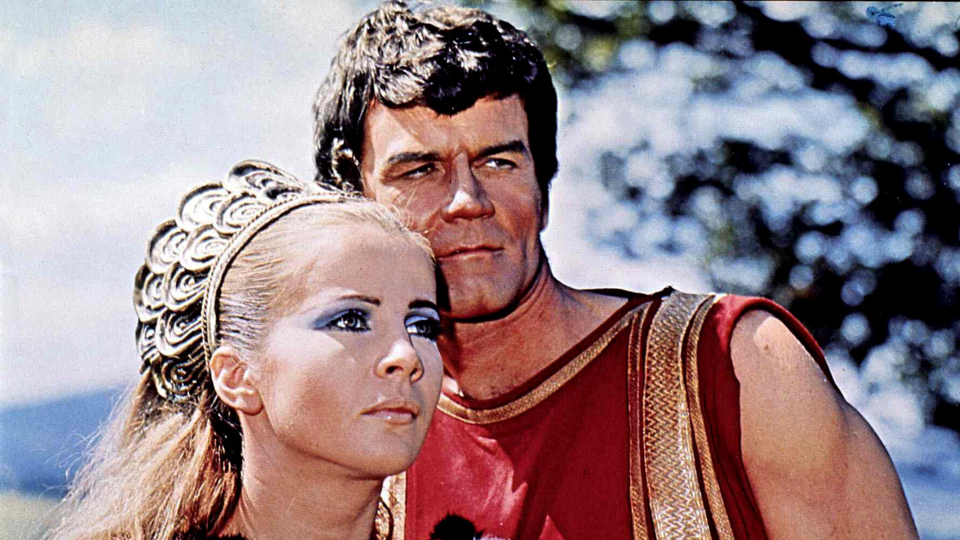
There are no Vikings in The Viking Queen. There are no longships, no ocean, not so much as a horned helmet hanging on a wall. The picture takes place in Roman Britain under Nero, and the closest thing to Scandinavia on the premises is Carita, a Finnish actress whose accent I assume is the whole reason for the title. That, and the hope that audiences might still be thinking of Kirk Douglas in The Vikings.
What they’ve actually made is the Boudica story with the serial numbers filed off. Salina inherits the crown of the Iceni, agrees to co-rule with the Roman general Justinian, and falls in love with him, while merchants, druids, and ambitious officers on both sides arrange the war that everyone but the lovers seems to want.
Hammer had no business making this movie. Historical epics are expensive. They require extras, and armor for the extras, and somewhere for the extras to stand. Hammer solved the last problem by going to Ireland, but there was no solving the others. The company spent roughly three times what it was spending back at Bray Studios on Frankenstein Created Woman, which sounds like a lot until you remember that three times a small budget is still a small budget, and that the money now had to come back threefold.
You feel the penny-pinching in the casting. Hammer got Ursula Andress for She, then stumbled onto Raquel Welch in One Million Years B.C., and someone must have concluded that this was a repeatable process. Carita, playing the queen, is proof that it isn’t. She is not bad. She is simply not enough to fill the hole in the middle of the movie, and her co-star can’t help her: Don Murray was nominated for an Oscar for Bus Stop, but he plays a Roman general in the accent of a man giving directions to the Bronx.
They fall in love after a chariot race pitches them both into a lagoon. During the ensuing clinch, at the moment of greatest passion, Carita looks over Murray’s shoulder directly into the camera. Director Don Chaffey seems to have noticed the chemistry problem, because from then on the two of them kiss immediately upon meeting, every time, in case we’ve forgotten.
Talk is cheap, so the picture is talky. It talks about druids and merchants and prophecies and a rebellion that may or may not be genuine. When there is an ambush, a messenger arrives to tell us it happened. Justinian is also required to announce his feelings out loud, since there is no other evidence of them. Nobody in this movie says anything at conversational volume, with two exceptions I’ll get to.
And then there are the battles. Chaffey shoots them tight, so we get elbows, spears, and grunting. Then comes the finale, where he has to pull back for grandeur, and there stands the might of the Roman Empire. I counted something under fifty men. The rebel horde facing them looked about the same, and I suspect some of them changed capes at lunch.
I could forgive the poverty if the story paid off. It sets up a revenge picture: Octavian, the second-in-command, seizes power while Justinian is away, slaughters Salina’s people, and has her flogged in the public square. Then Justinian returns, trades a prisoner to get Octavian released, restores him to his old job for reasons the movie declines to share, and defeats Salina’s army anyway. Seventy minutes of a queen insisting on peace, twenty minutes of a skirmish, and a martyrdom that never earns its tears. None of this was forced on the filmmakers by history. The plot is invented wholesale, and the anachronisms wander through it without embarrassment.
The supporting players fare better. Andrew Keir plays Octavian with real menace. Niall MacGinnis and Patrick Troughton, who by the time this opened was already traveling through time on the BBC, do honest work in small parts, mostly by declining to shout. Donald Houston, as the head druid, is starring in a different picture altogether, one the Pythons would get around to making eight years later.
What survives is the Irish countryside in the opening reels, shot wide and green and promising a better movie. Hammer was right about Ireland and wrong about everything else. There was a horror film waiting in those hills and stone circles, something small and mean with the druids handling the sacrifices and Christopher Lee lurking about. We got this.