One Million Years B.C.

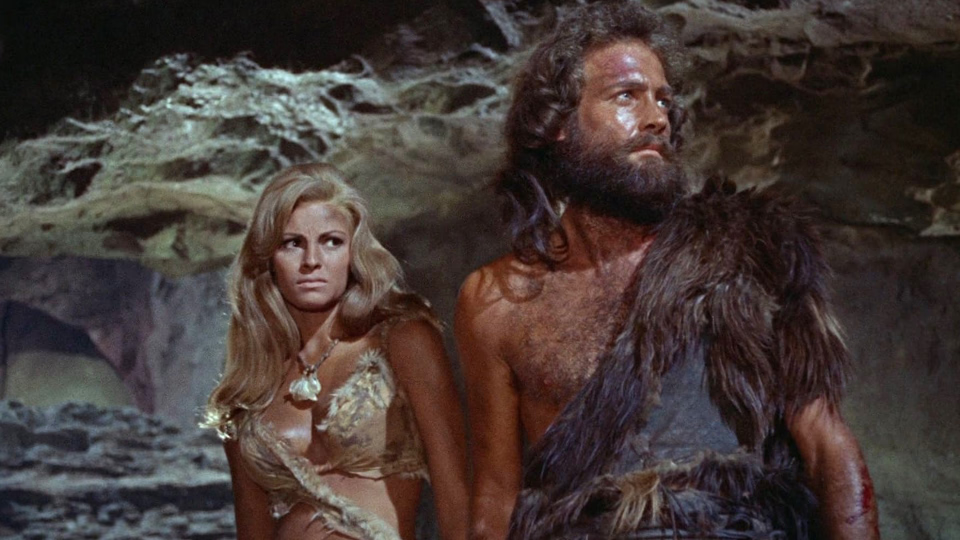
The opening credits carry the usual legal boilerplate promising that any similarity to persons living or dead is purely coincidental. The picture is called One Million Years B.C. I laughed before a single caveman appeared.
The story: John Richardson’s Tumak quarrels with his father over a hunk of meat and is thrown out of the Rock tribe, which is the sort of tribe that settles matters by throwing people off things. He wanders. He is menaced. He collapses on a beach and is revived by Raquel Welch’s Loana of the Shell tribe, who are blonder, cleaner, and further along the evolutionary ladder, having invented cave painting, fishing, and the strapless fur two-piece. Tumak cannot stop being Tumak, and is expelled a second time. Loana goes with him. They are menaced some more before running into his old tribe, who are not happy to see him.
There is almost no dialogue. After a stretch of solemn narration that could have been borrowed from a nature documentary, the characters communicate in single words, most of them names. “Tumak!” “Loana!” I confess I enjoyed picking up the vocabulary. “Akita” means “there,” or possibly “look there,” and by the end I had assembled a working lexicon of perhaps four words, which is three more than Tumak requires for most situations. This is charming. It is also the source of the film’s central confusion, because a movie this proud of its austerity has no business also containing a giant sea turtle.
The turtle, and the rest of the menagerie, come from Ray Harryhausen, and they are the reason to see this. Watch the Shell warriors pelt the thing with rocks and spears: the projectiles leave real hands and arrive as animation without a hitch anywhere in between. Harryhausen was short on time and animated only the front legs, so the creature hauls itself forward like a man dragging a sofa, and somehow this only makes it more alarming. Better still is a young Allosaurus that wanders into the Shell camp and demolishes a hut while actual human beings scatter around it. Nobody has ever been better at making a puppet share a frame with a person.
Then there is the iguana. Not animated at all, just a real lizard photographed large on a rock ledge, blinking, plainly wondering when lunch is. Harryhausen thought it would ease audiences into the fantastic. What it does is establish, early, that the seams are visible. So are the tan lines around the loincloths. So is the fact that the Rock tribe, who are meant to be our primitive cousins, have the foreheads of men who commute.
This is a Hammer production, though you would never guess. No Cushing, no Lee, not even Michael Ripper turning up as a Neolithic innkeeper. Director Don Chaffey, shooting in the Canary Islands, favors wide compositions that reduce his people to specks against volcanic rock, and those shots are the best argument the film makes for its own seriousness.
Richardson is serviceable, but his eyes are a problem early on. They are too knowing, too modern, the eyes of a man who has read the script. He improves considerably once Tumak is alone in the wasteland or enjoying himself in a fight. Welch is the real thing. Yes, the fur bikini is the image that outlived the movie, and yes, it earns its fame, but she also acts, and she does it with a vocabulary of one syllable. Look at her face when she decides to leave her tribe. Nothing is said and nothing needs to be.
She deserved a better story. The plot lacks urgency and quickly settles into a pattern. They fish; a monster attacks. They bathe; a monster attacks. These people carry conch shells specifically to sound alarms, and I spent an entire reel wondering why Loana had brought a purse. Not once does anyone think to post a lookout. The climax is built on a similar shrug: Loana staggers home half dead, barely able to stand, then sprints back across the desert with the rescue party because the third act requires it.
A more straightforward adventure would have served everyone better. Let the characters speak English, keep it terse, cut twenty minutes, add another monster. Chaffey and Harryhausen proved it three years earlier with Jason and the Argonauts. Two years later Kubrick would do the wordless “dawn of man” properly in 2001, and later tip his hat by lifting footage from this film for A Clockwork Orange.
Still, I am fond of it. The locations are magnificent, Welch is iconic, Harryhausen is Harryhausen, and the film’s ambition, while unmet, is commendable. I cannot recommend it. Don’t let that stop you.