The Anniversary

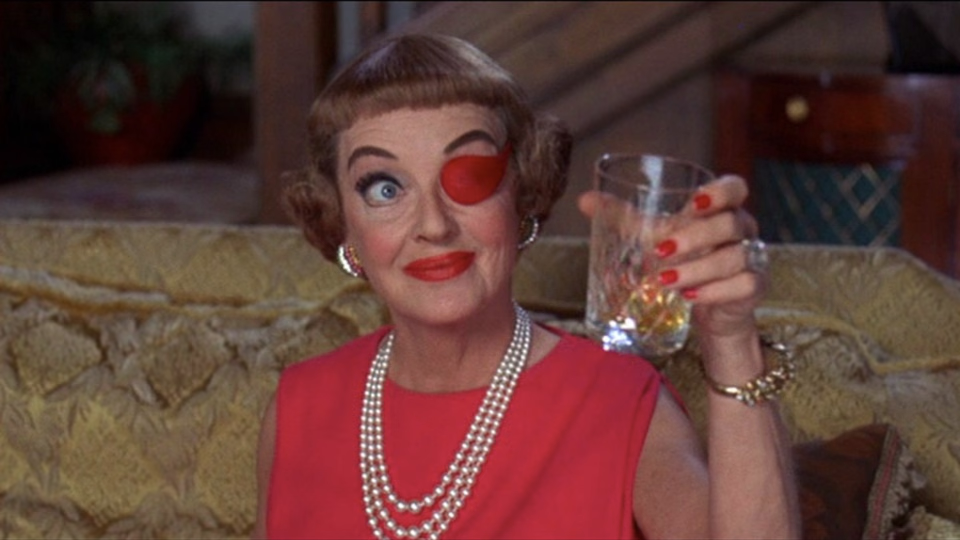
Bette Davis enters The Anniversary wearing an eyepatch the way other women wear a brooch. I spent a while wondering whether her character had the patch made to match the dress or the dress made to match the patch. It’s the kind of question the movie leaves you plenty of time to consider.
She plays Mrs. Taggart, who has summoned her three grown sons to her English home to celebrate her wedding anniversary. Her husband has been dead for ten years, which does not seem to her a reason to cancel. Henry, the eldest, still lives at home and supplements his wardrobe from the neighbors’ clotheslines, preferring the ladies’ things. Terry, the middle son, arrives with his wife Karen and the news that they are emigrating to Canada. Tom, the youngest, brings Shirley, his pregnant fiancée, who is about to find out what she’s marrying into. When Shirley sits down beside her on the sofa, Mrs. Taggart purrs, “Shirley, my dear, would you mind sitting somewhere else? Body odor offends me.”
Davis delivers that line with the relish of a woman who has waited her whole career to be this rude on camera. It’s funny. The next twelve like it are funny. By the fortieth you notice that she came in at maximum voltage and has nowhere left to go, and the picture has an hour to fill.
That creates a practical problem. If Mother is always like this, why does anyone come to dinner? A sensible family would decide she’d been at the whiskey, find their coats and drive home. The screenplay tells us a story about a childhood accident that has left Terry sick with guilt, but it’s weak cover and only explains Terry. The three sons have so little backbone between them that I stopped feeling sorry for them somewhere around the fifth insult, and before long I was rooting for Mother, who at least was having a good time. I doubt that was the intention, given the finale.
The source is a stage play, and the movie rarely escapes the house. That’s fine; I have loved many films in which people sit in rooms and talk. But the plot mechanics here grind audibly. In the third act, Henry takes Terry’s car on one of his clothesline raids and is nearly caught, and we’re told the police will trace the car and pin the thefts on Terry unless Mother supplies an alibi. Her price is Canada. I wondered why Tom and Shirley, who were at the house all evening, couldn’t vouch for Terry. I also wondered how long Henry, who perspires like a man with a slip in his pocket, would last in a police interview. The movie wonders about none of this.
Henry, by the way, is handled with more sympathy than I expected from a 1968 British comedy. When Shirley finds him wearing her clothes she screams, as the plot requires, and then she tries to understand him. The movie’s attitudes are of their time, but in that scene it treats him as a person instead of a punch line.
You probably already know whether this is your kind of picture. If the idea of Bette Davis in an eyepatch chewing her way through a dinner party sounds like a fine evening, it will be, and the camp value alone is worth the price. If you’re hoping for a family drama with some insight into why people stay where they’re wounded, you’ve come to the wrong house. Tennessee Williams wrote families this cruel, but he also knew why they couldn’t leave.