The Turning Point

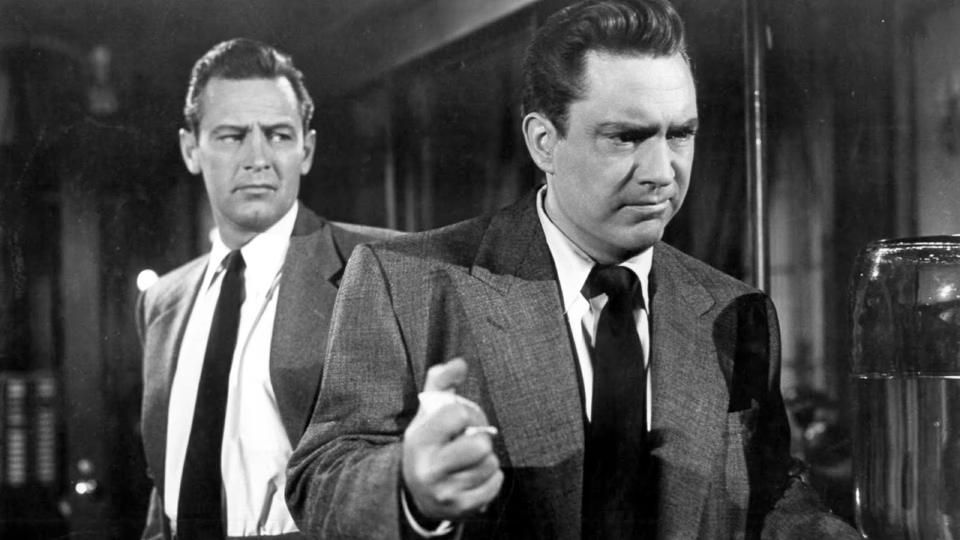
William Holden walks through The Turning Point like a man who knows the score and wishes he didn’t. He plays Jerry McKibbon, a reporter in what the film insists is a “fine midwestern city,” though the potted palms and familiar downtown Los Angeles locales insist otherwise. Jerry’s an old hand. He’s seen every racket, every fix, every two-bit alderman on the take. He still believes things could be better. He just wouldn’t bet on it.
In comes Edmond O’Brien as a hotshot prosecutor who returns home to crack a syndicate run by Ed Begley. Holden and O’Brien are old pals. Holden smells a setup. He’s right. There’s a leak, and finding it will cost O’Brien more than the case. There’s also a girl, because there’s always a girl.
Holden is the reason to watch. Even if you consider this a minor variation on his Sunset Boulevard cynicism, he still wears it beautifully. There’s a wonderful contradiction in his performance: the walk says confidence, but the eyes keep asking questions. Bogart could have played this part ten years earlier at Warners. Mitchum could have played it in 1952, but Mitchum never looked like he belonged in a newsroom. Holden does.
The trouble is that when Holden leaves the screen, he takes most of the movie’s energy with him. There is a long procedural stretch where O’Brien grills Begley in a hearing room, and it plays like what it is: two second-billed actors waiting for the star to return. O’Brien is competent but not magnetic. Begley is meant to be the heavy, but he never seems heavy enough. You want Raymond Burr in that chair, or Robert Ryan—someone whose glare alone could threaten a witness.
Neville Brand arrives late as a hired killer and immediately makes you wish he’d shown up forty minutes earlier. He has one of those faces that does half the acting for him. They could have done worse than give him Begley’s role from the start. Alexis Smith has an underwritten part as the girl caught between O’Brien and Holden and does the smart thing: she doesn’t overplay it.
The finale is set during a boxing match, shot in the Olympic Auditorium in Los Angeles—excuse me, our fine midwestern city—and it works. Director William Dieterle resists the temptation to stage the usual chase through the catwalks. Instead he uses the crowds, the noise, the chaos of a real arena, and lets the suspense build from the geography of the place itself.
At 85 minutes, the picture has the good sense to get in and get out. That counts for more than you’d think. A lot of crime dramas from this era mistake length for importance. The Turning Point knows what it is: a solid little programmer elevated by a star who could make even a minor picture worth your time.