The Phantom of the Opera

Here’s how you know you’re watching a disaster: A rat swims out to rescue a baby. I’m not kidding. In the opening scene, an infant floats down a sewer river toward certain death, and a rodent—presumably moved by some deep parental instinct—paddles over and tows the basket to safety.
This baby grows up to become Julian Sands, the Phantom, raised by rats, fluent in French, psychically gifted, and a skilled harpsichordist. Apparently the Paris sewers offer a hell of an education. Sands stalks the catacombs beneath the Paris Opera House in a black leather cape, killing intruders while rat exterminators kill his friends above. It’s The Jungle Book meets Willard.
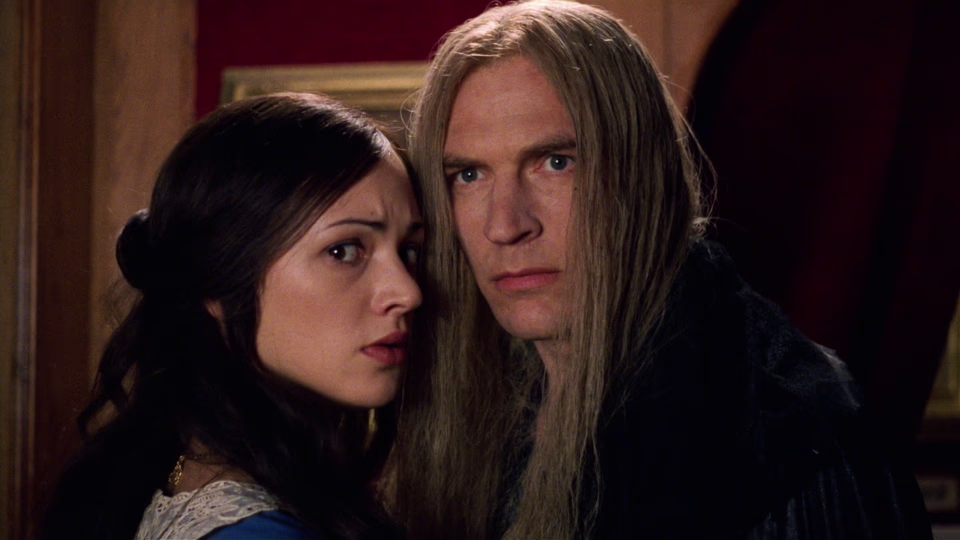
From there, Dario Argento’s film stumbles through the familiar beats. Asia Argento (the director’s daughter) plays Christine, the understudy. The Phantom falls for her. Baron Raoul also falls for her. She’s drawn to the Phantom, who helps her achieve stardom, but recoils in horror at his methods and takes solace in the Baron’s arms. The Phantom abducts her and he’s hunted down and killed.
What’s baffling is the tone. Argento can’t decide what movie he’s making, so he makes all of them. For long stretches, this plays like a live-action Disney cartoon—heightened, almost whimsical. You wonder if Argento toyed with the idea of having the rats talk. Then someone gets bisected at the waist. A rat hunter’s thumb-bone juts through torn flesh as he flexes his fingers. The Phantom rips out a woman’s tongue with his teeth.
These effects are mostly practical and excellent, save one CGI impalement that looks like an early Mortal Kombat fatality. The follow-up shot redeems it with proper in-camera gore.
This tonal whiplash recalls Hong Kong cinema at its most unhinged. But those films have the likes of Anthony Wong to anchor the chaos. Here, everyone flounders. Asia Argento can’t convincingly mime opera and generates zero chemistry with either suitor. Sands looks perpetually confused—unsure if he should brood, menace, or chew scenery. In one scene, after bedding Christine, he retreats to a back room and lets rats crawl inside his unbuttoned shirt and pants. I sympathize with his confusion.
The dialogue doesn’t help. “Your feminine smell flows through my veins like the melody of the rolling ocean.” That’s a real line from a man raised by rodents in a sewer. Speaking of which—no mask. No disfigurement. Just Sands as unlikely sex symbol, chopping shirtless at a pylon, swooping down from the rafters like Batman.
Argento’s choices confound. He cast his 22-year-old daughter in a role requiring nudity and sex scenes. He includes expensive looking ancillary scenes that add nothing to the story. In one, the Baron visits an opium den where he hallucinates while scores of naked bodies writhe in various configurations. In another, the exterminators assemble a rat-catching mobile they drive into the catacombs, vacuuming rodents until it crashes spectacularly.
The tragedy lies in the wasted production values. Real opera houses, authentic caverns, elaborate costumes. The film doesn’t look cheap, yet it feels amateurish, an improbable decline from the director who made the similarly set Opera just over a decade earlier.
At 99 minutes, it plays like a longer film butchered in the editing room. Maybe there’s a version that makes sense, where the tones cohere and the performances land.
This isn’t it.