The People Against O'Hara

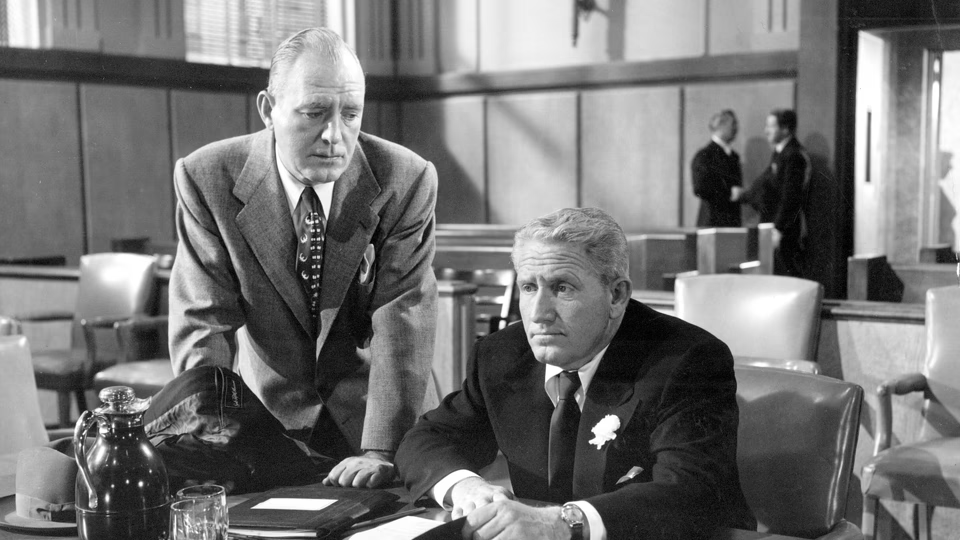
Spencer Tracy saves this one. Let me say that right up front. The script has holes big enough to drive a getaway car through, but Tracy fills them with sheer presence.
He’s 51, playing an alcoholic defense attorney who used to be somebody, and he makes you believe every second of it. When young Johnny O’Hara gets fingered for murder, and his family can’t scrape together enough for a decent retainer, Tracy comes out of semi-retirement to take the case. Bad idea. The pressure mounts. The booze calls. Tracy starts to crumble.
Director John Sturges opens with a knockout sequence. Night. Wet streets. Kids hit a jukebox in a small bar. The lone patron walks out, annoyed. We follow his gaze down a dark street to a distant house. Movement. Gunshots flash. Figures scatter. A car peels away. Cinematographer John Alton uses distance and shadow like weapons. It’s noir staging at its finest.
The procedural stuff works. Cops dust the car for prints. They haul in Johnny and lean on him. Then Tracy walks in and owns the movie. Sturges keeps him moving—standing in court, pacing, fidgeting with a briefcase. Even when Tracy sits, he’s doing something. As the trial grinds on, Sturges adjusts his camera angles to make Tracy look smaller, more beaten down. It’s subtle and devastating.
Tracy plays the alcoholic’s relapse without theatrics. No grand speeches. Just body language and exhaustion. His best moment? A eulogy that could’ve been maudlin melodrama. Instead, Tracy underplays it. We watch the words hit him, see him find the strength to do what’s right. It’s not showy. That’s why it works.
The supporting cast delivers. Pat O’Brien as the cop. Eduardo Ciannelli as the mobster with the trophy wife. William Campbell, perfectly smarmy as the goon who fingered O’Hara. James Arness as O’Hara, grounding what could’ve been a stock hot-headed kid. The script makes Arness withhold information from Tracy for no good reason, but he sells it anyway. Even a young Charles Bronson shows up uncredited—you’ll spot those biceps.
Only Jay C. Flippen stumbles. He’s playing a Swedish sailor with an accent nobody needed. Make him anything but Swedish. John Wayne in The Long Voyage Home had better odds.
Sturges knows how to tell a story. He mixes real NYC location footage with backlot work that blends seamlessly. And he’s smart about the courtroom scenes. Instead of showing us every tedious moment, he cuts to Tracy’s daughter reading the day’s transcript. “Skip to the part about—” Boom. We’re past the boring bits. Then Tracy rehearses tomorrow’s cross-examination, and Sturges cuts from rehearsal to the real thing mid-sentence. Efficient as hell.
But the script nearly sinks the ship. There’s a clunky scene where Tracy’s daughter and her boyfriend discuss his alcoholism like they’re reading from a pamphlet. Worse, what recovering alcoholic keeps scotch in his liquor cabinet? And when Tracy bribes a witness, he does it by check. A check! It’s necessary so he gets caught, but come on.
The finale goes full contrivance. Tracy wears a wire in a sting operation. It’s ludicrous. Yet Sturges manufactures real suspense through editing, and the cast—even bit players like Ann Doran as a narcotics agent—makes it work despite the plot.
This is a good movie in spite of itself. When you’ve got Tracy, Sturges, and Alton fighting a mediocre script, talent wins. As Ciannelli tells Tracy: “You’re a lush, counselor. But you’ve got a lot of guts.”
Same goes for this picture.