Rasputin: The Mad Monk

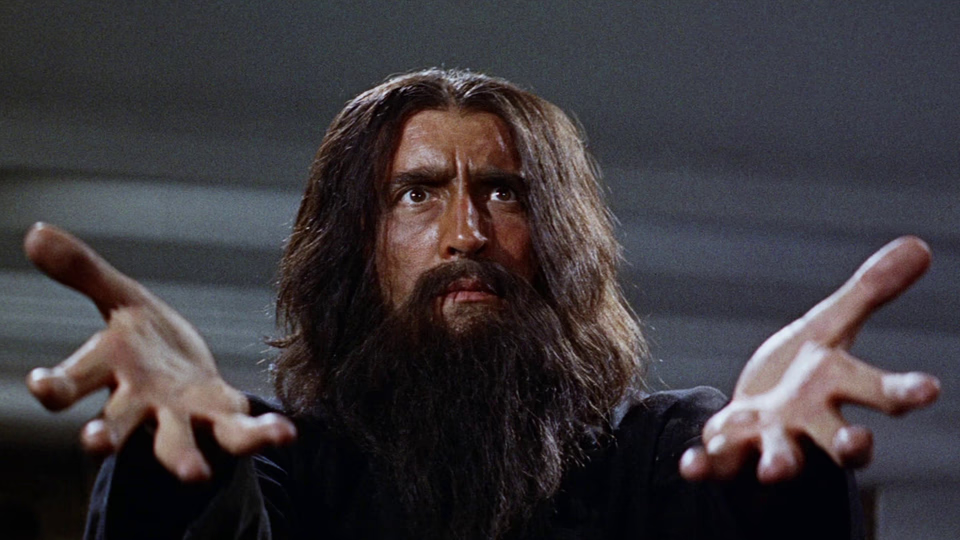
Christopher Lee storms into a sickroom, lays hands on a fevered woman, and wills the disease right out of her. His palms radiate heat. Downstairs, the celebration begins. He drinks, he dances, he takes the innkeeper’s daughter to the barn. When her young suitor objects, Rasputin chops the boy’s hand off. “He won’t trouble us anymore,” he says, and turns back toward the girl. The whole village runs him out of town.
It is a terrific opening. It tells you everything about Rasputin in ten minutes: the power, the appetite, the cruelty, the casual monstrousness of a man who heals a woman and mutilates a boy in the same evening. If only the ensuing film knew what to do with him.
Instead, we follow the holy man to Saint Petersburg, where he hypnotizes a lady-in-waiting—Barbara Shelley, reliably good—and worms his way into the Tsarina’s court. There is a nice touch when Rasputin, having just seduced Shelley’s character, tells her to leave some money on the bed. The court conspires against him. There is poison. There is grappling. Then it’s over.
This is a Hammer production that doesn’t know what kind of Hammer production it wants to be. It waffles between biographical drama and exploitation horror. Rasputin wanders through Russia by way of Victorian London, surrounded by characters in western suits. One fellow wears a Cossack hat, presumably so we remember which country we’re in. Director Don Sharp gets a single scene right—Rasputin taunting a would-be assassin from the shadows, practically daring the man to act. It could have come from one of Lee’s Dracula pictures. Nothing else in the film matches it.
Still, Lee is excellent. He is always excellent. He gives Rasputin a rock star swagger the film around him simply cannot match. But the script gives him no arc. We never understand what Rasputin wants beyond the next drink, the next dance, and the next woman. His assassins barely register as characters. He’s the enigmatic villain in a story with no hero. As a result, we’re left strangely detached from a story that should be lurid and gripping.
That they had to splice in shots from 1956’s Anastasia should have told Hammer they had no business trying for historical drama. There’s a decent exploitation picture here though, albeit one with less dancing and more hand chopping.