One Battle After Another

Paul Thomas Anderson’s sprawling political thriller wants to blend Dr. Strangelove with The French Connection. It’s a bad recipe.
The plot is baroque. Sean Penn plays a detention center officer who becomes a government assassin hunting a revolutionary cell led by a woman who once humiliated him. Leonardo DiCaprio is her bomb-making lover, left to raise their daughter alone after she turns informant. Sixteen years later, everyone’s hunting the kid.
That’s the compressed version. The film runs two hours and forty minutes.
The performances are strong. DiCaprio turns off his natural charisma and disappears into a paranoid husk. Penn chews scenery in what feels in-part like a Sly Stallone caricature. Chase Infiniti convincingly captures teenage rebellion. Benicio Del Toro radiates the kind of easy charisma that Brad Pitt exuded in Once Upon a Time… in Hollywood.
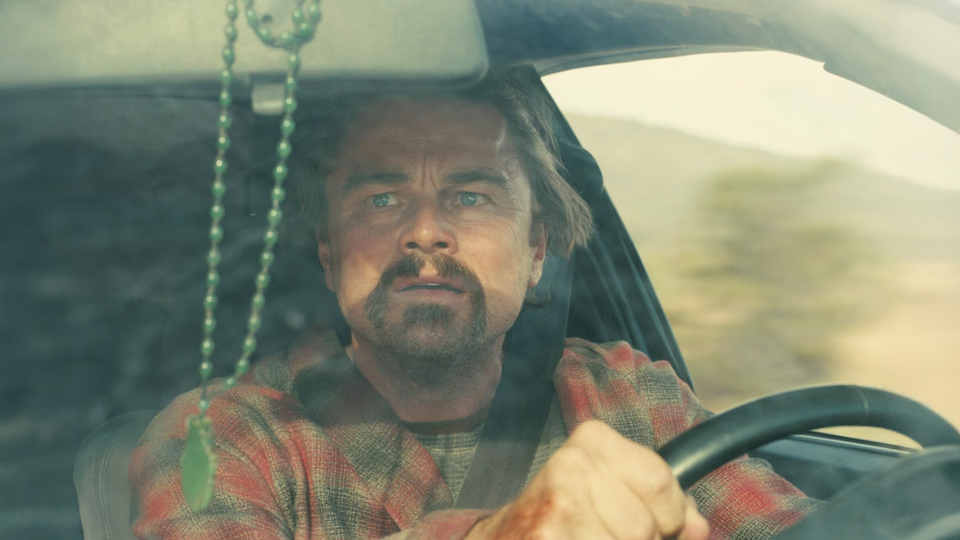
Anderson the director stages the proceedings with characteristic visceral precision. A desert car chase recalls the best 70’s paranoid thrillers. A pivotal bank robbery sequence crackles with dread.
But Anderson the writer can’t decide what he’s doing. He toggles between earnest melodrama and absurdist comedy. The comedy works. DiCaprio shouting “What kind of revolutionary are you?” at a triggered help-desk operator lands perfectly. The Christmas Adventurers Club—a white supremacist cabal chanting “Hail Saint Nick”—is inspired lunacy.
But these moments are too rare. In between Anderson tries threading melodrama through the satire. It’s like Kubrick wringing pathos from Peter Sellers in Strangelove. Why would you?
The tonal confusion bleeds into structure. We follow DiCaprio’s Bob, a man perpetually stoned and one step behind. He has no agency. We don’t care about him despite the committed performance. His daughter dooms fellow revolutionaries because she won’t surrender her phone, then shows no remorse. She’s arrogant by design, but still alienating.
This undermines what should be the film’s finest moments. Consider the climactic car chase. It should have been a tension-filled thrill ride. Instead, I’d long checked out, realizing the stakes were illusory and aware of where the story was going. Tension without stakes is just runtime. That car chase, technically brilliant, became tedious because the conclusion felt inevitable.
The ending confirms Anderson’s low-stakes comic intentions. Everyone gets what they want. That’s comedy, not tragedy. At least the final image—Bob fumbling with a selfie while Willa heads to a protest—is darkly nihilistic.
It also dovetails with the film’s evenhandedness. The revolutionaries are self-absorbed children. The government forces are cartoonish fascists. Everyone’s reductive, so nobody wins. Maybe that’s the point. If so, the Coens’ did it better in Burn After Reading.
Meanwhile, better stories flicker at the margins. Del Toro plays a sensei running an underground railroad. Give me that movie. Or make a deadpan satire about the Adventurers Club. Both offer actual engaging protagonists with agency and conviction.
Anderson made There Will Be Blood. He can do epic drama. Maybe tackling this material seriously would’ve forced him to take sides, creating something untenable in our polarized climate. So he hid behind absurdist caricature.
Fair enough. Then commit to the absurdity. Trim an hour and make Strangelove for our times. The cast was ready.
Instead we get a film that doesn’t trust its own instincts. Like The Master, it’s Anderson flashing technical brilliance while narratively adrift. Maybe his films hit you or they don’t.
This one didn’t. And worst-of-all, with that runtime, I’m hard-pressed to give it a second chance.