Murder-Rock: Dancing Death

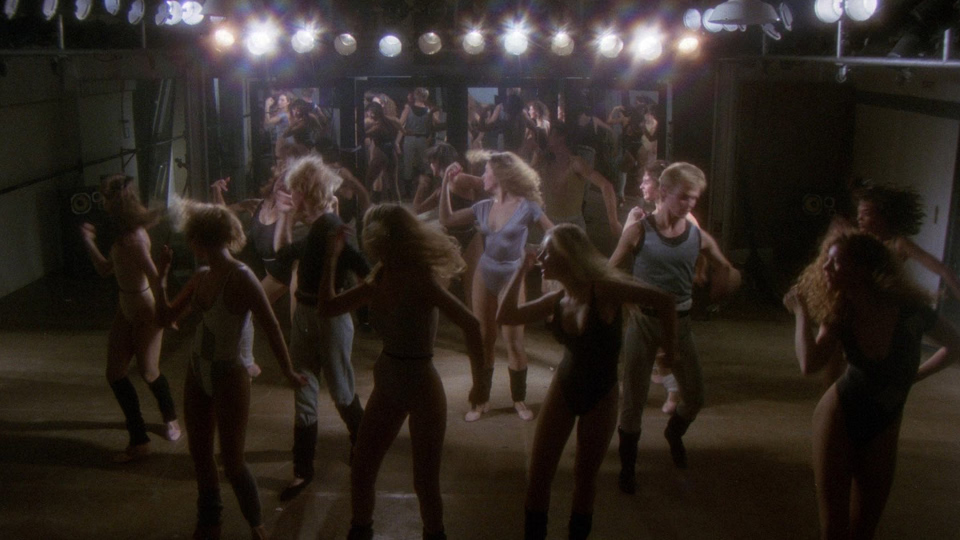
The Arts for the Living Center, a dance school in New York, has a curious closing routine. Each night a voice comes over the loudspeakers to announce that all doors will lock in ten minutes, and then the lights begin to throb on and off, the way they do on a villain’s island when somebody has pressed the self-destruct button. If my building ever started strobing at me at closing time I would be out on the sidewalk with one arm in my coat. The dancers in this movie linger, and some of them are murdered, and the survivors go on lingering.
The film is Lucio Fulci’s Murder-Rock: Dancing Death, from 1984, two years after his New York Ripper drew outraged reviews and trouble with censors. He returns here to the same dirty Manhattan streets and the same pairing of a police detective with a professor who advises him, and for a while I wondered if this was meant as a sequel. It plays more like what you’d get by putting Fame, Flashdance, and a toothless giallo into a blender and forgetting the lid.
The plot involves a troupe rehearsing for a show whose opening has been moved up two weeks. Only three dancers will be hired. Soon a killer in black gloves is subduing dancers with chloroform and finishing them with a hatpin to the heart, and the victims die in order of talent, best first. That’s a nasty, clever idea, since it means every dancer left alive must wonder whether being spared is an insult. The movie does nothing with it. We never get to know the dancers well enough to tell them apart.
A Fulci film usually gives its audience something to flinch at. This one barely bleeds. The hatpin goes in, the victim sighs, and the scene ends. There is plenty of nudity but none of the nastiness of The New York Ripper. With the nudity trimmed you could show Murder-Rock on television after the late news. Olga Karlatos plays Candice, the lead instructor, and Fulci gives us his trademark close-ups of her large eyes. But Fulci fans who remember what he did to one of those eyes in Zombie will be disappointed here.
Then there is the music. The opening credits play over an empty nightclub where a few breakdancers spin on the floor to a power ballad, which no breakdancer in history would have chosen. The song is by Keith Emerson, who gets bigger billing on the poster than Fulci does. Emerson, the keyboardist for Emerson, Lake and Palmer, had scored Dario Argento’s Inferno, but a dance picture needs dance music, and his theme song has the earnest, storytelling lyrics of something meant to play under a training montage. Someone should have phoned Giorgio Moroder. The troupe performs to this song again and again, on the same small stage. Then we get solo performances set to other Emerson prog-rock songs that feel just as out of place. One solo, lifted straight from Flashdance, takes place under a shower of water and is set to a song that makes you miss “Maniac.”
Two scenes made me laugh, neither of them on purpose. The police explain that every human voice leaves a unique “voiceprint” that can be identified on an oscilloscope, which would be news to Rich Little. And the detective, questioning a suspect, slaps him forehand, backhand, and forehand again, with a rhythm that suggests he had been practicing at home. Movie cops in America throw punches; movie cops in Italy slap, and they take pride in it.
In some countries this was released as Slashdance, which is a better title than the film earned. It feels like something knocked off over a long weekend, though it had a real schedule and Fulci’s craft is visible in nearly every setup. His admirers will spot his fingerprints here and there, and then they will rewatch The New York Ripper.