Conquest

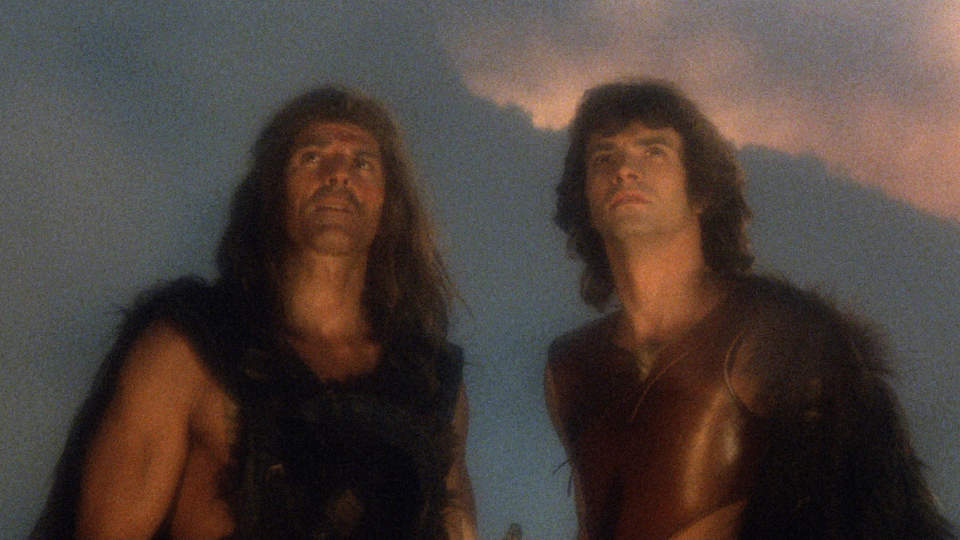
The first thing I did, watching Conquest two years ago, was get up and check the television. The image had gone soft. Nothing was wrong with the set or my eyes. Lucio Fulci shoots nearly the entire picture in soft focus, the way John Boorman shot the dream passages in Excalibur, except here the dream never ends. Then Fulci points the camera into the sun, so whatever survives the blur gets bleached out anyway. Then he adds fog. Then grain you could sand a table with. My first review would have run one damning sentence.
The story concerns young Ilias, played by Andrea Occhipinti, who arrives in a blighted land carrying a magic bow and a mandate to clean the place up. The land belongs to Ocron, a sorceress in a gold mask who wears little else and keeps a stable of dog-men. She has been dreaming of her own death at the hands of an archer. Ilias falls in with Mace, played by Jorge Rivero, a loinclothed loner who fights with nunchucks made of bone and has the symbol of Eibon tattooed on his forehead, which in a Fulci picture is roughly equivalent to a Yale class ring.
What follows is less a quest than a road trip. Ocron dispatches assassins, shapeshifters and the occasional zombie, the heroes handle them, and nobody seems in a hurry to reach the fortress. Ilias tags along with Mace. Mace decides to guide Ilias. They walk. The structure exists to hang set pieces on, and the set pieces are pure Fulci: skulls opened like melons, brains exposed to the daylight, limbs departing their owners. A dog-man raid on a tribe of ash-covered humans is staged with real appetite for cruelty. When Ilias is poisoned, pus-oozing boils erupt across his body and ants come to investigate. I squirmed. That was the intention.
During such horror sequences, Claudio Simonetti’s score is terrific. All nightmare menace. But when the dog-men march their prisoner across an epic landscape, the soundtrack answers with experimental post-punk, which is a bit like scoring the parting of the Red Sea with a Moog demo. I can forgive Simonetti. He never spoke to Fulci, only to the director’s long-time editor, Vincenzo Tomassi.
That’s the sad part. Despite having a two-picture deal with producer Giovanni Di Clemente, Fulci walked the moment shooting ended, convinced Di Clemente had lied to him, gutted the budget and forced crew members on him. Di Clemente took him to court and lost. Fulci later quipped that he had been too busy being sued to bother with post-production. Whatever Conquest is, it was assembled without the man whose name is on it. Tomassi did his best.
Still, you can glimpse the movie Fulci wanted. Mace rowing a small raft across an enormous lake with the sun going down behind him. Ocron snapping upright out of her fever dream, gold mask blazing. Those shots could be Frazetta paintings under all that Vaseline. There is also a genuinely clever fight between Mace and his own double, achieved with deft framing and cutting instead of an obvious stuntman in a wig.
Elsewhere the seams show. The dog-men talk, but the masks have no working jaws, so they deliver their menace with the mouth mobility of Muppets. I suspect the costume budget was spent chasing Chewbacca. In one rescue, Mace creeps up on a sleeping camp in what appears to be crisp nighttime photography, the sharpest images in the film. Then the fight starts, the camera swings around, and there is the sun sitting in the sky. They were shooting in the shade.
Can I recommend it? No, not even to Fulci’s faithful, because one viewing will have you demanding a refund. But if you saw it once, hated it, and have since worked your way through the rest of his later filmography, give it another eighty-eight minutes. It is nowhere near the Gates of Hell pictures or The New York Ripper, but now I’d take it over Manhattan Baby.
This time, when the hero’s magic arrows started flying around corners like homing missiles and he abruptly gained the power to teleport, I didn’t laugh out loud. Progress.