Marriage on the Rocks

There is a good movie hiding somewhere inside Marriage on the Rocks, and every so often Dean Martin finds it. The rest of the time we are watching a picture at war with itself, produced by a star who couldn’t decide whether he wanted to make a comedy or protect his image, and directed by a man who wasn’t about to force the issue.
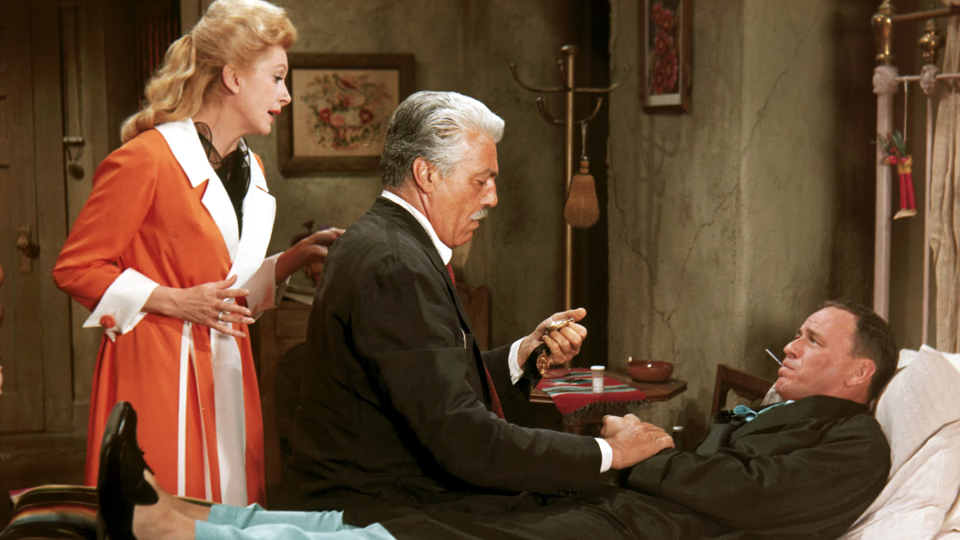
Frank Sinatra plays Dan Edwards, a nineteen-year family man running an ad agency with his bachelor pal Ernie Brewer, played by Dean Martin. Sinatra approves designs and presents to clients. Martin juggles dates. Sinatra’s wife, played by Deborah Kerr, has grown tired of feeling neglected. A second honeymoon in Mexico goes sideways when a spat leads to a quickie divorce, then a reconciliation, and then a remarriage ceremony that goes haywire when a confused Mexican mayor accidentally hitches Kerr to Martin instead. Sinatra takes this in stride, moves into Martin’s bachelor pad, and lets his pal inherit the wife, the whining kids, and the office headaches.
In the right hands this could have been savage. The year before, Martin had made Kiss Me, Stupid with Billy Wilder. That picture had the right edge but the wrong cast. This one has the right cast but no edge at all. The marriage switch doesn’t even arrive until an hour and eleven minutes in. When we should be heading into the third act, we’re starting what should have been the second. The ending feels abrupt, as though someone tacked the premise onto an existing script or, more likely, rewrote it until it couldn’t offend anyone, including Sinatra.
It was Sinatra who produced, of course. He cast his novice daughter Nancy in a key role rumored to have been earmarked for Mia Farrow. Now that would have been interesting. He also hired Jack Donohue, a television director whose credits included nineteen episodes of The Frank Sinatra Show. Donohue was Frank’s guy. He was not about to demand a second take.
You can see the single-take laziness in Sinatra’s early scenes, particularly a flat opening monologue burdened with expository dialogue. The script does him no favors, requiring him to function as a plot device for the first hour. But put him opposite Martin or Kerr and something clicks. He engages. He listens. He acts. Sinatra needed a strong scene partner, and when he had one, he was still Frank Sinatra.
Martin, though, is the reason to watch. Even in the background he is reacting, alive, doing bits of business that nobody asked him to do. In a nightclub scene he tries to dance like the kids, sits down winded, and when Kerr compliments him, tosses off a “Natural talent” that is funnier than anything in the script. Later, when he realizes he has accidentally married Kerr, he faints. I’ve seen the faint gag attempted a thousand times. This may be one of the few times it actually plays.
There is a nice costume touch after the switch. Martin trades his tans and oranges for Sinatra’s drab grays. Sinatra dons bright sweaters. Dressed as Sinatra, Martin seems to struggle just as much with the leaden dialogue, which tells you something about the writing.
Kerr brings class and backbone. Cesar Romero is a hoot as a Mexican jack-of-all-trades. The production values, however, are sitcom-grade. Apart from one exterior shot at Martin’s actual house, there is no location photography. The Mexico scenes look like a backlot western, which makes you wonder why these supposedly affluent people would honeymoon there.
Marriage on the Rocks was the last picture Sinatra and Martin co-headlined. Their chemistry deserved a better vehicle. Martin coasts through the whole thing, but he coasts magnificently. It is not a good movie, but when Martin is on screen, doing what only he could do, it offers a glimpse of the picture it might have been.