Maniac

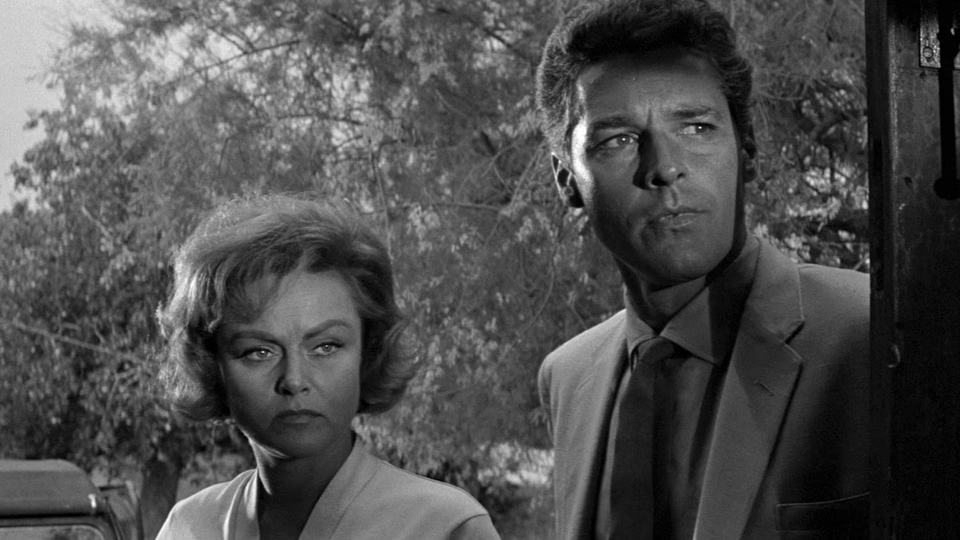
Maniac opens with a title card informing us that the Camargue region of southern France is a place where “violence is never far away.” This is the kind of thing title cards exist to tell us, because otherwise we might mistake it for a pleasant vacation spot. Which, for about thirty minutes in the middle of this picture, it is.
The first ten minutes are nasty and effective. A sweaty laborer eyes a schoolgirl walking home. He offers her a ride. The title slams onto the screen as the truck speeds off. What follows is an assault, a rescue, and then a scene in a garage where the girl’s father fires up a blowtorch and goes to work on the unconscious attacker. This imagery promises a certain kind of film. A ruthless one.
That film never arrives. Instead we meet Jeff Farrell, an American painter played by Kerwin Mathews, who has wandered into the Camargue after walking out on his wealthy girlfriend. Jeff is broke and not particular. He flirts with Annette, now nineteen and tending bar. Then he meets her stepmother Eve, played by Nadia Gray, and flirts with her too. Jeff is nothing if not efficient.
For a long stretch, Maniac forgets it’s a thriller. It becomes a sun-drenched love triangle with no tension, no atmosphere, no sense that anyone is in danger of anything worse than a complicated breakfast. Mathews and Gray have a cool chemistry that works precisely because Mathews is no matinee idol. He’s a budget William Holden—less magnetic and just seedy enough that you believe his bad decisions without hating him for them.
Eventually the plot remembers itself. Eve’s husband—our blowtorch artist from the prologue—is locked in an asylum. She wants Jeff to help spring him. In exchange, the husband will grant a divorce and vanish. Why she can’t simply divorce a convicted madman is never addressed. Jeff agrees because the screenplay requires him to, and off they go. The jailbreak succeeds. Then a nurse goes missing. Then a body turns up in their car. Then a shipment of propane tanks arrives at the house. Eve’s husband has not, it seems, held up his end of the bargain.
Now we’re cooking. Except Sangster immediately undercuts his own plot with twists so labored they collapse under scrutiny. Two characters corner Jeff and explain their motives to him in detail while preparing to kill him. Later we learn everything they said was a lie. Why confess elaborately to a man you’re about to murder? Because Sangster needs to misdirect the audience, and this is the only way he can think of. It doesn’t play fair.
The final twist is worse. It is so preposterous that it retroactively demolishes every scheme, murder, and double-cross that preceded it, leaving the entire plot pointless. Not pointless in the bleak, existential way a good noir can be. Pointless in the way of directions to your next-door neighbor’s house that call for four left turns.
It’s a shame. The Camargue locations are genuinely beautiful—seaside roads, desolate flats, a finale staged in caves carved from the rock of the Val d’Enfer. The black-and-white photography is crisp and moody (once the plot kicks in), with fine use of shadow. That ominous garage from the opening deserves its own, better movie. This is a Hammer production that actually left the studio, and the air and light reward the trip.
And a word for Hammer regular George Pastell as the police inspector. When he arrives to search Eve’s home and she protests that it would be “the last place” her husband would return to, Pastell replies, “I have learned, long ago, to search the last place first. It saves time.” It is the best line in the film. It is the only line that sounds like Sangster.
Sometimes a movie’s biggest crime is the better movie you can see hiding inside it. After his escape, the husband dons dark sunglasses, which, combined with the dark gloves and blowtorch, evoke an iconic giallo killer a year before Bava codified the form. Sangster had the setting, the look, and the nerve. What he wrote instead is a nonsensical riff on Diabolique that would never have been filmed if he weren’t also the producer.