The Pirates of Blood River

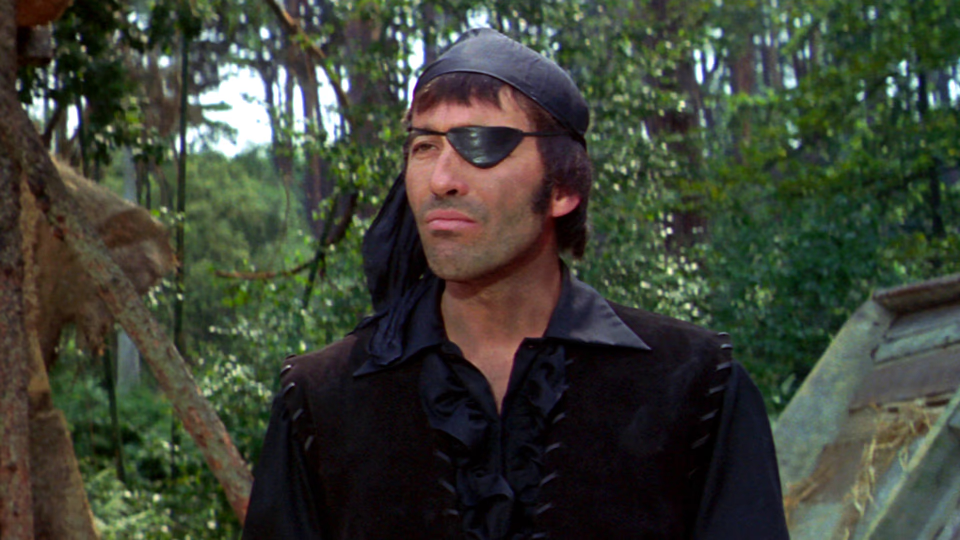
There are no ships in The Pirates of Blood River. No ocean, no buried treasure, no plank to walk. Hammer Films couldn’t afford any of that. What they had was Christopher Lee, and it turns out that’s enough.
The setup is pure Hammer economy. A Huguenot colony on a remote island, ruled by religious zealots. Jonathan, son of the community leader, gets caught with another man’s wife—in broad daylight, incidentally, which tells you everything about his judgment—and is sentenced to fifteen years on a penal colony. He escapes. Pirates capture him. Their captain, Laroche, offers a deal: lead us to your colony, and we’ll help you topple your father’s tyranny.
Jonathan agrees. He shouldn’t have.
Lee plays Laroche with a French accent, a paralyzed left arm, and an eye-patch. This should be ridiculous. Instead, it’s the kind of committed, fully inhabited villainy that makes you forgive everything around it.
His crew includes Michael Ripper, a Hammer regular finally given room to breathe, and a young Oliver Reed, who even then looked like trouble. They wear lurid colors that pop against Hammer’s Eastman photography. Lee, dressed entirely in black, somehow stands out more. The pirates are so vivid, so particular, that you could almost imagine a franchise. Hammer didn’t, which is a shame.
Opposite Lee, Kerwin Mathews is fine as Jonathan. His natural charisma carries him through a script that asks him to make baffling choices at regular intervals. At one point, with the pirates attacking and his people successfully holding a defensible position, Jonathan leads a charge out into the open. His men are cut down. There’s no good reason for it. Laroche, by contrast, calculates every move. He’s morally bankrupt and tactically brilliant. The wrong man is our hero.
Second-billed Glenn Corbett is a non-factor. He arrives with a distinctly American drawl that belongs in Dodge City, not a French colony. His entire part feels grafted-on for the benefit of U.S. ticket buyers.
Though lacking ships and seas, director John Gilling shoots much of the film outdoors, enhancing the atmosphere while avoiding the studio-bound feeling of Hammer’s gothic efforts. His action sequences deliver where it counts. A blindfolded sword fight lands. A musket shootout finale has real tension. And Lee’s death—I won’t spoil it—is almost comedic, the kind of exit that would fit right into one of his Dracula pictures.
Here’s the wrinkle: Hammer originally cut this as an X-certificate horror, graphic enough to earn it. Then they chopped out the gore and released a kid-friendly adventure instead. The movie that exists is lighter, brisker, less dangerous. Whether the bloodier version would have been better is hard to say. It might have exposed how thin Mathews actually is at the center.
The Pirates of Blood River is not a great film. It is an entertaining one. For Lee completists, it’s essential. For everyone else, it’s a breezy 87 minutes with one performance that elevates the entire enterprise. The pirate ship was never real. Christopher Lee absolutely is.