Hysteria

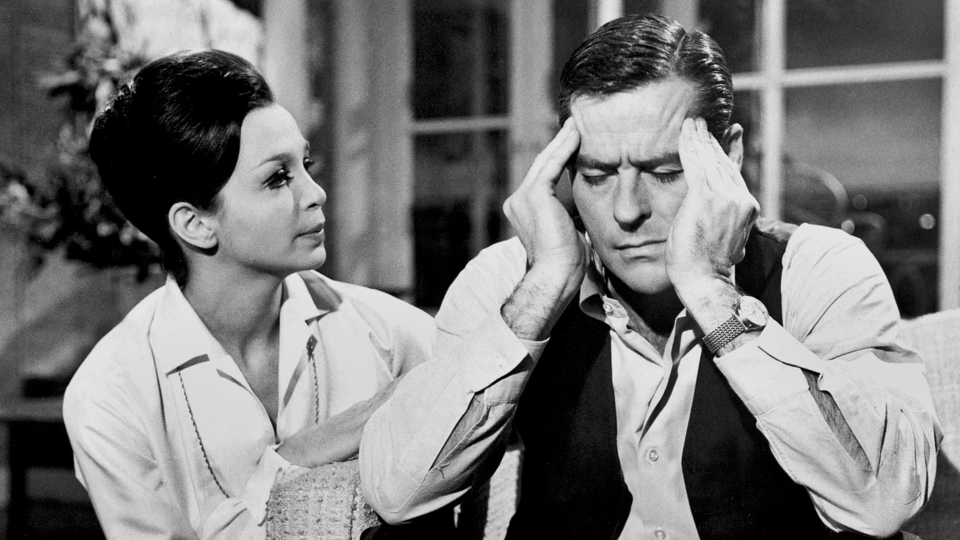
There is a moment in Hysteria where the film cuts to the victim’s point of view for a sudden outburst of violence that genuinely startles. It is an A-level shot stranded in a B-level picture, and it tells you everything about what this film could have been.
Robert Webber plays Chris Smith, an amnesiac pieced back together after a car accident by a kindly psychiatrist and installed in a swanky London penthouse. Who is paying for all this? Chris doesn’t know. He doesn’t know much. He hears voices. He sees things. Every clue he follows leads somewhere ugly.
If you’ve seen Hammer’s The Full Treatment from 1960, you’ve seen this before, because writer-producer Jimmy Sangster has essentially restaged that film’s plot—car accident, amnesia, psychiatrist, crumbling sanity—on a tighter budget with more twists. More twists do not always mean more fun.
At his best, Webber evokes a discount William Holden. Holden built a career convincing audiences to forgive his characters everything. Webber doesn’t have that trick fully mastered, but you tolerate him, which, for this material, is enough. He convinces as a guy who could have gone far if effort weren’t a foreign concept, and he wears the confusion of amnesia well. You believe he doesn’t know who he is. You also believe he wasn’t trying very hard to find out before the accident, either.
The real star is director Freddie Francis, a gifted cinematographer who knew what to do with a camera even when nobody gave him anywhere interesting to point it. Most of the film takes place in a single penthouse apartment, but Francis makes it work. When Chris arrives at his new lodgings, Francis cuts to an overhead shot showing him alone in the vast empty parking lot, then crash zooms in. The painted lines of the parking spaces become a cage. Isolation and confinement in one image.
Francis also has a knack for cross-cutting: a seltzer bottle spraying Chris in the face dissolves into a drink being poured, a character lighting a pipe cuts to another putting out a cigarette. It’s playful, confident work.
But Francis can only do so much with Sangster’s script, which is built on contrivances stacked like a house of cards in a draft. Chris possesses a torn magazine photo of a woman. He tracks down the photographer, barges in, and bullies the man with questions. Yet he never asks her name. Of course he doesn’t. If he had a name, he could verify things, and the movie would be over in twenty minutes. The plot needs him stupid, so stupid he becomes. By the climax, one character actually demands of another: “Why did you have to make it so complicated?” It is a question the audience has been asking for some time.
Hysteria is a minor Hammer thriller that moves briskly enough and looks better than it has any right to. Francis gives it visual wit. Webber gives it a passable leading man. Sangster gives it a story that doesn’t survive the car ride home.