Die! Die! My Darling!

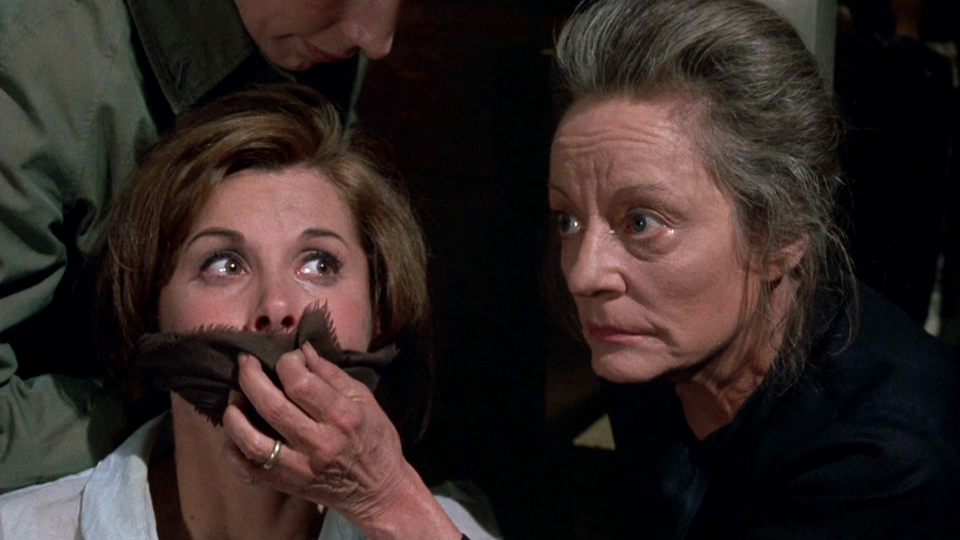
Known as Fanatic in the UK and Die! Die! My Darling! in the USA, here is a movie unsure of its identity.
Stefanie Powers plays Susan, a young American in London who makes the fatal error of visiting her dead fiancé’s mother before starting a holiday with her new man Alan. The mother is Mrs. Trefoile, played by Tallulah Bankhead, and she lives in one of those remote English villages that exist in movies so that no one can call for help.
Mrs. Trefoile is a religious zealot who conducts services in her own home because the local vicar had the audacity to remarry two years after his wife died. She has opinions about lipstick. She has opinions about everything. She believes Susan is spiritually wedded to her dead son Stephen and must remain pure to join him in the hereafter. The hereafter may be arriving ahead of schedule.
The setup is promising. It suggests a Whatever Happened to Baby Jane? for the English countryside. For a bit, it is just that, complete with harpsichord cues on the soundtrack.
But then there is a scene where Susan escapes her attic prison by climbing down bedsheets, crashes through a conservatory roof, and runs for the woods. One of the servants, Harry, played by Peter Vaughan with his usual air of oily menace, gives chase. Though she has a huge head start, he catches up instantly. The film switches to handheld shots. Harry feints and grabs at her, half laughing, half drooling. The dread here is real and specific: this is implied sexual violence, and it is effective. Susan plunges into a river. Harry circles her in a motorboat and drags her out by her hair. These scenes would not be out of place in a 1970s exploitation picture. Then we cut back to Mrs. Trefoile reading scripture in the attic, and the film forgets what it just showed us. The harpsichord cues return. We are apparently back in a kooky thriller.
This tonal whiplash might work if the film built on it. It doesn’t. The pattern repeats with numbing regularity: Susan resists, is thwarted by some contrivance, and Mrs. Trefoile reads more scripture.
Hitchcock said suspense is showing the audience a bomb under the table and then having two people sit down to chat, unaware. This film puts the bomb in a different café entirely, has the characters wander over to it by coincidence, then leave just before it goes off, then wander to a third café where there is another bomb. Contrivance is not suspense. It is the thing that curdles suspense into tedium.
The film also thinks very little of its heroine. Susan starts out sharp and self-possessed. By the third act she has been physically overpowered by everyone in the house, including the elderly Mrs. Trefoile. Her attic prison is full of heavy objects. Not once does she think to hide behind a door with a candlestick. When rescue comes, it arrives in the form of Alan, who storms in and sorts everything out with masculine vigor. For a film built around two women, handing the resolution to a man proves the lone genuine surprise. The film does not seem to notice the irony.
Bankhead, I should say, is good. She is better than good. There is no winking, no air of slumming. She plays Mrs. Trefoile with absolute conviction, and you believe every deranged syllable. A smarter script might have given us a “what if” version of Psycho where Norman died and Mrs. Bates ran the motel. Bankhead could have carried that film.
And then there is Donald Sutherland, in just his third credited role, playing an intellectually disabled albino on the household staff. It is a strange, small part. You keep getting distracted because you recognize him but can’t figure out why he looks like that. He belongs to the eccentric movie this one seemed to be at the start, before it tried to escape its own intentions and, like Susan, was dragged back.