Stop Me Before I Kill!

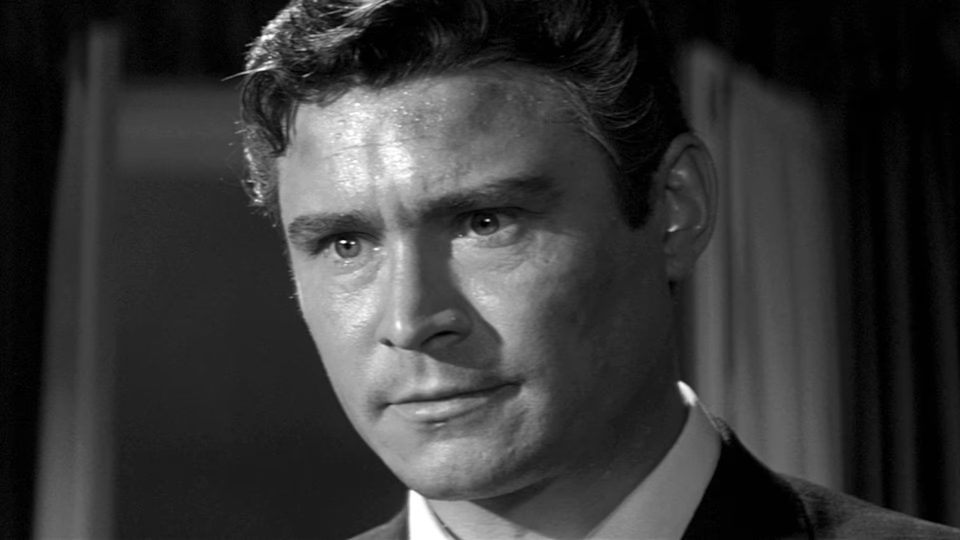
There is a moment early in Stop Me Before I Kill! (The Full Treatment in its native UK) when Alan Colby, race car driver turned newlywed wreck, wraps his hands around his wife’s throat during what was supposed to be a kiss. She gasps. He recoils. The scene is effective because Ronald Lewis plays it not as horror but as confusion. He doesn’t know why he did it. Neither do we. That uncertainty is the best thing in the picture.
Lewis plays Alan as a man whose body has betrayed his brain. A crash on the honeymoon has left him volatile, jealous, and seized by murderous impulses whenever he touches his wife. Watching him now, knowing what we know about what repeated head trauma does to a person, the performance feels less like melodrama and more like a case study published thirty years early. He’s good. He has the wound-up energy of a man who used to channel all that adrenaline into something and now has nowhere to put it.
The couple retreats to the Côte d’Azur, where they meet Dr. Prade, played by Claude Dauphin, a psychiatrist on holiday who offers to treat Alan. Writer-director Val Guest has studied his Hitchcock, and Dauphin’s performance carries unmistakable echoes of Claude Rains in Notorious. He is helpful in a way that makes you uneasy. Charming in a way that makes you suspicious. You can imagine Guest casting Rains, Grant, and Bergman if he’d had the budget and the luck. He didn’t, but Dauphin nearly closes the gap on his own.
The trouble is with Alan’s wife, Denise. Guest and his script spend the first two acts building Alan into a ticking bomb, which works, but they forget to give Denise a reason to stay in the room with it. She’s been married a year. Known him for two. He has tried to strangle her multiple times. Any reasonable person would be on the next train to anywhere. She stays because the plot requires her to stay, and the movie never bridges that gap. Worse, the script has her lying to Alan about trivial, easily disproven things, which triggers the very rages she’s trying to prevent. Diane Cilento does her best to charm us in the part, but you quickly go from sympathizing with her, to being frustrated by her, to wishing that the movie would just get on with it.
Still, the film holds you. Even when you know where it’s headed, you want to see how it gets there. When the setting shifts from the sun-bleached Mediterranean to cramped London flats, the change is abrupt but useful. The walls close in. The characters have nowhere to hide from each other. The story finds a new gear.
Then comes the ending and the movie loses its nerve. Everything the film built in shades of gray gets sorted into black and white. There is a cable car involved. Chekhov would have appreciated the setup if not the payoff. A braver film would have left us unsettled. This one leaves us reassured, which is the last thing a thriller about a man who can’t stop trying to kill his wife should do.
That said, between the location photography, Lewis’s committed performance, and Dauphin’s silky menace, you could do worse on a rainy afternoon. Fans of early-’60s Hitchcock imitations will find enough here to justify the time. Just make sure you’ve seen the real thing first.