A Fistful of Dollars

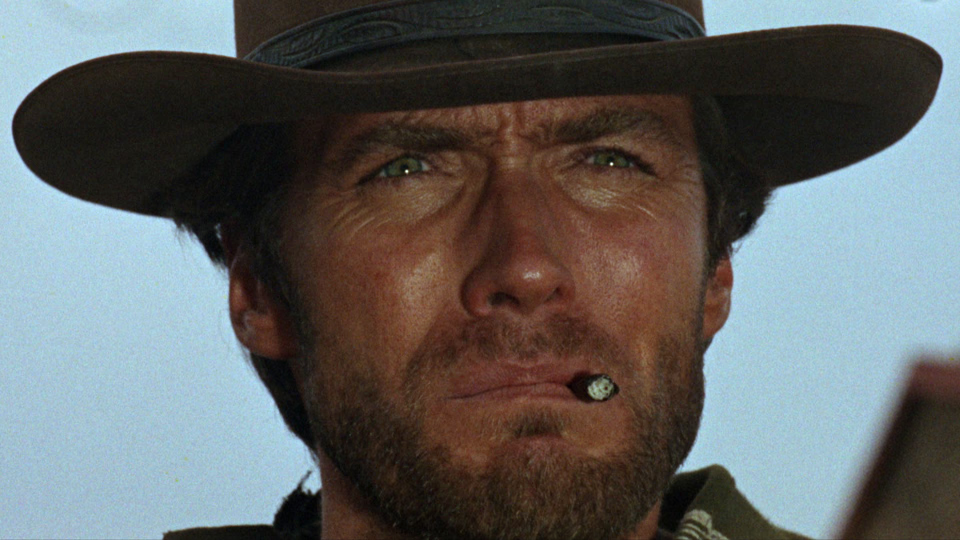
Clint Eastwood keeps a thin cigar clamped in his teeth throughout A Fistful of Dollars. He said later that he bought the cigars for their look, only to discover they tasted vile. I believe him. He looks like a man who has just been quoted a price he considers unreasonable. At the time he was a television cowboy, second banana on Rawhide, and he flew to Spain to make a Western for an Italian director whose previous credit was The Colossus of Rhodes. Nobody expected much. The film opened in Italy in 1964, reached America three years later, and made Eastwood a star on two continents.
He rides a mule into San Miguel, a border town so thoroughly divided between two families, the Rojos and the Baxters, that the only prosperous citizen is the coffin maker. The stranger looks around and sees a business opportunity. He will sell his gun to one side, then the other, and collect from both until there’s nobody left to pay him.
Anyone who has seen Akira Kurosawa’s Yojimbo will recognize the story, because it is the same story, moved from a samurai village to the Mexican desert. Sergio Leone didn’t ask permission. Kurosawa wrote to tell him it was a fine film but it was Kurosawa’s film, and the lawyers settled it with a share of the profits going to Tokyo. Fair enough, but Leone, going second, could see where Yojimbo sagged and made the better movie.
Some of the credit belongs to Eastwood. Tim Lucas, whose commentary track is worth your time, reports that the actor went through the script and crossed out much of his own dialogue. Toshiro Mifune’s ronin is a great creation, but he explains and grumbles and comments, and every explanation lets a little air out of him. Eastwood keeps his reasons to himself. We learn what he thinks by watching what he does, usually with his eyes narrowed against the sun or whoever is standing in it. United Artists sold him as “the Man with No Name,” although the coffin maker calls him Joe. The marketing department understood the character better than the screenplay did.
Leone makes cuts of his own. Kurosawa’s hero is exposed by a contrivance, a letter turning up where it shouldn’t. Leone’s is undone by plain bad luck, which preserves our sense that he was a step ahead of everyone and that it took an accident to catch him. Other scenes play as they did in Japan, only faster. When the stranger wants work with the Rojos, he skips the interview. He tells the coffin maker to get three coffins ready, walks over to the Baxter men who laughed at his mule, explains that the mule’s feelings were hurt, and shoots four of them. On the way back he amends the order: “My mistake. Four coffins.” The movie is often funny in this dry, morbid way, but it never stops to wait for the laugh.
The scene I keep returning to comes midway, at a hostage exchange in the street. One of the hostages is Marisol, whom the Baxters have seized and Ramón Rojo has claimed for himself, never mind that she has a husband and a small son who are forbidden to see her. Eastwood leans against a wall and watches as if it were somebody else’s funeral. Then the boy breaks loose and runs to his mother, and she sinks to her knees to hold him, and the husband starts toward them. The Rojos raise their guns. The old tavern keeper charges out with a shotgun to defend the husband, and the Rojos turn on him. That is when Eastwood comes off the wall with his hand at his hip. He doesn’t say a word and doesn’t need to. Until then we have found him fascinating. After it we are on his side, because we have learned in about a second and a half that he is decent. Yojimbo has nothing like it.
Listen to what Ennio Morricone does under that scene. Masaru Sato’s score for Kurosawa had a jazzy edge that dates it to its decade. Morricone writes opera, and beneath the reunion he lays a mournful march that recalls Dimitri Tiomkin’s “El Degüello” arrangement from Rio Bravo. When Eastwood steps forward, the music stops, as startled as the Rojos. Everyone stares at everyone. Only when the guns come down does the orchestra dare to resume.
Leone filmed in widescreen color, and Spain makes a convincing Mexico. The sky goes on forever, the adobe is baked nearly white, and the blood, when it comes, is an alarming red. Like most Italian productions of the day, the film was shot without sound and dubbed later, so lips and voices are not always on speaking terms. In a movie where the hero says so little, it hardly matters.
For a Few Dollars More and The Good, the Bad and the Ugly are better films, with bigger canvases and with Lee Van Cleef and Eli Wallach to give Eastwood someone worth squinting at. I admire them more. But A Fistful of Dollars runs ninety-nine minutes and plays shorter, and it’s the one I reach for most often. When I want an epic, I clear an evening for Tuco. When I just want to watch Eastwood size up a man who has made a mistake, this one does the job and gets me to bed on time.