Yojimbo

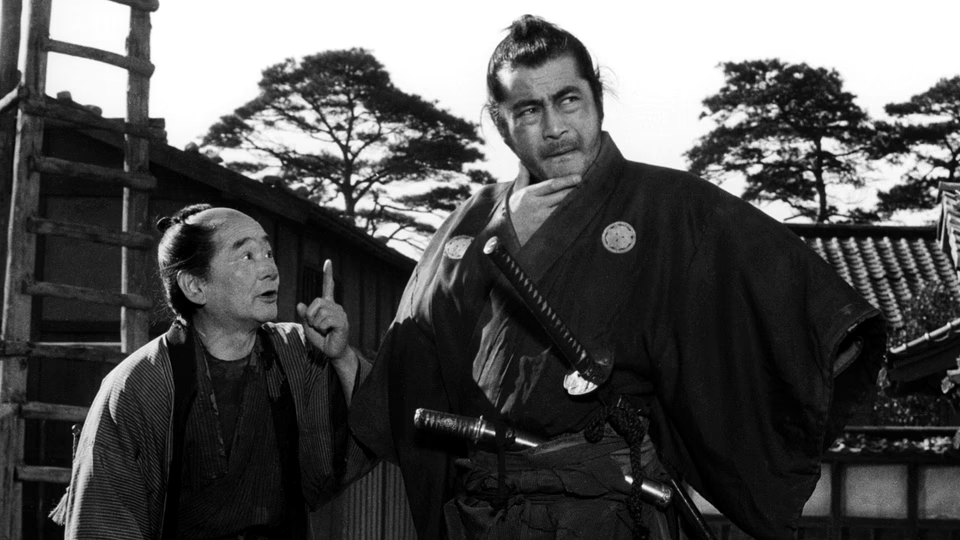
Many a filmmaker has looked at Yojimbo and thought: I could do that even better. Sergio Leone thought so just three years later in 1964. Walter Hill thought so thirty-plus years later in 1996. There were countless others in between and since. They were all wrong, and they were all right, and that is the particular genius of what Akira Kurosawa built here.
Toshiro Mifune plays a ronin who drifts into a town torn apart by two warring gangs. He sizes up the situation, kills a few men to establish his credentials, then offers his sword to the highest bidder. Then he offers it to the other side. He is playing a game, and the stakes are everyone else’s life.
Kurosawa introduces him from behind, his broad shoulders filling the frame, one hand scratching absently at his scalp like a flea-bitten dog. We know this man instantly. He carries himself with the bored confidence of someone who stopped needing to prove anything years ago.
It is one of the great screen entrances, and Mifune earns every frame of it. He was ten years older than Clint Eastwood would be when he inherited the role for Sergio Leone’s A Fistful of Dollars, and the age matters. There is a weariness behind those cold eyes. A fatalism befitting an actor at his apex instead of his ascension. Mifune convinces you that a lifetime of thought and feeling lives behind his stare but never lets you verify it. He is a cipher in a folktale, and a punishing angel in a town that has it coming.
Kurosawa films him with an inventiveness that never calls attention to itself. When Mifune, wounded, drags himself through a crawlspace beneath a building, the camera gets down in the dirt with him. Tight shots squeeze us into his claustrophobia; wider angles reveal guards stomping past inches away. It is a sequence of terrific tension built entirely through editing and camera placement, and it is over before you think to admire it.
The sword fights are another pleasure. Mifune uncoils from stillness and cuts through half a dozen men before any of them can draw. One of the opposing gang employs a giant named Kannuki who carries an oversized mallet. A bullet is an equalizer. A mallet is a problem. The young Tatsuya Nakadai, sleek and dangerous, carries a pistol and represents modernity creeping into this feudal story, and it is no accident that he is the one man Mifune cannot simply outfight.
But what may surprise anyone arriving from Leone’s version is the tone. Yojimbo is, for much of its runtime, a dark comedy. Mifune climbs to a watchtower to observe the two gangs finally squaring off, and they advance and retreat in a choreography so timid it could be the Jets and the Sharks without the dancing. Mifune laughs. So did I.
And yet. There is always an “and yet” with Yojimbo.
The violence is curiously bloodless. An early shot of a dog with a severed hand in its jaws sets expectations the film never meets. Mifune’s blade slashes across backs and chests and men crumple obediently. Kurosawa pushed things by including the sound of metal slicing flesh, but there is no blood, no consequence you can see. The gunfights in the remakes may not have sprayed crimson either, but a man dropping from a bullet convinces in a way a dry slash across the shoulders does not.
Then there is the population problem. Kurosawa fills his village with rival bosses, their sons, merchants, a mayor, an innkeeper. A key plot turn hinges on a woman held captive to leverage a merchant named once, forty minutes earlier. I had to rewind to remember who he was. Leone would later strip the cast to its essentials, and he was right to do so.
Mifune also talks a shade too much. Not a great deal—he is no chatterbox—but Leone proved the character works with almost no dialogue at all, just as Walter Hill’s Last Man Standing proved that adding more dialogue is fatal. Kurosawa lands closer to Leone, but there are moments where Mifune tells us what his face has already said.
The jazzy score, heavy on brass and percussion, stamps the film firmly in its early-1960s moment. It suits the mischief of the first two acts but sounds nothing like Ennio Morricone’s operatic grandeur. Both scores are good. They are scoring different movies that happen to share a plot.
And that is the key. Kurosawa made a very good film, but he crafted a perfect story—one so clean in its architecture that it survives every adaptation, every tonal shift, every new setting from the Old West to Prohibition-era Texas. Want something wry and economical? Watch Yojimbo. Want something mythic and expansive? Watch A Fistful of Dollars. You cannot go wrong. You will also, inevitably, sit there thinking about what you would have done differently. That’s Kurosawa’s genius.