The Stranger Wore a Gun

André de Toth wore a patch over one eye and could not see in three dimensions. That did not stop Warner Bros. from hiring him to direct House of Wax, the big 3-D hit of 1953, and a few months later Columbia gave him a 3-D western. I watched The Stranger Wore a Gun flat, on a television, and I doubt I missed anything he saw.
The prologue shows Quantrill’s Raiders sacking Lawrence, Kansas. Horsemen push rifles and torches at the lens so that audiences in cardboard glasses would flinch. After that the effects thin out to an occasional object thrown at the camera and some rear projection that was meant to suggest depth but instead suggests a soundstage. House of Wax at least had the barker with the paddle ball, whacking it at the front row; this one mostly throws furniture.
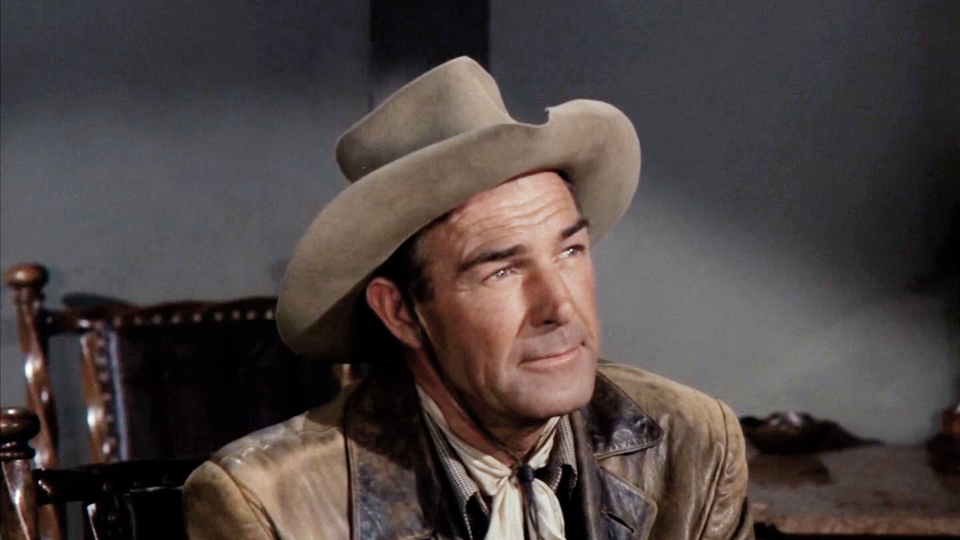
Randolph Scott plays Jeff Travis, the spy who scouted Lawrence for Quantrill. After the war he turns up on a riverboat, playing cards with an old flame named Josie Sullivan (Claire Trevor), until some passengers remember his face from the raid. Travis tells them he quit Quantrill afterward and fought for the regular Confederate army. They aren’t interested, and he goes over the rail. We hear the splash without seeing him go, which is typical of a movie that would rather tell us about its action than film it. Even a stagecoach robbery happens offscreen and gets reported to us later.
The prologue errs the other way. It shows us what the movie should have held back and answers the question about Travis’s past before anyone on the boat asks it. If the movie had opened on the riverboat, with strangers accusing a man we had only just met, we could have wondered whether he was lying. Since we already know, the scene can only wait for him to jump.
At Josie’s urging he goes to Prescott, Arizona, and looks up Jules Mourret (George Macready), another old raider, who wants him inside the local stage line so his gang can rob it. Travis owes Mourret and agrees, then spends the rest of the picture playing both sides and looking for a way out. Scott co-produced the film. He has moments of dry charm, but as a producer he might have noticed how many of his scenes consist of explaining things while seated.
Maybe the 3-D rig, two cameras yoked together, was too clumsy to haul into the hills. For whatever reason, most of the movie stays indoors, and the exteriors sit under gray skies that would flatten the scenery in any number of dimensions. The exception is a stagecoach chase up a snowy mountain trail. It looks cold and steep and actually dangerous, and it made me wish de Toth had been let outside more often.
The villains are no help. Alfonso Bedoya was the bandit in The Treasure of the Sierra Madre who had no use for stinking badges. Here, as a bandit named Degas, he jabbers and mugs as if he’d been hired for comic relief. Bedoya knew how to be menacing, so I blame the direction. Lee Marvin and Ernest Borgnine play Mourret’s muscle, which sounds promising. Marvin looks like a man who read the script on the first day and decided to save himself for a better one. Borgnine works hard to invent a personality the screenplay never gave him. Then, in his big fistfight with Scott, the camera gives us a good long look at his stunt double, who resembles Borgnine about as much as I do.
Claire Trevor is the only one who seems to know what kind of movie she’s in. She plays it big and enjoys herself, the way Vincent Price would later in Roger Corman’s Poe pictures, and while the budget runs out around her, she gives you something to watch. The finale even sets a saloon on fire, which is how Corman liked to end those pictures too.
This one is for 3-D completists and Trevor fans only. If you came for Scott and Marvin, look for 7 Men from Now, which Budd Boetticher made with both of them in 1956. Judging by Marvin’s performance in that one, it was the script he was saving himself for.