7 Men from Now

Most revenge westerns begin with the crime. They give you the happy marriage, the robbery, the gunshot, the funeral, the hero strapping on his irons.
7 Men From Now skips all of that. Burt Kennedy’s screenplay seems to have had its first forty pages torn out. We open on a stormy night in the Arizona frontier. Randolph Scott approaches two men camped in a rocky alcove. The tension needs no backstory. Five minutes in, it’s not seven men anymore. It’s five.
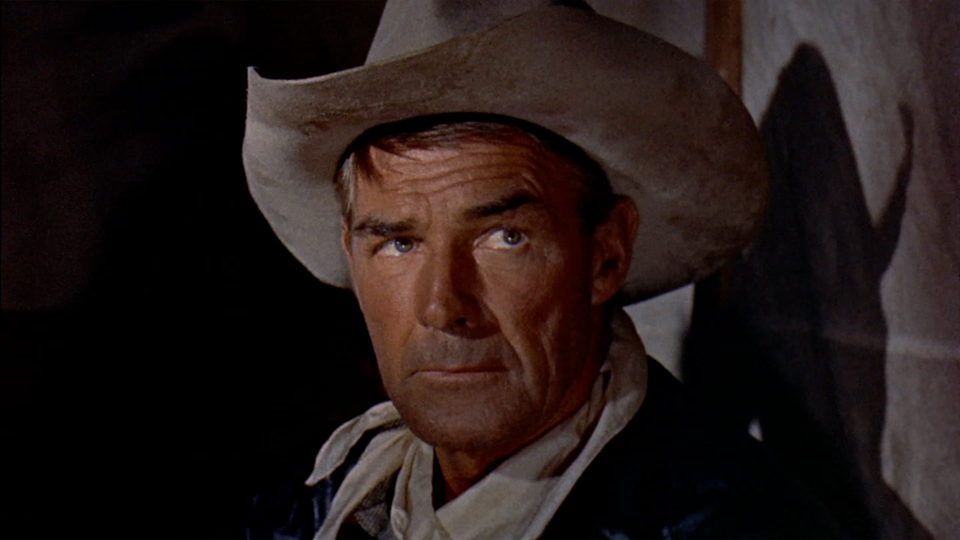
Scott’s Ben Stride is a former sheriff hunting the men who robbed a Wells Fargo office and killed his wife. We learn this in spare fragments of dialogue, never in flashback. No weeping over a photograph. No nightmare sequence scored with violins. Scott’s face tells us everything. That granite jaw. Those pale, unblinking eyes. He is a man who has absorbed a terrible blow and converted grief into purpose.
Along the trail, Stride falls in with the Greers, a married couple from back east heading to California. He rides with them because it’s in his nature. He is not an anti-hero. He is that rarer thing in westerns—a genuinely decent man who has made peace with his own flaws. His great sin was pride, and he’s done the work. When an attraction flickers between him and Mrs. Greer, played with quiet longing by Gail Russell, he draws the line. There is a wonderful scene where she asks him, referring to her somewhat hapless husband, “Do you think I love him any less because of the way he is?” Scott replies, without a trace of emotion: “Yes, ma’am.” Two words that land like a slap. He means it. He also means to leave it there.
Scott was pushing sixty during filming. You wouldn’t know it. He looks muscular and capable, his weathered face and silver hair suggesting hard miles, not old age. The performance is a triumph of minimalism. You sense he has feelings for Russell. You sense he’d like to gun these men down in cold blood. He resists both urges with the same quiet discipline. He is not far removed from John Wayne in Rio Bravo, which is no accident—Wayne produced this picture and considered starring before choosing John Ford’s The Searchers instead. A wise call. Wayne would have been fine. Scott is better.
And then there is Lee Marvin as Bill Masters, a gunslinger Scott jailed twice when he wore the badge. He and his partner are also hunting the Wells Fargo gold, but their interest is purely financial. Marvin enters the picture grinning, all restless hands and quick-draw practice, a man who can’t stop rehearsing for a fight he’s dying to have. He speaks in that slow, seductive baritone—the voice of a man who enjoys the sound of his own menace. His scenes with Scott crackle.
Marvin is especially good in the finale. I won’t spoil it, but there is a cut from his face to Scott that delivered the kind of heroic thrill westerns aspire to but so rarely earn. I can picture the 1956 audience cheering. I nearly did myself.
Director Budd Boetticher stages this on some of the most beautiful landscape photography you’ll find in a fifties western. Forests, mountains, desert, rivers—the kind of wilderness that makes you understand why people left perfectly good cities to risk death heading west. Nearly every scene plays outdoors, and the vistas do what process shots never could.
Kennedy’s script stays lean throughout, setting up a third-act reveal that works the way good reveals should: surprising on impact, inevitable on reflection.
Two blemishes. The theme song puts a chorus of men singing the plot synopsis where an orchestral score belongs. And there is a canyon ambush early in the third act that Boetticher fumbles badly—odd fast motion as characters run, no sense of geography, men climbing around rocks until one of them falls down dead. It plays as though footage was lost or coverage was never shot. In a film this tight, the sequence sticks out like a wrong note in a piano recital.
No matter. 7 Men From Now is a great small western. Seventy-eight minutes, no fat, a hero worth admiring, and a villain worth savoring. They don’t build them like this anymore. They barely built them like this then.