The Curse of Frankenstein

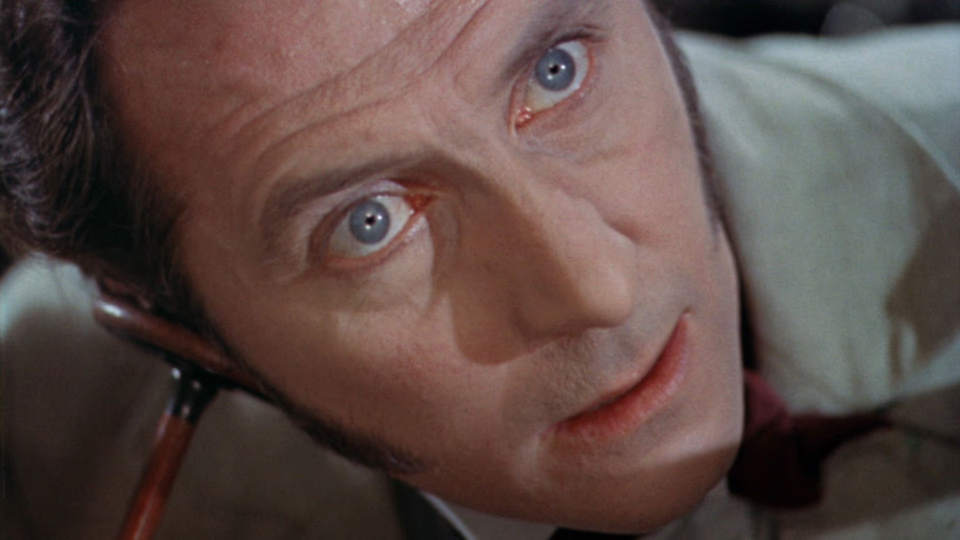
Peter Cushing wipes his hand on his lab coat.
It’s an absent gesture, the kind you make after washing dishes or changing a tire. Except he’s just sawed off a corpse’s head, and it’s not dirt but blood that streaks the fabric. That sort of casual brutality defines The Curse of Frankenstein, Hammer’s 1957 breakthrough that turned gothic horror into eye-popping Eastman Color spectacle.
The plot unfolds in flashback. Cushing, as Baron Victor Frankenstein, awaits execution, telling his story to a skeptical priest. Orphaned at 15, he becomes obsessed with creating life alongside his tutor Paul Krempe, played by Robert Urquhart. They resurrect a puppy. Paul wants to publish. Victor wants to build a man.
What follows is 83 minutes of momentum. Jimmy Sangster’s script is a bullet train, hurtling from graverobbing to murder to resurrection without wasted motion. When Victor needs a brain, he murders a visiting professor. Paul catches him mid-extraction. They fight. The brain gets damaged. The creature, played by Christopher Lee, becomes a savage rather than a genius.
The film squeezes maximum impact from minimum budget. No army of torch-wielding villagers here. Hammer couldn’t afford the extras. Instead, we get intimate horror. Lee’s hand slamming over his eye socket as blood pours down his face. Cushing grunting through off-screen decapitation while Urquhart watches, barely containing his revulsion.
The production design follows a similar born-of-necessity origin. Without the elaborate sets, electrical equipment and Tesla coils used in the Universal version, Hammer had to lean into their advantage: color. Neon-bright laboratory fluids. Saturated red blood. Director Terence Fisher birthed what would become the Hammer aesthetic: gothic atmosphere drenched in impossible color.
Lee, cast in large part due to his towering six-foot-five height, and hidden behind Phil Leakey’s gruesome makeup, shines as the monster. He makes the role his own, bringing a feral savagery missing in Boris Karloff’s iconic turn and injecting a welcome streak of menace to the creature while still retaining a degree of audience sympathy.
And Cushing. He’s magnetic as Victor. Despite playing a sociopath, Cushing’s performance remains utterly engaging. His charisma is so potent that I always leave suspecting Paul is the real villain. Paul sabotages the experiment, denies the creature’s existence, and walks away with Victor’s fiancée and fortune while Victor marches to the guillotine.
Paul is the worst.
This reading helps explain the script’s inconsistencies. Victor confesses to an affair with his maid that feels wrong for his character and recounts scenes between Paul and Elizabeth he couldn’t have witnessed. These gaps make sense if you view them as Victor reframing Paul’s betrayal, projecting sins onto himself to protect his father-figure.
Am I reading too much into budget constraints masquerading as narrative choices? Of course I am.
But it doesn’t matter. This is the film that launched Cushing and Lee to stardom and gave Hammer nearly two decades of gothic glory. Four talents new to horror—Cushing, Fisher, Lee, and Sangster—creating alchemy from corpse parts.
Just like Victor’s creature, really. Except this one achieves the perfection Victor aspired to. Unlike Paul—who remains the worst.