The Bloodstained Shadow

There’s a good movie somewhere in The Bloodstained Shadow. Unfortunately, it didn’t make it to the screen.
What we get is a Venetian giallo with all the right pieces—black-gloved killer, colorful suspects, a priest who may have seen too much, a Goblin-performed score—but nothing to hold them together.
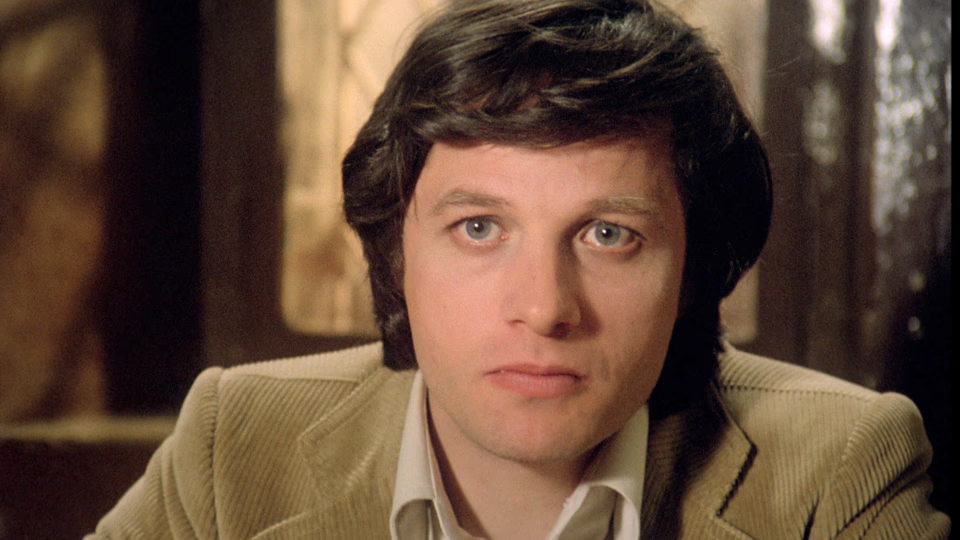
Stefano, a young professor devoted to turtleneck sweaters, returns to his island hometown to visit his brother Don Paolo, the local priest. A woman is strangled. It echoes a schoolgirl’s murder years prior. Don Paolo may have witnessed something. Threatening letters arrive. Bodies accumulate. You know the architecture. You’ve seen it before, done better, in less time.
Director Antonio Bido opens on the schoolgirl’s murder in slow motion. With a runtime pushing two hours, slow motion is not what this film needs. It’s the first sign of a director who mistakes style for content. If the killing looks strange enough—slow-motion, jump zooms, rapid edits—surely it must be interesting? Not so much. Argento earns his set pieces by first making you care who’s in them. Bido can’t be bothered, he just moves to the next set piece and hopes you’ll follow.
You won’t care about the victims. We don’t meet the first two before they’re killed. The murders are, surprisingly, quite tame. Each is stretched to the breaking point while delivering nothing memorable.
The film’s logic is similarly strained. Don Paolo witnesses a murder from his window, rushes to find Stefano, and when no body turns up, Stefano concludes there was no murder. Nobody mentions that a killer might move a body. Nobody suggests the victim could have crawled away. They don’t even look around. “No body, no murder, back to bed.” In a sharper film, this would be dark comedy. Here it’s just inattention.
Later, a victim escapes by grabbing a rope on a passing boat. He doesn’t call out to the crew standing feet away. They don’t feel the drag. The killer simply hops in a speedboat and solves the problem. Physics, like pacing, is optional.
The supporting characters include a satanic medium, a pedophiliac count, and a backroom abortionist. Lucio Fulci would have had a field day. Bido gives each of them a scene or two and then dispatches them, disconnected from anything resembling a narrative. They pass through. So does the audience’s interest.
The mystery telegraphs its solution and still requires a torrent of exposition to explain it. Yet the circumstances behind the schoolgirl’s murder that set everything in motion are never explained. The film asks you to wait two hours for an answer it cannot fully provide.
Lino Capolicchio is a convincing Stefano—warm, watchable. Stelvio Cipriani’s score, filtered through Goblin, is genuinely good. Together they create a veneer of competence over the film’s structural rot.
A thin veneer.