Red Spirit Lake

There is a moment in Red Spirit Lake where the ghost of a dead woman—or maybe her reanimated corpse, the film is not particular about this—violates a man on a table with her fist in a scene that plays like Tex Avery directing something you’d find behind the curtain at the video store. It is grotesque, cartoonish, and so committed to its own absurdity that I found myself laughing in disbelief. If that sentence intrigues you, this is your movie. If it doesn’t, nothing else I write will change your mind.
The story is simple enough. Marilyn inherits a remote lakeside property from her aunt. The aunt was a witch. The lake is a place of power. A wealthy industrialist murdered the aunt to seize that power and now has designs on Marilyn. Various people arrive at the property. Bad things happen to them. One is cooked alive in a sauna. Another castrates himself. Compared to the man on the table, they got off easy.
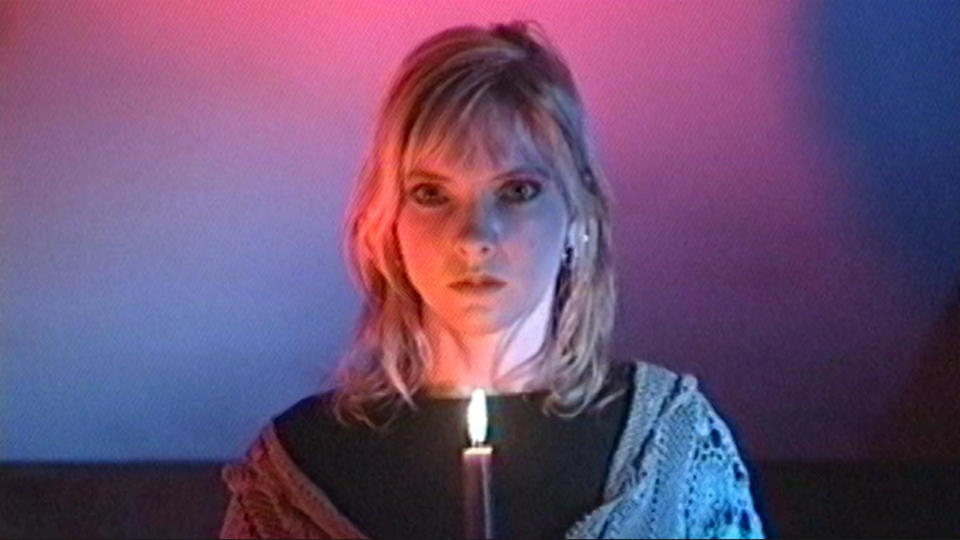
This is a shot-on-video production, and it wears that fact openly. The first scene nearly lost me: flat lighting, wooden dialogue, and gratuitous sexual violence deployed with all the subtlety of a fire alarm. But with a runtime of only sixty-nine minutes, I stayed.
I’m glad I did. Not because the film finds its footing—it never quite does—but because it keeps stumbling in interesting directions. The lighting remains inconsistent, as it does in so many of these productions, where the filmmakers seem unaware that a single dark corner can transform a room. Yet there are flashes of real effort here. Color filters appear. Actual night exteriors show up, moody and grainy. Someone was trying.
The script has a curious relationship with logic. Events connect through “and then” rather than “therefore.” Characters fall asleep whenever the plot needs them out of the way. In one scene, amid murders and disappearances, Marilyn goes upstairs to play the violin. In another, a character performs what I can only describe as naked tai chi in the snow. I cannot explain these choices. I suspect no one can. But they give the film a loopy, good-natured strangeness that keeps it from ever curdling into meanness.
The practical effects deserve genuine praise. They are goopy, gory, and enthusiastic in the Frank Henenlotter tradition, where more is more and too much is just right. Other effects are less convincing. The “otherworldly lights” are clearly flashlights being waved just off camera. It is that kind of movie.
My favorite detail, though, is the snow. Real snow. Not the fluffy white drifts of a Hollywood backlot, but the hard, gray, icy slush you slip on while scraping your windshield at six in the morning. The actors slip on it too. This is not choreographed. It is the unavoidable reality of shooting outdoors in winter on no budget. They trudge through it with that stiff, cautious gait everyone in northern climes recognizes, and it lends the film an accidental texture that money cannot buy.
Red Spirit Lake is not good in any conventional sense. The performances are forgettable, the lighting flatlines, and the story lurches forward on sleepy characters and dream logic. But it has real snow, real guts, and one scene of such deranged audacity that it earns a kind of respect. For the specific audience that seeks out films like this—and you know who you are—it delivers.