Red Rooms

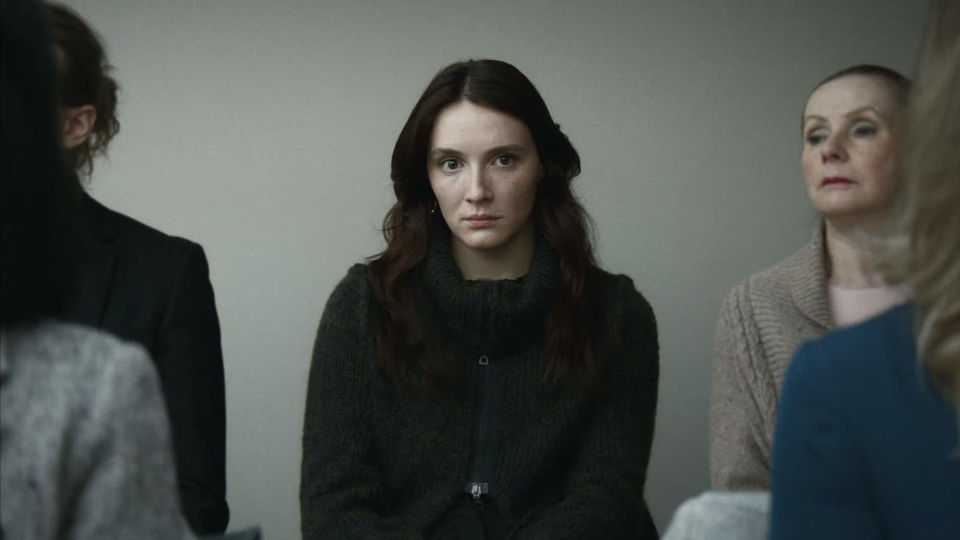
Pascal Plante’s Red Rooms opens with a woman waking up in an alley. She has slept outside a Montreal courthouse to guarantee a seat at the trial of a man accused of murdering three teenage girls on camera for paying dark-web customers. Most people would not do this. Kelly-Anne is not most people.
She’s a fashion model who lives in an austere high-rise condo, has no friends, and supplements her income by playing high-stakes online poker. She attends the trial with religious discipline. Beyond that, nothing. No backstory, no confessions, no voiceover to let us in. Juliette Gariépy plays her with an unnerving stillness that suggests everything and nothing is happening behind her eyes. She holds the screen through sheer refusal to perform, which is its own kind of performance.
For a long stretch, Red Rooms earns its ambitions. Plante films the courtroom proceedings in long, clinical takes that recall Michael Haneke at his most detached. We sit. We watch. We are given no instructions on how to feel. This is harder than it sounds, both for the filmmaker and for us. The camera studies Kelly-Anne the way she studies the accused, and we are left to wonder what draws her there. Fascination? Complicity? Something worse?
She attracts an unlikely companion. Clementine is younger, louder, and has hitchhiked to Montreal because she is convinced the accused is innocent. She is a fan. The two women circle each other warily, and their dynamic produces the film’s most devastating scene. Kelly-Anne shows Clementine the actual murder footage. We never see it. We see Clementine’s face as she tries to endure it, crumbling, while Kelly-Anne watches unfazed. It is a scene Haneke himself might have admired.
Then the film loses its nerve.
Plante, having spent two acts constructing a Haneke-style enigma, decides in the third to pivot toward Paul Schrader. Kelly-Anne breaks into a house. She takes selfies. She plants evidence. There are the contours of a redemption-through-self-destruction arc, the kind Schrader built so powerfully in Taxi Driver. But Schrader’s films work because we live inside his protagonists. We hear Travis Bickle thinking. We feel his loneliness calcifying into purpose. When he erupts, we understand the eruption even as we condemn it. Kelly-Anne’s eruption arrives from nowhere and detonates nothing.
Haneke understood this. If you build a cipher, you must honor the cipher. You don’t get to spend two hours refusing to explain your character and then ask the audience to feel the gravity of her choices. The Piano Teacher ends with a shot that explains nothing and haunts you for weeks. Plante wanted something tidier. Tidier in this context feels disingenuous.
Credit where it’s due. Plante is a skilled technician. Watch how he gradually migrates from those composed early shots into handheld work, as if the film itself is losing its composure. You feel the instability before you can name it. He has Haneke’s eye, just not his conviction.
Red Rooms is not a bad film but a compromised one, which is in some ways harder to forgive. Still, it has an audience. If Haneke and Schrader are too bracing for your taste, here is a less-challenging alternative. Whether that’s a compliment is up to you.