The Piano Teacher

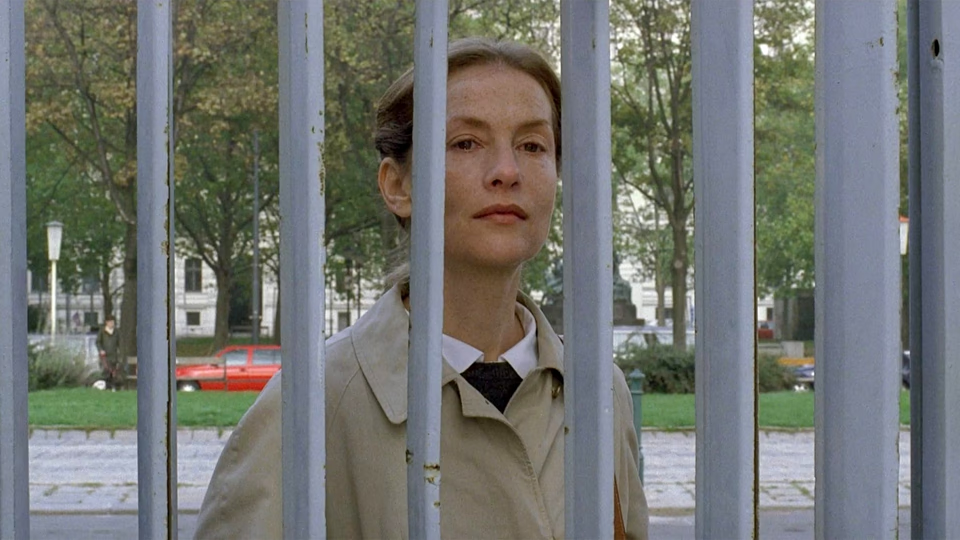
Michael Haneke does not make comfortable films. He makes necessary ones. The Piano Teacher is among his most necessary, a film so unblinking in its gaze that you may want to look away. You should not.
Isabelle Huppert plays Erika Kohut, a piano instructor at a prestigious Vienna conservatory. She is brilliant. She is respected. She goes home each night to the apartment she shares with her mother, who monitors her like a parole officer. Erika is somewhere past forty and has never been allowed to grow up. She has been so thoroughly consumed by discipline and denial that she has become a kind of void in human form, eating her little sandwich alone in her practice room, staring out the window at a life she will never enter.
Into this sealed world comes Walter, played by Benoît Magimel. Walter is young, handsome, wealthy, and plays piano with the reckless confidence of someone who treats it as a passion rather than a prison sentence. He is better than Erika’s students. He may be better than Erika. He wants her, and she wants him. What follows is not a love story, though it wears that costume for a while.
Erika’s understanding of intimacy has been assembled entirely from pornography and voyeurism. Haneke shows us this without flinching. When Erika visits a sex shop and enters a video booth, we see what she sees. It is explicit. What she does while watching will disturb you more than the footage. I will not describe it. There are other scenes I will not describe either. A scene of self-mutilation so quiet it plays almost like meditation. A sexual assault committed against her own mother. These are not scenes designed to shock. They are scenes designed to make you ask why you are shocked.
This is Haneke’s great trick. He refuses to judge Erika. His camera maintains a cool, observational distance, a few steps behind her at all times, watching but never editorializing. His longtime cinematographer has called the style “hyper-realism,” but I think that undersells the precision. Every shot is composed with surgical care, yet nothing feels showy. It is the visual equivalent of a doctor’s bedside manner: calm, professional, and deeply unsettling when you consider what’s on the table.
What strikes me most, watching the film now, is how prophetic it feels. Here is a person stunted in development, isolated, friendless, whose entire sexual imagination has been constructed by a screen. Someone who wields petty authority in their small domain and rages when reality refuses to match their fantasies. Change the gender and you have a profile that has since become grimly familiar. Haneke saw it in 2001. He adapted Elfriede Jelinek’s novel and stripped out all the backstory, all the explanations. He is not interested in why Erika became this way. He is interested in making you sit with her.
Huppert is extraordinary. I do not use the word casually. She plays Erika as a woman wound so tight that every flicker of emotion registers like a seismic event. A slight loosening of her jaw. A half-second too long holding someone’s gaze. As her affair with Walter deepens, small changes appear: a hint of lipstick, a scarf with color. In another performance these details would vanish. Huppert makes them feel enormous, because Erika would consider them enormous. It is a performance of absences, of everything held back, and it is devastating.
Magimel has the less showy role and plays it with a naturalism that sneaks up on you. He is charming in the way that handsome young men are charming when they know they are handsome. You believe the girls who giggle around him. You believe his desire for Erika, which is the harder sell, and he sells it. You also believe the finale, which requires him to go somewhere very dark. In a film owned by Huppert, it is easy to overlook him. That ease is the performance.
If the film falls short of Haneke’s very best work, it is in the ending. The final image mirrors the novel but lacks the gut-punch precision of Funny Games or The Seventh Continent. Those films leave you reeling. This one leaves you unsettled, which is not quite the same thing. There is also the matter of everyone in Vienna speaking French, but that is a minor consequence of the film’s financing.
But falling just short of a masterpiece still puts you in rare company. Huppert alone is worth the price of admission, and Haneke’s exacting vision has never felt more relevant. This is a film about what happens when a human being is sealed off from genuine feeling for so long that the seal becomes the person. It is not pleasant. It is not for everyone. But I suspect the people who need to see it most are the ones most certain they don’t.