Racket Busters

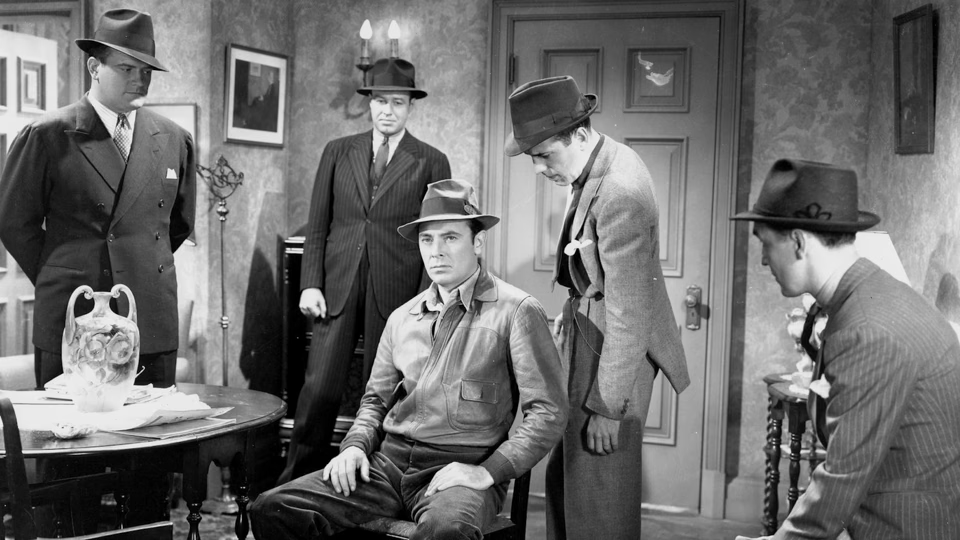
Racket Busters is a Warner Bros. crime picture assembled from the spare parts of other Warner Bros. crime pictures. You can almost hear the bolts rattling.
Humphrey Bogart plays a gangster muscling into the trucking business. George Brent plays the trucker who must choose between the syndicate and starvation. Walter Abel plays the special prosecutor sworn in to clean things up. You have seen all of these men before, in better films, wearing different hats. The opening scene, where the governor administers Abel’s oath, feels so rote it could play as a screen test. Someone remembered to point the camera. That’s about it.
Bogart gets top billing but this is Brent’s picture, and Brent plays it like a man waiting for his lunch break. He’s a poor man’s George Raft, which is already a phrase that should give you pause. Bogart, for his part, does what he can. He glowers. He threatens. He is Bogart. But the script gives him nothing to chew on, so he grinds his jaw and moves to the next scene.
The script is the real crime here. Every character is a type, not a person. The evil racketeer. The noble prosecutor. The grizzled union elder. The honest working stiff. They don’t talk to each other so much as deliver speeches in each other’s general direction. Even the courtroom scenes, which have a built-in excuse for oratory, can’t resist. After the judge passes sentence, he turns and delivers a homily to the audience. I half expected him to look into the lens.
Abel’s prosecutor has a novel strategy for fighting organized crime: jail the victims. If truckers won’t testify, lock them up until they will. The film presents this as tough but necessary, which is a strange kind of justice. One man does testify. He goes home, waves off his police guard, and is promptly beaten by Bogart’s goons. You start to wonder if the police in this city exist at all. Bogart’s men destroy trucks, wreck storefronts, and assault drivers in broad daylight with the impunity of men who have read ahead in the script and know nobody’s coming. If the governor really wanted results, he’d skip the prosecutor and call the National Guard.
The film flirts with an anti-union message it lacks the nerve to consummate. Unions, we’re shown, can paralyze a city, jack up prices, crush the little guy. But the movie’s position is that a union run by Bogart is bad while a union run by Brent would be good. This is not an argument. It’s a wish. A braver screenplay would have Bogart seize control through legal means and then dare us to find the line between corruption and collective bargaining. That movie might have been worth watching.
Then there are the women, who exist to suffer decoratively. Gloria Dickson plays Brent’s wife Nora, a bundle of nerves destined for a country sanatorium. Penny Singleton plays Gladys, the girlfriend of Brent’s partner, a nag with no off switch. Neither woman is a character. They are plot tools. When Brent finally joins Bogart’s racket to pay for Nora’s treatment, she resents him for it. If you’re going to write a woman as helpless, at least let her stay grateful. Consistency in your stereotypes isn’t much to ask.
The melodrama piles up until it starts to feel like satire. By the finale, Brent drives a truck through the wall of Bogart’s headquarters. A shootout follows. Bogart, a gangster who has presumably held a gun before, fires repeatedly at a man standing a few feet away and misses every time. I laughed. I don’t think the movie was in on the joke.
It is, by all fair measures, a bad film. And yet, there’s an early scene where Bogart’s car winds through a backlot Washington Market set teeming with extras hauling crates of produce. The camera prowls through the crowd, and you feel the noise, the energy, the chaos. And later, a runaway truck sequence on a steep hill—brakes cut, trees snapping, a fence obliterated—has real kinetic energy. These are good shots that wandered in from a better film.
But two shots cannot save a picture. You might think better casting would help—and it would—but the real problem is underneath. The story is anti-crime propaganda, not drama. Someone at Warner Bros. must have realized it. Two years later, the studio released They Drive by Night, which took the trucking milieu, added Raft, gave Bogart the sidekick role, wrote women who breathed, and threw the gangster nonsense in the wastebasket. Watch that instead.