Pat Garrett & Billy the Kid

Sam Peckinpah’s Pat Garrett & Billy the Kid is a film I have now seen three times, in three different cuts, and each time I liked it more. This is not necessarily a recommendation. It may simply mean I am wearing down.
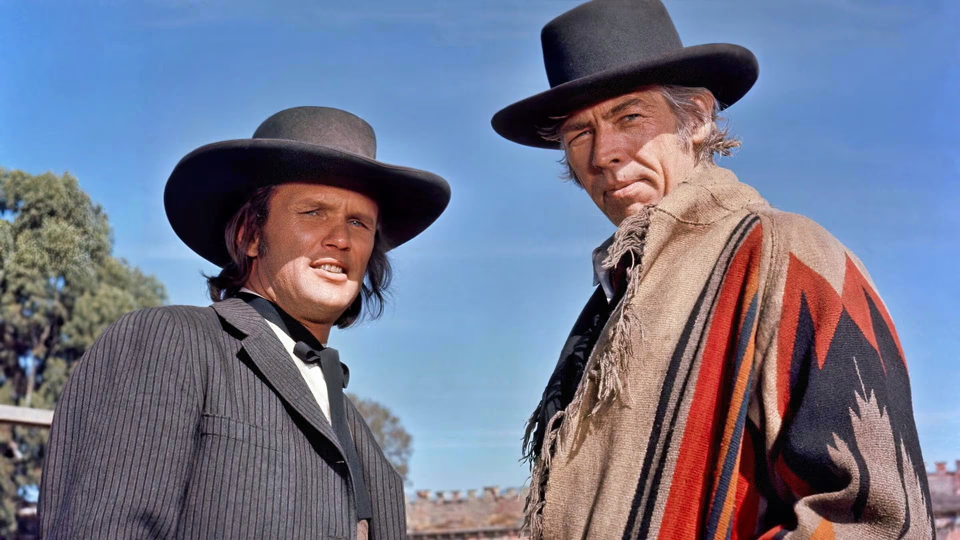
The setup is classic Western mythology. Pat Garrett, now a sheriff bought and paid for by the cattle barons, must hunt down his old friend Billy the Kid. James Coburn plays Garrett. Kris Kristofferson plays Billy. Both are too old for the parts, and this matters more than you’d think.
The real Garrett was thirty-one. The real Kid was twenty-one. That’s a gulf. One man staring down the compromises of adulthood, the other still drunk on his own immortality. It’s the story of the friend who gets married and stops returning your calls, set against the New Mexico desert with considerably more gunfire. Coburn was forty-five. Kristofferson was thirty-seven. At those ages the gulf becomes a gully. Two middle-aged men circling each other lack the generational tragedy the story demands.
Kristofferson has a separate problem. He’s likable. He convinces as someone who could buy a round and charm a saloon. He does not convince as a killer. Not when the supporting cast includes Harry Dean Stanton, Jack Elam, and L.Q. Jones—men whose faces alone could chill a room. The film shows us Kristofferson killing people but he never feels dangerous.
The structure is its own puzzle. We open in 1909, nearly three decades later, watching Garrett gunned down by his own associates. This tells us everything before the story begins. Garrett will betray Billy and be betrayed in turn. The fatalism is total and immediate, which robs the film of any gathering dread. What follows is less a narrative than a series of vignettes—someone tracks down one of Billy’s associates, someone dies violently, repeat—and you can feel the movie drifting. Yet because we already know the destination, the drifting becomes almost hypnotic. It’s a Möbius strip that either deepens the film or undermines it, depending on when you ask me.
Then there is Bob Dylan, who acts in the film and scored it. As an actor he is neither good nor bad, occupying a role so underwritten it could be excised entirely. His soundtrack is another matter. “Knockin’ on Heaven’s Door” lends genuine devastation to a death scene that earns it. The rest of the music sits uneasily against the period setting, though if Peckinpah meant to use contemporary folk to underscore the collision of old and new, you can squint and see the intention. With younger leads it might have been a statement. Here it’s a suggestion that keeps calling attention to itself.
What works, works beautifully. The Durango locations have a sun-bleached grandeur. The character actors—Elam, Elisha Cook Jr., Paul Fix—populate the margins with faces that tell their own stories. Coburn, age aside, is superb. His Garrett is a man who has already begun to rot from the inside and knows it.
You can feel the film Peckinpah wanted to make pressing against the film he delivered. A meditation on violence more nuanced than The Wild Bunch, where nostalgia itself is interrogated. The old-timers swap tales of the good old days, and the tales are horrifying—snakebites, ugly deaths, casual brutality. The new West may steal your freedom, but it might also let you die in bed. A meditation on loyalty more nuanced than Ride the High Country. Garrett avoids going after Billy. Billy escapes prison and doesn’t flee to Mexico. Neither man can let go, and both know they must.
We’ll never know exactly what Peckinpah intended. He assembled a 165-minute cut. MGM president James Aubrey demanded changes and gave him three weeks. Peckinpah, working around the clock with six editors, produced a 124-minute preview version. Aubrey then seized the film and carved it to 106 minutes. Peckinpah disowned it. The production had been a war between a penny-pinching studio chief and a fiercely independent director whose alcoholism had overtaken his genius. Coburn remembered a narrow daily window of clarity: “He was a genius for about four hours, then it was all downhill.”1
My gut says Peckinpah lost the movie somewhere during production and believed he could find it again in the editing room. Some accounts have him declining the chance to re-edit it later, which tells you something. But I wouldn’t call it a failure. It is watchable and absorbing, a film that falls short of greatness while never letting you forget that greatness was the target. Give me another viewing or two and I may change my mind. The film seems to insist on it.
Footnotes
-
David Weddle, “If They Move… Kill ’Em!”: The Life and Times of Sam Peckinpah (Grove Press, New York, 1994), 562, Kindle. ↩︎