Executive Suite

Robert Wise’s Executive Suite opens with a gimmick. We see through the eyes of Avery Bullard, president of a furniture empire, as he moves through a lobby where no one dares meet his gaze. He sends a wire. He walks outside. He raises his hand for a cab, groans, and the camera drops to the pavement. He’s dead.
It’s meant to be startling. It isn’t. When a man dies, his vision doesn’t fall like a toppled tripod. It goes dark. Wise wanted the image that follows—Bullard’s arm outstretched over the gutter, billfold in hand—and it is a good image. But he rigged the machinery to get there, and you can hear it creaking.
This is the film’s recurring problem and, strangely, part of its charm. Wise never met a moment he couldn’t oversell. Yet the story he’s telling—a corporate power struggle among six executives circling an empty chair—is sturdy enough to survive his enthusiasm.
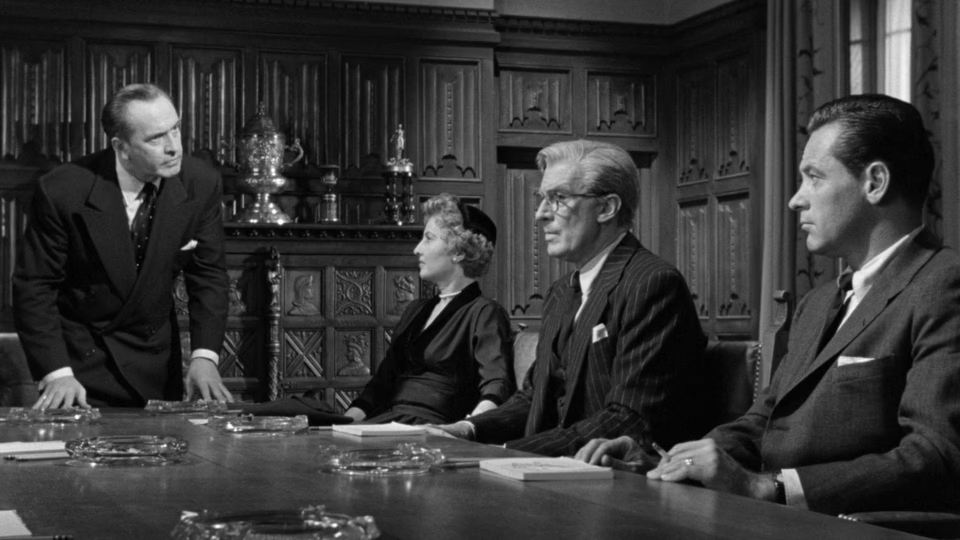
The film gets the details right. The executive floor’s dark wood paneling and ceilings high enough to echo. Every corporation in America still builds them this way. The ceilings just keep getting higher and the wood darker.
And the cast is magnificent. Once Bullard drops dead, his board of directors begins circling. Louis Calhern, who witnesses the collapse from across the street, doesn’t call an ambulance. He calls his broker. He wants to short the stock before the news breaks. Calhern plays this with such oily ease you almost admire the efficiency. Paul Douglas is the sales chief, a schmoozer allergic to conflict. Dean Jagger runs manufacturing the way he’s always run it and intends to keep doing so. Walter Pidgeon is the treasurer, competent and cautious, the eternal number two. Fredric March is the comptroller, a man who looks at a beautifully crafted piece of furniture and only sees a profit margin. He believes he’s saving the company. Every good antagonist does.
Then there is William Holden as the head of design, the idealist in a room full of pragmatists. The film positions him as the conscience of the company, which is a lot to ask of one man in a boardroom.
What the film doesn’t quite say—but nearly does—is that these men represent capitalism’s life cycle. Holden is the innovator. Jagger is the operator who consolidates after the market is won. March is the extractor, the man who hollows out the enterprise in the name of quarterly dividends. That Executive Suite even flirted with this idea in 1954 is remarkable. That it flinches from the conclusion is forgivable.
But it’s Nina Foch, as Bullard’s secretary, who gives the best performance in the picture and earned an Oscar nomination for it. She is cool, precise, and professional—a woman who processes grief by doing her job. She belongs in a Howard Hawks film. She shows what Executive Suite might have been if everyone had played it this quietly.
Not everyone does. June Allyson, as Holden’s wife, has the wrong temperature entirely. She and Holden generate no heat. You don’t believe in the marriage, which means you don’t believe in half his motivation. Shelley Winters, as Douglas’s mistress, gets a scene where she weeps with her fist in her mouth. It is exactly the kind of moment Wise should have cut. A woman savvy enough to be sleeping with a vice president knows how to keep her composure. As played, she’s a cliché.
Barbara Stanwyck fares better because she’s Barbara Stanwyck. She plays the founder’s daughter, a major stockholder who had an affair with Bullard and never forgave him for choosing the company over her. She backs March for president out of pure spite. Wise gives her a scene on a balcony—tears, a deafening clock chime, a scream—that a lesser actress would have drowned in. Stanwyck survives it by finding the bruised dignity underneath the theatrics. She shouldn’t have had to.
And then there is the climax. Holden’s big speech to the board. A passionate case for craftsmanship over cost-cutting, for making something worth making. It is a fairy tale. Wise cuts between the faces of the directors as they weigh their votes, and for once his melodramatic instincts serve the material. The tension builds honestly. The speech lands. You want to stand up and clap, which is exactly the feeling a fairy tale should produce.
I think a cooler, more restrained film lives inside Executive Suite, and I think it would be a better one. But this version—overheated, uneven, sometimes clumsy—is still worth watching. It gets the big things right about how power works in a corporation: who wants it, who deserves it, and how rarely those are the same person.