Daleks' Invasion Earth 2150 A.D.

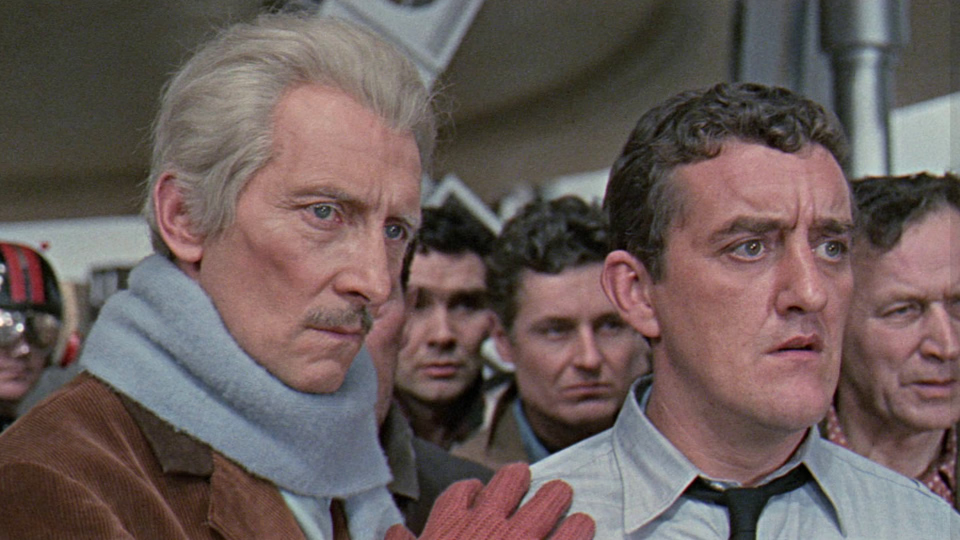
Peter Cushing returns as Doctor Who, still not a mysterious alien but a dotty grandpa who travels through time the way most men travel to the hardware store—out of mild curiosity and a lack of anything better to do.
He’s joined this time by Bernard Cribbins as a London policeman who stumbles into the TARDIS and winds up in the year 2150. The Daleks have conquered Earth. The surviving humans are either enslaved as mine workers or converted into “Robomen” enforcers, who shuffle around in motorcycle helmets with sunglasses glued on and patent leather jumpsuits that look borrowed from a fetish shop’s clearance rack.
While the first film was content to be a children’s picture, this sequel tries to grow up. Though Cushing’s granddaughter Susan is still present, Cribbins replaces her as our way into the story. Andrew Keir brings welcome grit as a resistance fighter. The tone is harder, the stakes supposedly higher. But the film pays for its ambitions with its women. Cushing’s niece Louise and Susan spend the picture being abducted, separated, and rescued. They exist so the men have somewhere to run.
The budget was, according to Cushing, almost double the first film’s.1 You cannot tell. The TARDIS interior features curtains for walls. We see the same flying saucer corridor recycled from every possible camera angle. Matte paintings of ruined London look less persuasive than the first film’s alien landscapes, because we know what cities look like. The flying saucer descending over London is held up by visible strings.2
The script has a shaky relationship with its own logic. The TARDIS doors are blocked by fallen girders, sending our heroes off in search of a crowbar—but the doors open inward. A Dalek is thrown down a ramp and explodes on impact, yet minutes later they shrug off bombs. Then one is neutralized by a tarp. The Daleks, it seems, are only as durable as the script needs them to be.
Cushing remains the biggest missed opportunity. He opens with a vaguely Scottish accent that evaporates by act two, and the script again treats him as a supporting player in his own franchise—a plot device who arrives in the third act with a clever scheme. He fell ill during production, and scenes were rearranged to shoot around his absence. You’d never know it. Cushing was incapable of giving less than his best, even when the material gave him little to work with. He deserved a script that understood what it had in him.
The film is less talky than its predecessor. I’ll give it that. If you liked that one, you’ll likely enjoy this one. If not, nothing here will change your mind. Cushing deserves a better movie. So, for that matter, do the Daleks.