Close Encounters of the Third Kind

I keep going back to Close Encounters of the Third Kind the way some people visit a difficult uncle. Every time I hope it will finally take. Every time I come away admiring the workmanship and feeling nothing much at all. That is an uncomfortable place for a critic to stand on a picture the whole world has agreed to love, so let me show my work.
For the first two acts, Spielberg tells parallel stories. Claude Lacombe, a French scientist played by François Truffaut, travels the world collecting impossibilities. A cargo ship lost in 1925 appears in the Gobi Desert. A squadron of World War II fighters, lost over the Bermuda Triangle, turns up parked in the Sonoran Desert in mint condition, as though returned from a very slow dry cleaner. Truffaut plays these scenes with a gentle amusement that suggests a man being handed one wonderful gift after another. He’s the best thing in the movie and he barely speaks English.
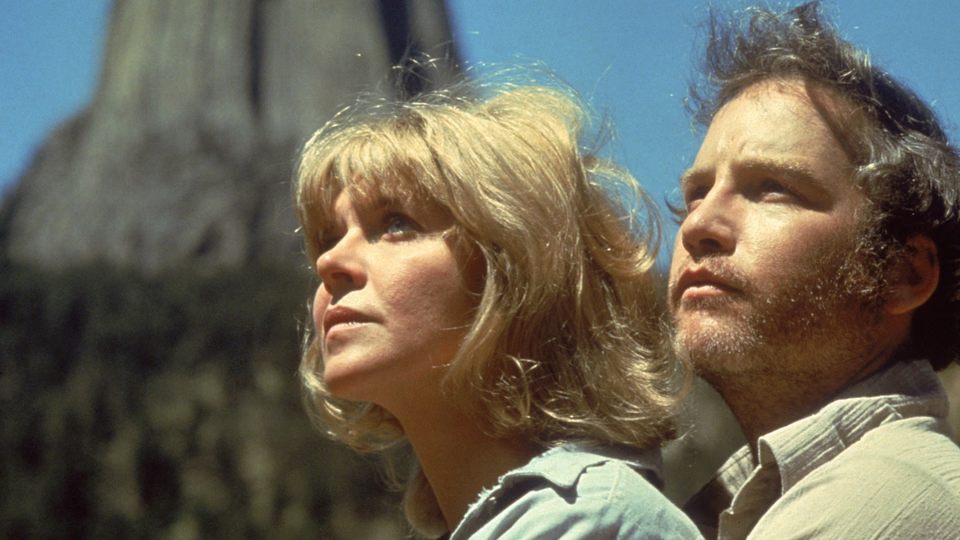
Meanwhile, in rural Indiana, a toddler named Barry wakes to find his toys performing without him. He is delighted, not scared, and he pads downstairs to a ransacked refrigerator and a back door standing open, and out he goes. His mother Jillian, played by Melinda Dillon, will spend the rest of the film chasing him. Richard Dreyfuss plays Roy, a lineman sent out into those blacked-out backroads, where he gets lost and then gets found by a sky-blotting ship. The ship leaves, and Roy gives chase, nearly running down Barry in the process. But he’s only mildly concerned for the child. His eyes are on the sky.
Afterward Roy cannot stop seeing a shape. He sculpts it in his mashed potatoes at dinner. He builds it out of shaving cream. Eventually he shovels half the yard through the living room window to get it right, which is when his wife takes the children and goes.
Here is my trouble. Take away the saucers and you’re left with Roy, and Roy cannot carry a movie. He’s off-putting before anything supernatural happens to him. We meet him forcing his kids to see Pinocchio because he loved it, deaf to what they want and to what his wife thinks. The flying saucers do not change him. They amplify a trait already there.
There’s a darker movie hiding in here. Swap the UFO for cocaine and everything clicks: the euphoria of the first hit, the job gone, the family gone, the increasingly frantic chase after a high that keeps receding. The special edition adds a scene of Roy sitting fully dressed in a running shower, sobbing, begging his wife to hold him while his children cry in the doorway. I’m fairly sure Spielberg wants my heart to break for Roy. I see a grown man behaving like the youngest person in the house. My sympathies went to Teri Garr and the kids.
The addiction reading collapses at the ending, which rewards Roy with a starship. So try another: Roy as Spielberg. Paul Schrader and several others took passes at this script, but the screenplay credit belongs to Spielberg alone. Read Roy’s compulsion as an artist’s compulsion and the sculpture in the living room becomes noble, the abandoned family becomes the price, and the finale becomes literal ascension. It hangs together. It also tells you something about the man who wrote it.
What sinks the picture for me is that Spielberg believes, and requires me to believe with him. Wonder is asked to do the work that plot logic should be doing. A secret government installation the size of a small airport sits at Devils Tower, invisible to every satellite overhead. The ships bank and dart and hover like hummingbirds the size of shopping malls, obeying no law Newton wrote down, least of all the third one. Roy and Jillian come away sunburned, which is to say irradiated, which is to say we should probably check in on them in ten years. Nobody checks. This is science fiction that has misplaced the science.
And a scene meant to shame the skeptics has curdled completely. An official challenges a roomful of witnesses: with all those millions of cameras out there, where is the photograph? A newsman answers that the press never catches the plane crash or the car wreck as it happens. In 1977 that landed. Today every one of us carries a camera, every third car has a dash cam, and we have watched a meteor streak over Chelyabinsk from a dozen angles. The saucers remain camera-shy.
The craft is real. Dreyfuss convinces even while I dislike his character. Vilmos Zsigmond shoots the Indiana night so that headlights become a threat. Douglas Trumbull’s effects have aged with dignity, though those ships never once feel like objects with weight. Lacombe’s globe-trotting, the hundreds of chanting extras in India, the wind and the sand, all foreshadow Raiders of the Lost Ark. The night scene where the lights come for Barry, with Jillian bracing the doggie door while the house shudders, is Poltergeist five years early.
In the end it comes down to appetite. If you have spent your life wanting the ship to land and the door to open and the invitation to be extended to you personally, this movie is a sacrament, and I would not dream of arguing you out of it. I’ve always been a shrug on the subject of aliens. When Roy walked up that ramp, my first thought was that he hadn’t asked about the return trip.