Basket Case 3

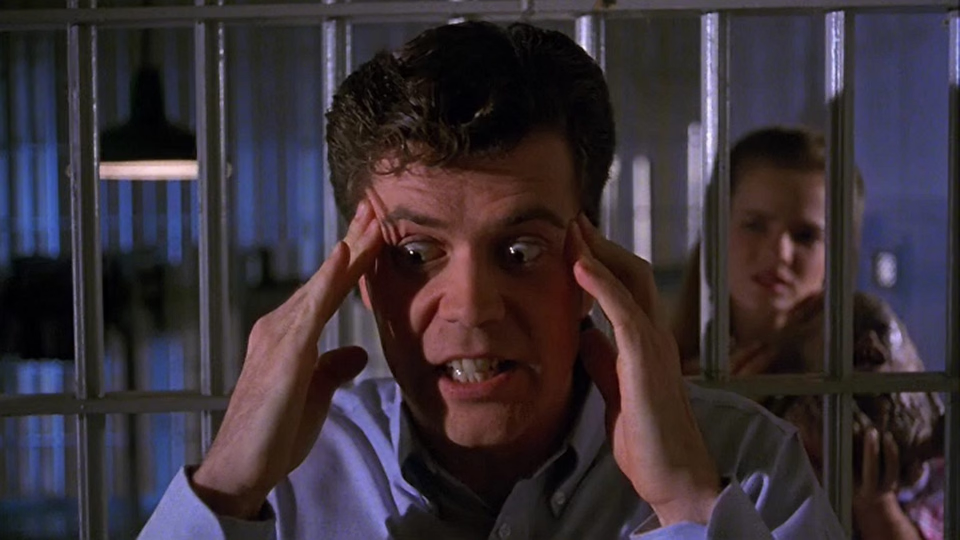
Frank Henenlotter begins his third Basket Case picture with five minutes of his second one, including the finale in which Duane Bradley takes a needle and sews his monstrous twin brother Belial back on. Then the new story starts, and they are separated again. Sequels have walked back cliffhangers before, but rarely do they screen them first.
Duane is now a captive in Granny Ruth’s boarding house for what she calls unique individuals, chained up and talking to himself. Belial is not speaking to him. Belial’s beloved Eve, the she-creature he met in the last picture, is expecting, and close enough to term that Granny Ruth packs the whole household onto a school bus and drives to Georgia, where her friend Uncle Hal keeps a unique individual of his own, Little Hal, in the back room. Eve produces twelve babies. Two deputies with an eye for a quick dollar steal them. Belial, who has spent two movies establishing his position on such matters, responds.
If you’ve seen the prior entry, this will feel like more of the same. The plot still meanders, as the last one did, and it picks up when the blood starts, and there is another homage to the Alien pictures, this time the cargo loader from Aliens, which, if you’re feeling generous, could be considered a callback.
Still, the movie is unexpectedly funny. The producers balked at the gore Henenlotter wanted for the birth scene, pages went out, and Jim O’Doherty filled the gap with improvised play-by-play, sweating and narrating like a man calling a horse race he has money on, finally requesting an “ovarian ovation” for the mother. I laughed out loud.
Later the sheriff, played by Gil Roper, dispatches his deputies in a torrent of B’s. Bailey books the Bradley boy. Baxter takes the bassinet of baby Belials in back and fetches Brody. Where are Brannon and Banner? “Bowling.” Henenlotter reportedly couldn’t stop laughing at Roper’s delivery and had to walk off his own set. I believe it.
Not everything lands. Annie Ross, who spent the 1950s as one third of Lambert, Hendricks & Ross, is given a musical number on the bus and performs it lip-syncing to her own recording of “Personality.” The idea of a busload of sideshow attractions singing backup is charming. The execution is a woman mouthing words on a bus.
Duane, the lead of two films, is here a device. He is released whenever the story requires a door opened. But there is one sequence that justifies him. He escorts Belial into a deputy’s home, and while wet work proceeds in the next room, Duane fixes himself a bowl of cornflakes and enjoys it thoroughly. Kevin Van Hentenryck plays it with a serenity that is almost sweet.
Elsewhere the movie grabs at whatever is within reach. Jolt Cola appears often enough that I assume a check changed hands. Tina Louise Hilbert turns up as the sheriff’s daughter, who is fond of whips and disinclined to stay dressed, in a scene with no relationship to anything around it. Odd as these detours are, they wake the thing up.
The result isn’t a bad film so much as a tired one. Anyone who liked the second will like this one, but anyone who hasn’t seen Brain Damage or Frankenhooker should watch those first. There you have Henenlotter’s full attention.