Brain Damage

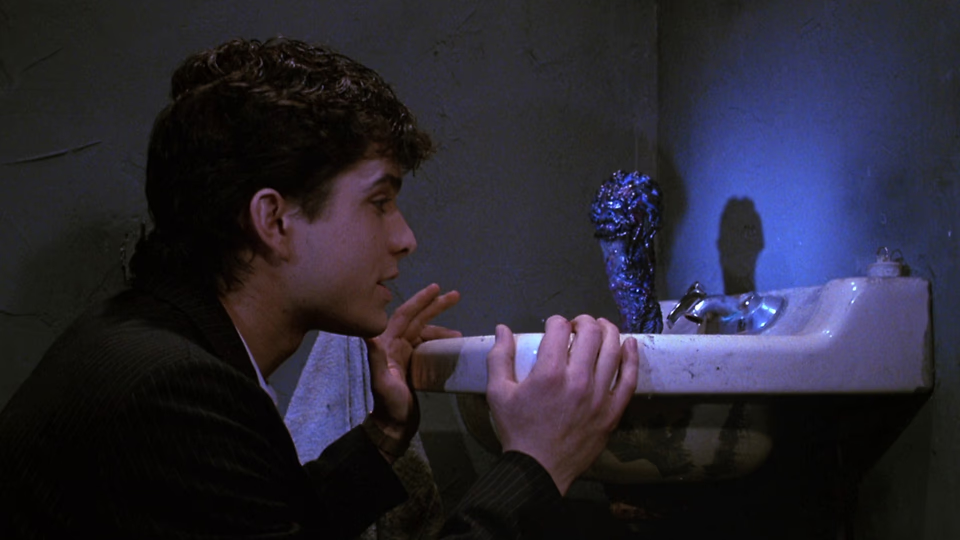
Frank Henenlotter’s Brain Damage is a movie about a penis-shaped talking parasite who gets a nice young man hooked on brain juice. I know how that sounds, but Henenlotter knows what he’s doing.
The young man is Brian, played by Rick Hearst, who shares a New York apartment with his brother and seems to lead a perfectly ordinary life until a creature named Elmer turns up one evening and injects him with a euphoric blue fluid straight into his brainstem. The high is extraordinary. The price is dinner. Elmer eats brains. Human ones. He prefers them fresh.
We are barely ten minutes in before this arrangement is established. Henenlotter understands the first rule of exploitation pictures: don’t waste our time.
What’s remarkable is how good the picture looks. Henenlotter shot in 35mm and uses the city not as backdrop but as collaborator. He bathes whole scenes in a cold blue light that makes Brian look increasingly like a man visiting his own life from the outside. The New York here is the one you find at 3 a.m. when nobody decent is awake, and it has the texture of a place that has given up trying to be saved.
The hallucination sequences are genuinely inventive. In one, a junkyard erupts in color like a neon reef. In another, Brian lies on his bed while a strange blue liquid fills his room inch by inch, swallowing the furniture, rising past his chin, and he doesn’t move, doesn’t care. It is beautiful and horrible. As a portrait of what drugs promise, it understands something important: the terror isn’t the high. The terror is how much you want it back.
Elmer himself is a triumph of creativity. His animatronic body is convincing enough, but his real party trick is a jaw that unhinges to reveal a nest of teeth and tentacles. You want to look away but can’t.
The gore is abundant. In one scene, Brian tugs at something in his ear. Out comes a piece of bloody flesh. Then more. Then more. It keeps coming, growing thicker, until his ear detaches and blood sprays from his skull like a busted hydrant. In another, more notorious sequence involving Brian, Elmer, and a woman at a bar, Henenlotter drives past offensive and out the other side into the absurd. It is not pleasant. It is also not what it first appears. Look past the shock and you’ll find first-rate satire.
The performers surprise. All are newcomers and none of them are polished, but there is a wonderful scene where one of Brian’s neighbors delivers Elmer’s history—a chain-of-custody speech lifted straight out of The Maltese Falcon, deployed here with perfect deadpan absurdity. And Hearst carries the film with a fearlessness that earns real sympathy. You believe his terror. You believe his need.
But the movie’s secret weapon is Elmer’s voice. Henenlotter cast John Zacherle, a veteran creature-feature TV host, and the choice is inspired. Zacherle doesn’t growl or hiss. He purrs. He sounds like a pastor who’s been skimming the collection plate for thirty years and has made his peace with God about it. The contrast between this warm, avuncular baritone and the glistening little horror it comes out of is the funniest thing in the picture, and also the scariest. You laugh every time Elmer opens his mouth, even when he’s about to eat somebody.
Brain Damage is built on contradictions. A harrowing addiction story where the drug is a phallus parasite. A low-budget picture with effects that shame films costing ten times as much. A movie that is funny and disgusting and, in its strange way, sad. Henenlotter understands something essential about addiction: the thing destroying you is also the thing you love most, and it has a wonderful speaking voice.