Barbary Coast

San Francisco, 1849. The fog rolls in off the bay, the mud never dries, and somewhere a violin is weeping. It weeps a lot in Barbary Coast. More than you’d like.
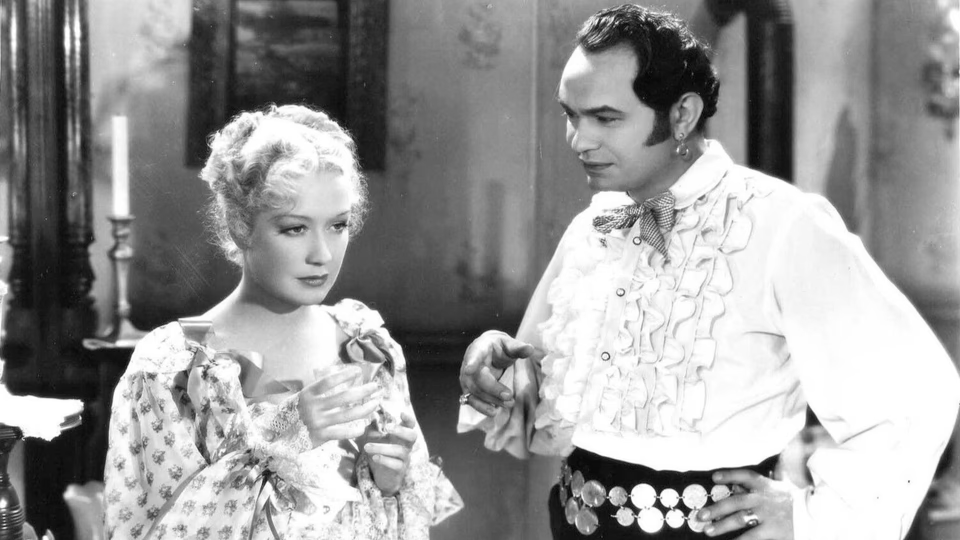
Miriam Hopkins plays Mary Rutledge, who arrives in frontier San Francisco flat broke, expecting to marry a gold miner. The miner is dead. His claim now belongs to Luis Chamalis, played by Edward G. Robinson, the casino boss who runs the town like a despot. Mary was only marrying the miner for his money, and her tears aren’t for him but for her rotten luck. Soon she’s working Luis’s rigged roulette wheel. He calls her “Swan.” She doesn’t object. Then a poet-turned-miner named Jim Carmichael, played by Joel McCrea, wanders in, they fall in love during a rainstorm, and Luis objects violently. A vigilante committee provides the third act.
Howard Hawks directed this picture, but you’d scarcely know it.
The story behind the camera is better than anything on screen. Producer Samuel Goldwyn was determined to wring a picture out of Herbert Asbury’s history of the San Francisco underworld. Before Hawks ever signed on, Goldwyn burned through eleven writers and over eighty thousand dollars on outlines, treatments, and scripts that went nowhere. William Wellman was hired to direct, collected thirty-nine thousand, and never shot a frame. When Hawks finally came aboard, the stars were already locked in—Hopkins and McCrea were under fresh contracts—and the source material was a fait accompli. Goldwyn offered Hawks sixty thousand dollars, double his last salary.1 That should have been the warning.
Hawks brought in Ben Hecht and Charles MacArthur, his reliable collaborators, but the material defeated even them. When Hawks was lunching with the writers’ agent, who bragged about selling the same story for the third time, Hawks asked if the story was about a man named Chamalis. Why yes, it was. “Every once in awhile they’d get into a story like this—a prostitute and a poet—and then they’d go kind of bad,” Hawks later said. But Goldwyn loved it. Hawks didn’t, and he was stuck.2
It shows. Consider Robinson, that quintessentially New York actor, playing a Frenchman in a frilly shirt, a belt made of shiny circles, and a single dangling earring. He looks like a pirate rock star with a receding hairline. You can tell Hawks had checked out when he approved that costume. Ironically, Robinson is actually the closest thing in the picture to a Hawks character, but only in his final scene, where his personality pivots so completely it feels beamed in from another movie.
McCrea fares worse. He spends a few hours with Hopkins during a rainstorm, and that same evening gives away two years’ worth of gold dust because he’s miffed she lied about her name. Hawks was a director who celebrated quiet competence, but there’s nothing noble or romantic about the gesture. McCrea’s just a fool. Compound that with his affectation of answering every question with a line of verse and he’s a pretentious fool. The following year, The Petrified Forest would handle the bookish-romantic type with far more conviction. Here, McCrea feels crammed into the plot because the contract demanded it and the resolution needed a warm body.
Hopkins doesn’t help. Her Mary never wins us over, never seems to have a plan, never exercises real will. What was her angle in partnering with Luis? The film doesn’t say. Instead it supplies an ever-present weepy violin that creeps higher in the mix every time Hopkins sobs in her room. The violin is the most committed performer in the picture.
Two things rescue the film from total forgettability. The supporting cast is one. Walter Brennan—who always sparkled under Hawks—plays an amoral rascal called “Old Atrocity” with the kind of relish that makes you wish the movie were about him. Brian Donlevy turns up as Luis’s enforcer, Knuckles Jacoby, looking like he wandered in from a better gangster picture. Harry Carey lends quiet gravity as a town leader. These are small pleasures, but real ones.
The atmosphere is the other. The mud is everywhere, thick and permanent. The fog rolls through every exterior like a second cast member. You can practically feel the damp. San Francisco here is a cold, filthy settlement where law is a rumor and order hasn’t arrived yet. Hawks may not have had a story worth telling, but he had a sense of place.
Barbary Coast is the kind of picture that exists because a producer bought a property and was determined to use it. But conviction is no substitute for story, and Goldwyn’s hands-on approach—picking the cast, approving the story—handcuffed the talent behind the camera. The resulting picture is a mishmash of ideas with the leads all in different movies. Robinson is in a pirate-gangster mash-up, Hopkins, a melodrama, and McCrea, a screwball romance. A more engaged Hawks would have aligned things to a single vision—his vision—but this wasn’t his picture, it was Goldwyn’s and it shows.