Winter Light

Ingmar Bergman doesn’t believe in comfort. He believes in truth.
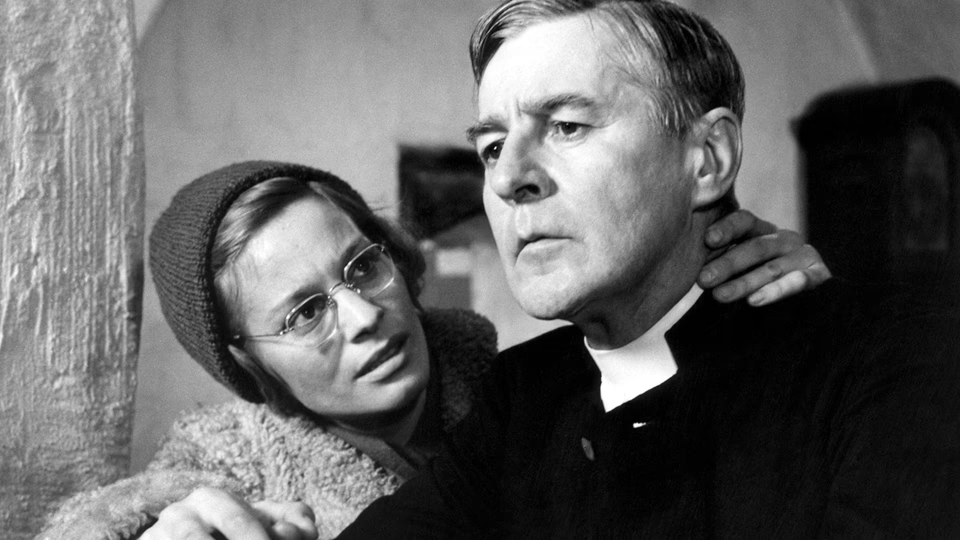
Winter Light opens on a nearly empty church in rural Sweden. The stone walls look damp. The trees outside are skeletal. Pastor Tomas Ericsson conducts communion for a handful of souls, and you can see it in his face: he’s lost God. Or God has lost him. Either way, the result is the same.
This is Bergman at his most severe. No warmth. No hope. Just the cold, wet certainty that faith built on ego will crumble.
Tomas is sick with flu, but that’s just his body catching up with his soul. He once believed—young, idealistic, full of fire. Then came the Spanish Civil War. Then came his wife’s death. Now there’s nothing left but the motions, the rituals, the empty words.
Enter Märta, the schoolteacher who loves him. Ingrid Thulin plays her, and Bergman gives her a six-minute close-up that will shred you. She stares directly into the camera—directly at us—while we hear her letter to Tomas. She confesses her love. She condemns his cruelty. She tells him about her rash, how it repelled him, how he couldn’t stand to look at her suffering while drowning in his own.
Six minutes. One take. Her face filling the frame. It’s devastating.
Meanwhile, a fisherman comes to Tomas seeking counsel. He’s terrified of nuclear war, of the Chinese getting the bomb. Tomas offers nothing—some platitudes, then his own doubts. It ends badly. It has to.
Bergman shoots most of this film in static frames. The camera refuses to move, refuses to let us escape. When we do venture outside, it’s into howling wind and driving sleet. Nature offers no solace here.
This is not a feel-good picture. But it’s not entirely hopeless either. The film’s original title translates as “The Communicants.” Bergman is asking: How do we communicate with God? With each other? With ourselves? His answer is brutal. We don’t. We’re too busy nursing our own wounds.
The characters have everything they need to escape their private hells. They just can’t see it. They’re too consumed by ego, too focused on their own suffering to notice the suffering of others.
The film ends where it began: another communion, another nearly empty church. We’ve come full circle. Nothing has changed. Hell, Bergman suggests, isn’t fire and brimstone. It’s being trapped in your own head.
In our age of echo chambers masquerading as communities, Winter Light feels more urgent than ever. Bergman shows us people who could save each other if they’d only look beyond themselves. They never do.
The film is quietly brutal. It refuses comfort. It offers no easy answers. But it insists we ask the questions.
That’s enough.