Walk Don't Run

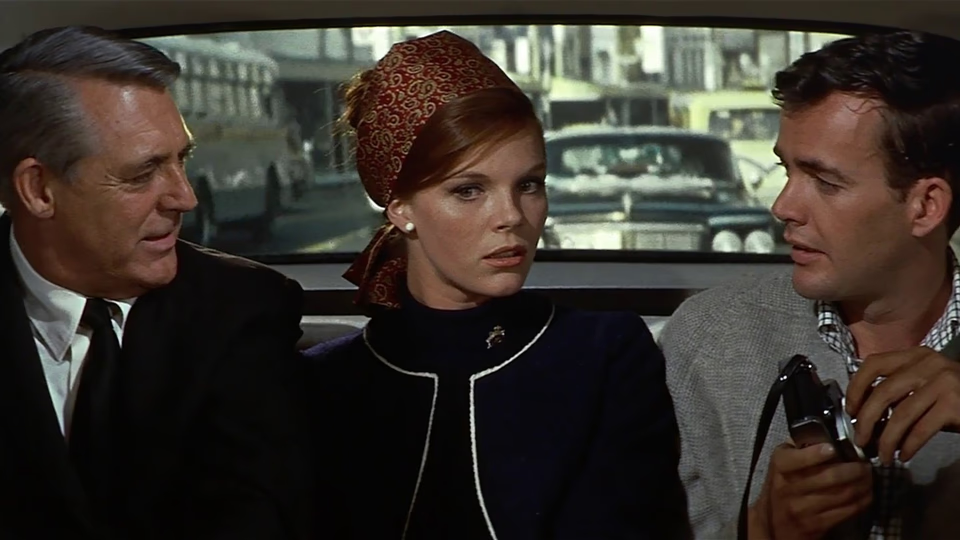
Cary Grant’s swan song deserves better than this labored Olympic comedy. He plays a businessman stranded in Tokyo during the 1964 Games, crashing with Samantha Eggar’s uptight embassy worker, then playing matchmaker when American athlete Jim Hutton joins the overcrowded apartment.
The problem? Without Grant, this would be utterly forgettable. With him, it’s merely disappointing.
The film aims for farce. We get Grant with shaving cream on half his face trying to squeeze into Eggar’s bathroom schedule. Pants flying out windows. Grant trying to make coffee. These gags telegraph their punchlines from a mile away. When you see the setup coming, the surprise dies.
The few moments that work feel like Grant ad-libbing his way out of the wreckage. After hunting for his pants forever, Hutton hands them over and Grant, jaw agape, asks, “How’d you do that?” Later, in a nice callback to To Catch a Thief, Grant climbs through Eggar’s window and notes, “You know, a burglar can get in like that.”
Grant’s still got it, but he can’t save the leads.
Hutton and Eggar have zero chemistry. Worse, they’re charmless. Hutton comes off as a smug ugly American. When we meet him he’s snapping photos of buildings despite having nowhere to sleep that night. Grant keeps saying Hutton reminds him of his younger self. Maybe if Jimmy Stewart were playing Grant’s role we could buy it. Here? Bridge too far.
Eggar fares no better. She’s all persnickety scheduling with nothing underneath. What would these two see in each other? Why would Grant see a match? The film never answers. Her fiancé is a mousey type, half Hutton’s size, killing any underdog sympathy.
Better casting: swap Hutton into the fiancé role and get someone smaller and more charismatic for the lead. Think a younger Jack Lemmon. Maybe David Hemmings? While you’re at it, stick Billy Wilder in the director’s chair and let him and I.A. Diamond rewrite the thing. But now we’re dreaming of a different movie.
Back to this misfire. The title, it turns out, refers to Hutton’s sport—race-walking—a reveal the film treats as a punchline. It isn’t. The third act leans heavily on Hutton being nearly comatose after his race. He’s walked 30 miles (the film reminds us constantly). But wait. A marathon is 26 miles with world records then around two hours fifteen. Hutton’s an Olympic athlete. He couldn’t do 30 miles in under five hours without passing out?
And speaking of pace, at almost two hours, the film runs thirty minutes too long. Gags get recycled endlessly. Grant locked out, and locked out again, and locked out again. Eggar’s friend shocked to find more people in the apartment. Standing toasts at a sushi restaurant. Kids cranking up the TV volume. Pure padding. Grant vanishes for a chunk at the halfway mark and the film flatlines.
That’s the ache at the center of Walk Don’t Run. Grant never disappoints. He’s still game at 62. Climbing sets, padding around in his undershorts, deadpanning lines with perfect timing. His performance shows us exactly what cinema lost when he retired, and proves—in his case—that it really was the pictures that got small.