Time Bandits

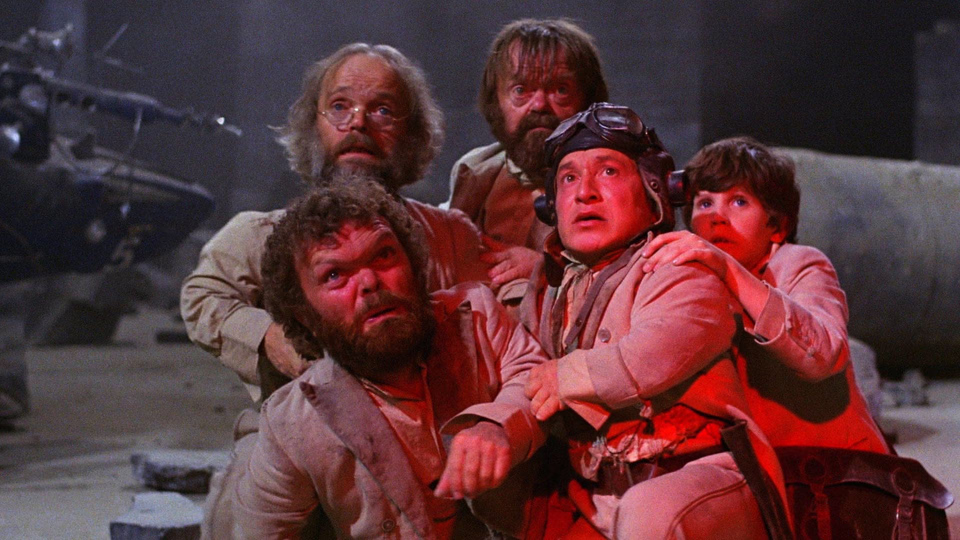
Kevin is about eleven and lives in a house where the furniture wears plastic. Downstairs his parents sit in the blue light of a game show, worrying over a kitchen appliance the neighbors have bought. Upstairs, Kevin is reading about Agamemnon. One night a knight in full armor rides out of his wardrobe, tramples the carpet, and disappears into a forest where the bedroom wall used to be. The boy does not scream for his mother. The next evening he goes to bed early, and he takes a camera.
That detail tells you what kind of picture Terry Gilliam has made. There is a child at the center of Time Bandits, and the film has almost no interest in comforting him. This is not the Amblin model, where the bicycles and the suburbs and the divorced mother arrive pre-sanded for our affection. Gilliam’s suburbs are a place to escape, and the escape costs something.
What comes out of the wardrobe next is six dwarves carrying a map they have stolen from their employer, the Supreme Being. The map shows the holes in creation. Their plan is to rob history and vanish into another century before anyone can take a statement. Pursuing them is an enormous floating head. Waiting for them in the Fortress of Ultimate Darkness, is Evil.
Gilliam brought in Michael Palin to write it with him, and the division of labor shows in the best way. Gilliam supplies the cosmology and the catastrophes; Palin supplies people who talk. When Kevin asks whether the Supreme Being is God, one of the bandits explains that they don’t know Him that well. They only work for Him.
The structure is episodic and the episodes are wonderful. Ian Holm plays Napoleon as a man who invaded Italy because he heard they were all small, and who sits rapt before a Punch and Judy show, because little things hitting each other is his idea of the sublime. John Cleese turns up as Robin Hood, distributing stolen treasure to a queue of villagers while one of his men punches each recipient in the face. “Is that absolutely necessary?” Cleese asks, in the voice of minor royalty touring a hospital ward. Told that it is, he says, “Ah. Fine,” and moves down the line.
Then Sean Connery appears as a Greek king, and the movie stops kidding for a while. Kevin is taken in, fed, looked at. Connery gives the boy the attention his parents have been spending on the television, and the film lets us do the arithmetic ourselves.
The last act goes into pure fantasy, the Time of Legends, where the bandits’ black tuxedos turn white and a giant rises out of the sea wearing a ship as a hat. I saw that image at the right age and it has been in my head for forty years. Here they find Evil himself, played by David Warner with long fingernails and a helmet that appears to be sweating. Warner is superb because he plays Evil as a disappointed administrator. “Benson, I shall have to turn you into a dog for a while,” he sighs. He also loves technology, and complains that if he had made the world he wouldn’t have bothered with butterflies and daffodils. He would have started with lasers. Eight o’clock, Day One.
My complaint is that six bandits plus Kevin is too many. David Rappaport’s Randall registers. The others have hats. By the climax, I was watching a bandit dangle over a chasm and thinking, “Which one is that?” Disney kept his dwarfs one-dimensional on purpose. You could tell them apart. This film rounds them out just enough to make them interchangeable.
The ending owes something to The Wizard of Oz, down to the Supreme Being turning out to be Ralph Richardson in a business suit, who, asked why there must be evil at all, murmurs that it has something to do with free will and changes the subject like a headmaster caught without his notes. But Dorothy got to wake up. Kevin gets something colder, delivered as a punchline, and I suspect it gave a generation of children nightmares they were careful never to mention on the playground.