Outland

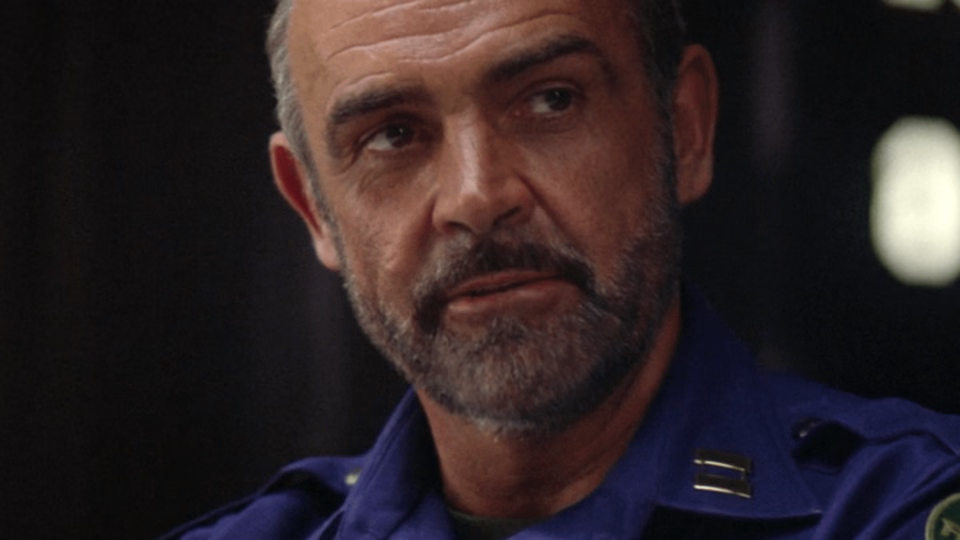
Outland is a western. It knows it’s a western. There are even saloon doors on the police station. All that’s missing is a player piano and a tumbleweed rolling through the airlock.
Sean Connery plays a Federal Marshal named O’Niel—an Irish name delivered in that unmistakable Scottish burr—who arrives at a mining colony on Io for a year-long posting. Miners have been dying. The company calls it suicide. Connery calls it suspicious. Peter Boyle, as the general manager, calls it none of Connery’s business.
The setting owes nothing to Star Wars and everything to Alien. The corridors are grimy. The technology is analog—wired phones, green-on-black monitors, switches that click. Nobody’s quarters look comfortable enough to sleep in. You could convince me this is an earlier chapter in the Weyland-Yutani universe, back when the corporation was still calling itself Con-Amalgamated and hadn’t yet graduated to weaponizing xenomorphs. The production design has aged better than the script deserves, because analog futures don’t date. They just become alternate worlds.
The cast is terrific. Connery at this age was past Bond but not yet the silver eminence of his later career, and the role of a space-western lawman fits him like a worn holster. Frances Sternhagen, as the colony’s doctor, is his only ally and steals every scene she’s in. Their chemistry is the best thing in the picture. She’s the cantankerous frontier doc who’s seen too much and stayed too long, and Sternhagen plays her with such bone-dry timing that you wish the movie were about her instead. James Sikking, who’d look equally at home on a horse, also registers as Connery’s deputy. And Boyle is quietly chilling as the villain. He never raises his voice. He never pounds a desk. He simply explains, in measured tones, why things are the way they are. He tells O’Niel, “You’re dead,” the way he’d tell someone they’d been transferred.
So the parts are here. Why doesn’t the whole work?
The trouble is Peter Hyams, who wrote and directed. He has two movies he wants to make and can’t quite finish either one. The first half is a mystery: Connery investigates the deaths and uncovers the conspiracy. The second half is a countdown: Boyle sends for two professional killers on the next shuttle, seventy hours out, and makes sure everyone on the station knows it. The split might have worked if Hyams had committed. He didn’t. The mystery is solved too easily, and the countdown never generates the dread it needs.
There are also logic problems that nag. Connery intercepts a video transmission in which Boyle openly admits to the conspiracy and orders the hit. In any rational universe, you’d transmit that recording to every law enforcement agency within radio range. The film never considers this, because if Connery did the obvious thing, there’d be no third act. A plot that depends on its hero ignoring the simplest solution is a plot in trouble.
Time behaves strangely, too. Early scenes suggest Connery has just arrived; dialogue tells us he’s been there two weeks. A member of his staff is murdered, and the next scene carries on as though it didn’t happen. And the finale asks us to care about the geography of the station—which corridor, which sector, which airlock—without ever giving us a map. When Connery tells Sternhagen to lure the killers into “C-5,” we nod as if that means something. It doesn’t.
There’s a deeper missed opportunity in the character himself. O’Niel is written as a man chasing redemption after a demotion, a lawman who takes on Boyle not because it’s right, but to prove he still can. That’s a darker, more interesting arc than the one Connery plays. Connery gives you competence and grit, which is fine. But the role wanted doubt and self-destruction, and either Connery wouldn’t go there or Hyams couldn’t take him. It’s the difference between a good performance and the right one.
Hyams has said he wanted to make a western. He should have. It would have cost a fraction as much and probably worked twice as well. Instead, Outland is a handsome, well-acted film trapped inside a script that keeps reaching for greatness and settling for adequacy. The frontier is fascinating. The story that happens on it is not.