The Texas Chain Saw Massacre

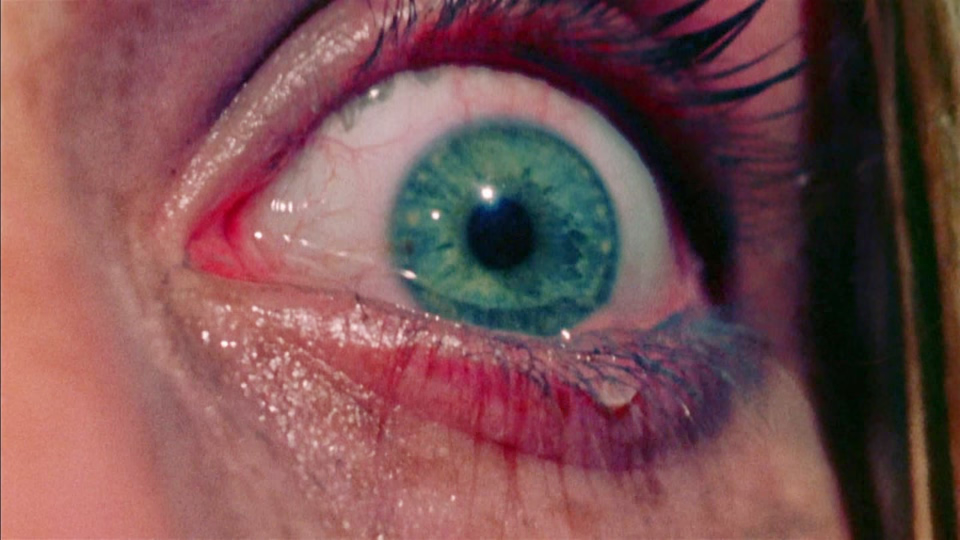
Ask me for my favorite horror movie and the answer changes with the weather. Ask me which one is the best made and I don’t hesitate. Tobe Hooper’s The Texas Chain Saw Massacre arrived in 1974 looking like a film you shouldn’t be watching. Anyone who wants to make a horror picture could skip film school and just watch it four times.
The story is barely a story. Five young people drive across rural Texas in a van: two couples and Sally’s wheelchair-bound brother Franklin. They pick up a hitchhiker who cuts his own hand with a razor to pass the time. They stop for gas at a station that has none. They poke around Sally and Franklin’s abandoned family house, all dust and spiders and rotted floorboards. Kirk and Pam wander off toward the sound of a generator, hoping to buy gasoline from whoever owns it. Kirk knocks. Nobody answers. The door is unlocked.
What follows is the best entrance a killer has made in an American movie. The camera stays back in the hall while Kirk calls hello into the dark. He steps through a doorway. A huge man appears from nowhere, hits him with a mallet, and Kirk goes down with his legs still kicking. The man shrieks like a hog, drags the body inside, and slams a sliding metal door shut. Twenty seconds. Almost no blood. And the rules of the movie are now established: death arrives brutally, without a drumroll and without reason.
Hooper made this for pocket change, and the poverty is his best collaborator. There are no sets to speak of. He shot in real houses in the Texas summer, and everyone on screen is genuinely, miserably hot. Sweat rings, flies, the heat shimmer over the road. That filling station floor has more atmosphere than a million dollars’ worth of studio production design.
Despite the title, exactly one character dies by chain saw, and we watch that from behind. Hooper wanted a PG and cut his gore accordingly. What he understood, and what his imitators never did, is that a saw roaring on the soundtrack does the work that latex cannot. In one scene, Hooper dresses a girl in a backless halter and shoots her walking away from us, so her bare tanned back is sitting in our heads moments later when she’s lifted onto a meat hook. We never see it go in. We remember it going in anyway. This is also why half the reviews call these people cannibals. They run a barbecue stand and they set a table. The movie never shows anyone eating anybody. We fill in the recipe ourselves.
The casting is inspired down to the corners. Edwin Neal’s hitchhiker gives off the specific unwholesome energy of a man who has done terrible things to animals and is working his way toward people. Paul Partain plays Franklin as a whining, sweaty, demanding pill, which is braver than it sounds, since the audience’s irritation with him becomes part of the general unbearable pressure. And Gunnar Hansen’s Leatherface fills a doorway like weather moving in, yet crosses a room faster than seems fair. He swings the saw one-handed the way a conductor waves a baton. Watch him after a kill, though, fussing and pacing and looking out the window. He isn’t a mastermind. He’s a three-year-old with the strength of an ox and no one to say no.
Hooper opens with a radio bulletin about oil fires, cholera, a man jumping out a tenth-story window because the ballgame was blacked out. The world is already coming apart before the van leaves town. The house is just where the disorder concentrates.
Marilyn Burns, as Sally, keeps our sympathy because she keeps moving. She makes the wrong choice, running upstairs instead of out the back, and when the saw comes up after her she goes through a window. Hooper never parks her under a bed while the killer creeps around. We aren’t waiting to see whether he finds her. We’re pulling for her to get out.
Wayne Bell’s soundtrack is the other lead performance: the opening drone, the hammering generator, the pig noises Leatherface uses for speech. None of it tells us how to feel. It just joins the din.
And it’s funny, in its way. The man of the house comes home, surveys the front door sawed to splinters, and hollers, “Look what your brother did to the door!” It’s a hilarious line that nobody laughs at the first time, because the joke reveals the depths of the family’s insanity.
Fifty-plus years of cheap horror debuts have followed, and none has beaten it.1 It may not be as gory as the title and reputation would have you believe, but it’s every bit as intense. See it enough times and you’ll start laughing. What that says, I leave to the viewer.
Footnotes
-
Clive Barker’s Hellraiser comes nearest, and it had money for gore, some of which it should have kept in the bank. ↩︎