The Tenant

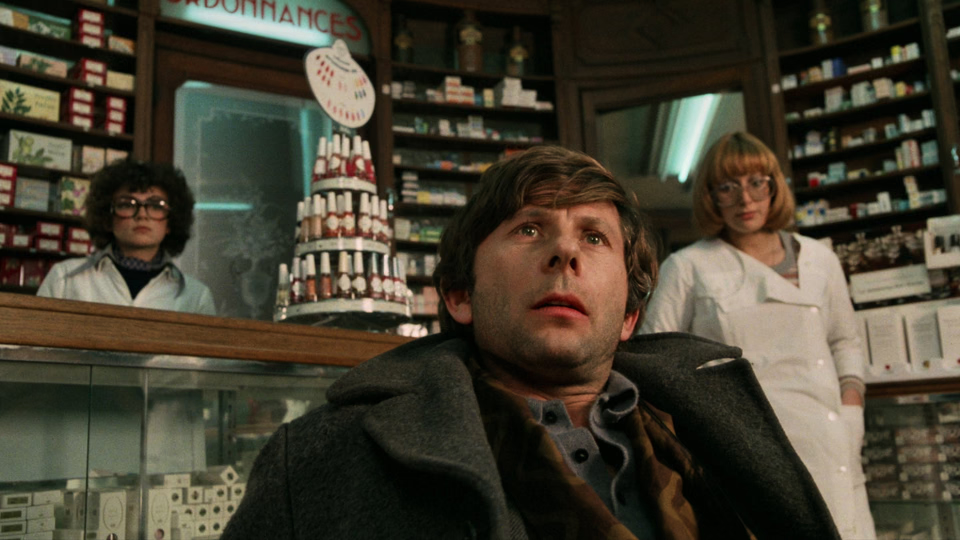
Roman Polanski has made a career of trapping people inside rooms and watching them come apart. In Repulsion, it was Catherine Deneuve alone with her hallucinations. In Rosemary’s Baby, it was Mia Farrow alone with her neighbors. In The Tenant, it is Polanski himself, alone with both, and the results are uneven.
He plays Trelkovsky, a mousy Polish-born clerk who rents a Paris apartment whose previous occupant threw herself from the window. This is not a spoiler. The concierge, played by Shelley Winters, can’t wait to show him exactly how and where. Soon Trelkovsky begins to suspect his neighbors are conspiring to turn him into the dead woman. Or perhaps he is turning into her on his own. Or perhaps there is no difference.
The opening shot announces the film’s ambitions. The camera pans across the courtyard windows in a slow survey borrowed from Rear Window, except here the voyeurism has a different purpose. Figures appear and vanish. We are being shown a building that devours its tenants. Then we step inside, and the visual tricks begin. The floor seems to shift elevation where no step exists. The stairways loop like an Escher drawing. In one bravura sequence, the room itself elongates through forced perspective and oversized props, as if the walls are stretching to swallow Trelkovsky whole. As pure craft, the film is stunning.
Polanski also finds a Paris that postcards forget. Dilapidated side streets and cramped neighborhood shops form a sealed little universe, the kind of block where everyone knows your business and resents you for having any. Trelkovsky is an outsider here. When his apartment is burgled and he goes to the police, they don’t investigate. They ask for his papers. He is a French citizen born in Poland, which means he is Polish. Like Roland Topor, who wrote the source novel, Polanski is of Polish-Jewish origin, and knows this scene from the inside.
The film raises questions about identity that are genuinely unsettling. In one scene, a drunken Trelkovsky works through a thought experiment about amputation. If you cut off my arm, I say “me and my arm.” Cut off my head, and who gets to say “me”? It’s the kind of dorm-room philosophy that sounds profound at 2 a.m., except here it lands, because the film is busy demonstrating the answer.
And there is a fine streak of black comedy running through the picture. During the climax, a policeman surveys the scene and mutters, “You must be getting them wholesale.” But my favorite moment is smaller and pitched so deadpan you wonder if Polanski is joking. He sits in a park, watches a toddler scream, waits for the parents to look away, then walks over and slaps the child and storms away. I admit, I laughed, but I’m not sure I was supposed to. There’s also a sly dig at Americans: Winters is the petty concierge, Melvyn Douglas the imperious landlord, and Bernard Fresson plays a coworker dubbed with an American accent and the manners to match.
So why does The Tenant feel like an endurance test? The pacing. For roughly an hour, Trelkovsky’s decline is calibrated with precision. Then something snaps, and it snaps too fast. The gradual unraveling becomes full-blown mania in a matter of minutes, as if the film’s reels were out of sequence. Imagine Deneuve seeing corpses in the hallway fifteen minutes into Repulsion. You would not buy it. The same problem exists here. The final hour tries to provoke when it should still be earning.
Stanley Kubrick faced a version of this problem with The Shining four years later. He solved it by having Nicholson arrive already a little unhinged, which shortened the distance between sanity and madness. Many critics faulted that choice. Having now seen the alternative, I think Kubrick was right.
There is also the question of ambiguity, or the lack of it. Trelkovsky finds a tooth embedded in his wall. He sees hieroglyphics in the bathroom. In one genuinely chilling scene, he looks across the courtyard and sees himself staring back. These moments suggest a world tilting toward the supernatural, the kind of liminal territory Polanski navigated so brilliantly in Rosemary’s Baby, where you were never quite sure what was real. Here, the film insists it is all delusion. It is too certain of its own answers. David Lynch would later mine similar territory with far more productive ambiguity.
The production history may explain the stumble. After Chinatown, Polanski could not get Pirates financed and seized on The Tenant, a Paramount property that had been languishing in development. He gave himself roughly eight months to write, direct, and star. Sets were being built while the script was still being written. That the film looks this good under those conditions borders on miraculous. That its structure buckles under those conditions is no surprise. The abrupt tonal pivot may be Polanski looking at the calendar and panicking.
Still, there are images here I will not forget, and ideas that lodge themselves like that tooth in the wall. I suspect The Tenant will improve on second viewing. Knowing where it goes should make the getting there less frustrating and more fascinating. I look forward to finding out. But a film should not require a return trip to work.