The Night Porter

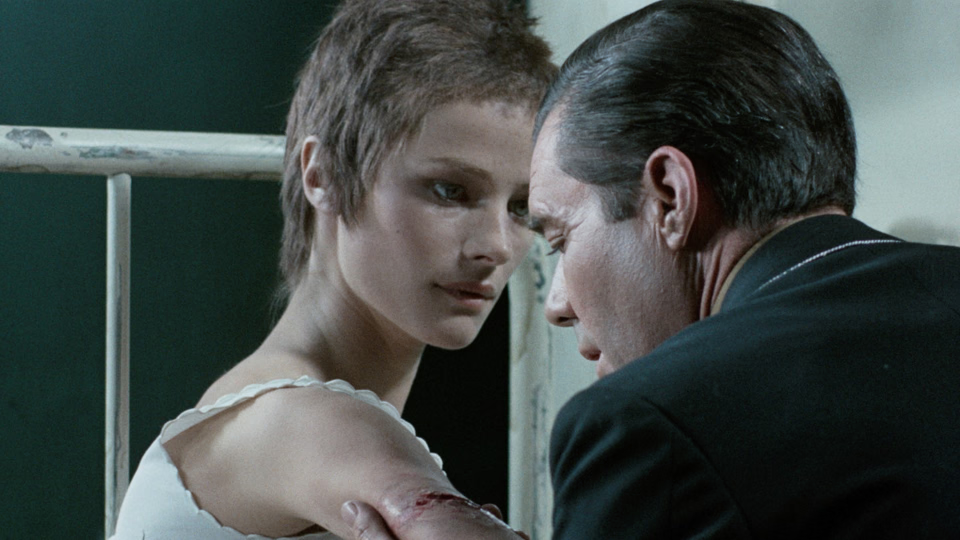
In Vienna in 1957, a woman crosses a hotel lobby with her husband, an American conductor in town to lead The Magic Flute. She glances up at the night porter. He looks at her. Neither says a word, but the picture has told us where they are going, just not how low they will take each other.
The porter is Max, played by Dirk Bogarde with a stillness that keeps threatening to crack. He was an SS officer. The woman is Lucia, played by Charlotte Rampling, who was fourteen or so when she arrived at his camp, sent there on account of her father, a prominent Socialist. Max had a camera and a fake medical title and used both to record what was done to people. He also had Lucia, in an arrangement the film declines to name and refuses to excuse.
Liliana Cavani, who co-wrote and directed, wants to know whether a man like this can love. Her answer is neither yes nor no. The movie is not soft on Nazis. In the camp, Max has Lucia dance for the other officers and then rewards her with the head of a prisoner who bullied her. He tells this story as scripture and leaves out Salome. Thirteen years on, he murders a witness to keep Lucia’s identity secret. He hasn’t reformed, he’s only gotten tired of the alibi.
His old comrades meet in hotel rooms and rehearse. They have destroyed the documents and, where necessary, the witnesses, and now they stage mock trials so that Klaus can practice the prosecution and everyone can practice the acquittal. The Reich is gone but the filing habits survive. These men stroll around in the sunshine and feel wonderful. Max works nights. He has figured out what he is, which is the one thing they cannot forgive, since it implies there was something to figure out.
So he has a sickness and knows it, and in Lucia he has the only person on earth he doesn’t have to lie to. He regards her as the whole world and will die for the privilege. She has a husband who treats her as an item on the program, somewhere between the timpani and the flowers. Being unseen by a decent man or being seen by a monster: she takes the monster.
That choice is the whole picture, and it works because of Rampling. She convinces as both the girl in the camp and as the poised woman in the fur coat who recognizes Max across the lobby. Her eyes do something I can only describe as arriving somewhere. We have to believe that these two would destroy themselves rather than walk away from each other, and she settles the question in about four seconds. It is one of the great screen performances, in a part that on paper looks unplayable.
Bogarde has the easier role opposite her. Cavani affords him small monologues to voice his thoughts and other characters to talk to. Notice how his early stillness begins to crack as he folds and refolds his napkin while talking to the witness he will soon kill.
The two of them talk in blows. He slaps her. She arranges for him to step barefoot into a field of broken glass, and when she reaches to inspect the damage he grinds her hand into the same glass. Cavani offers no commentary and no psychology. They are saying things they have no words for.
Where the film loses me is in the flashbacks, which Cavani stages as filmed theater. Officers in white pancake makeup watch a man in a thong perform a muscular ballet. Lucia sings Dietrich in an SS cap and suspenders under a green wash while masked men look on. I take the point. The camp was a nightmare and the nightmare wants formal clothes, and there is always an audience sitting comfortably while the worst thing happens on stage, which is more or less the history of the century. The images have become famous. They also stop the movie. I was watching a cabaret number and thinking about the two people in the hotel. Interesting is not the same as compelling. I have a similar problem with musicals.
The ideas keep coming anyway. The makeup eventually leaks out of the past and onto the living, so that the survivors and the hunted alike look embalmed. Cavani extends her understanding to a collaborator as well, which is more forgiveness than most audiences care to see handed out.
By the last act the two of them are barricaded in a flat with the phone dead and the jam jars empty, and their solution to being hunted is to put the old clothes back on.
I kept thinking of Possession, another film shot under a permanent gray lid, another wife trading a husband for a monster. Zulawski pushed his fantastic elements until they became the best thing in his movie. Cavani has the heavier subject and the smaller payoff. I admired this film greatly and enjoyed it moderately, but Rampling’s performance has outlasted my reservations.