The Fly

There is a scene early in The Fly where Jeff Goldblum sits down at a piano in his own laboratory and begins to play. He is talking to Geena Davis, whom he has just met at a party and lured home with the promise of something that will change the world. The music floats beneath his words. It is charming and a little awkward and completely disarming, and it tells us something: David Cronenberg has learned to let actors breathe.
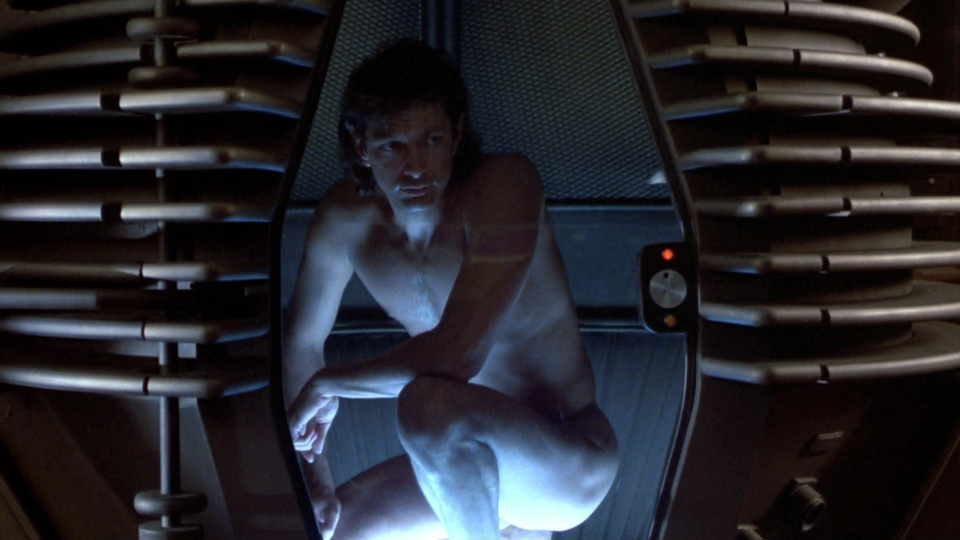
Goldblum plays Seth Brundle, a scientist who has built a working teleporter in his loft apartment. He can send a stocking from one pod to another. Inanimate objects only. Living things come out… wrong. Davis is Veronica, the journalist he persuades to document his breakthrough instead of publishing it. They fall in love. He solves the problem. And then, drunk and stupid with jealousy over her ex-boyfriend, he tests the machine on himself. A fly slips into the pod with him. It is not there when he steps out.
What follows is one of the great remakes. Like Carpenter’s The Thing, Cronenberg takes the premise of a 1950s creature picture and asks what it would actually look like if you stripped away the rubber antennae and reductive plot. The 1958 film gave us a man with a fly’s head. Cronenberg gives us a man becoming a fly, cell by cell, and makes us watch.
Goldblum is inspired casting. His trademark stuttering stream-of-consciousness delivery shines here. Brundle is brilliant but not wise, the kind of man who can crack the puzzle of molecular transport but cannot read the obvious signals of the woman sitting across from him. Goldblum makes you believe both halves. And Davis, in a role that could have been thankless, makes you believe she would stay. Part of it is the writing—I like that we see her eating steak and cheeseburgers instead of picking at salads—but most of it is Davis herself. She has warmth. We understand what Brundle sees in her, and more importantly, we see it too.
Their romance matters because without it, the horror that follows is merely clinical. Cronenberg has always been fascinated by the body as a site of betrayal, and here he finds his purest expression of it. Brundle pulls out a fingernail the way you’d slip off a ring. His teeth come loose. He begins vomiting digestive enzymes onto his food before eating it. In one priceless moment he does this in front of Veronica, catches himself, and offers a sheepish “Oh, that’s disgusting,” as though he’d merely sneezed on the appetizers. The line is funny. It is also the last moment in the film where Brundle sounds like himself.
Cronenberg knows the line between horror and comedy is thin, and tap-dances on it. There is a stretch where Brundle, freshly fused, is buzzing with manic energy—doing gymnastics on the rafters, downing cups of sugar moistened with coffee, talking nonstop. When Veronica suggests something might be wrong, he storms out and picks up a woman at a bar. She wants to stay out and hit a few more bars. A few more bars for the fly. Cronenberg had to be grinning when he wrote that.
The film is not perfect. Before that barroom exit, Brundle delivers a monologue about “the flesh” and “the plasma pool” that sounds like Cronenberg speaking through a megaphone. It is the kind of speech that could have come straight from Videodrome, and that is the problem. It belongs to the director, not the character, and Goldblum can’t quite sell the difference. Later, in the final act, the rubber suit meant to convey Brundle’s advanced decay looks like exactly what it is. The muscles don’t move. The skin doesn’t breathe. You’ve seen this suit before, in cheaper movies. For a film whose entire premise hinges on the reality of flesh, the suit makes for unfortunate irony.
But these are flaws in a very good film, not a mediocre one. What endures is the pathos beneath the gore, the sadness of watching a man lose himself in increments. Near the end, Brundle tells Veronica he has figured out what he is. “I’m an insect who dreamt he was a man and loved it,” he says. “But now the dream is over, and the insect is awake.” Nearly forty years later, that line still cuts.