The Body Snatcher

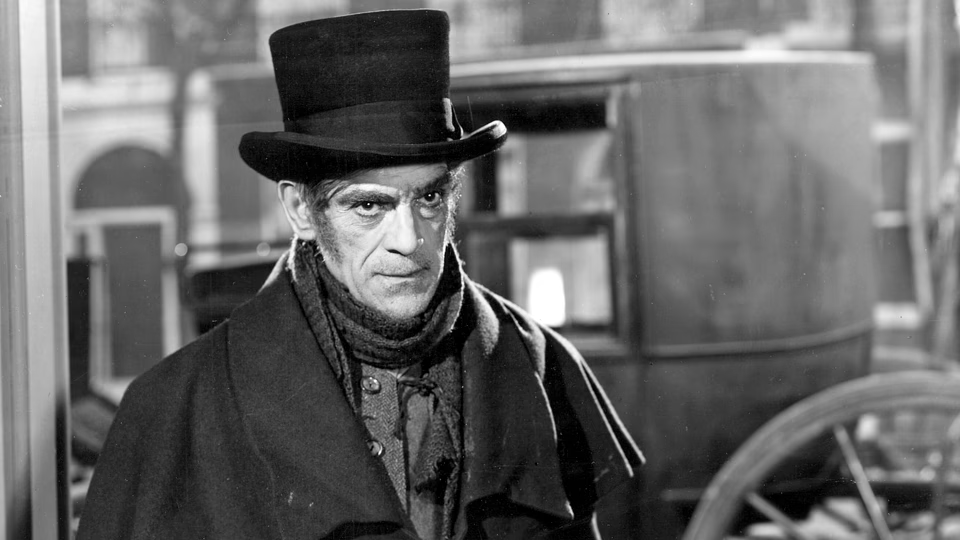
Boris Karloff strides through The Body Snatcher with the assurance of a man who has done things he won’t apologize for. As John Gray, the cabman who supplies cadavers to Edinburgh’s finest medical school, he radiates menace, the way a stove radiates heat.
The film, loosely drawn from Robert Louis Stevenson’s short story, pairs Karloff’s Gray against Henry Daniell’s Dr. MacFarlane, a cold-eyed surgeon who needs bodies to teach and knows better than to ask where they come from. Gray’s leverage over MacFarlane is an old secret, and he savors it the way some men savor a good scotch. Karloff’s smile oscillates between servile and predatory, but the shrewd eyes never change.
Opposite Karloff, Daniell is good. At his best, he echoes Basil Rathbone—driven, cold, convincing as a man who has rationalized his sins into virtues. He holds his own. That’s the highest compliment available here, because holding your own against Karloff in this picture is no small thing.
The rest of the cast is not so fortunate.
Russell Wade plays Fettes, the audience surrogate. He speaks his “wee”s and “aye”s in a flat American accent that doesn’t even try for Scottish. Perhaps that’s for the best, as he delivers every line—anguished, curious, horrified—with identical vacancy. The corpses Karloff delivers have more charisma.
Then there’s Bela Lugosi. Second billing. Eleven years earlier, in The Black Cat, he towered over Karloff. Here he’s hunched, diminished, submerged—literally, in one scene, in a tub of water. This was their final pairing. It’s a forgettable part and a sad goodbye.
Director Robert Wise and producer Val Lewton deliver the signature Lewton atmosphere. Shadowy streets, fire-lit pubs, damp basements—they conjure genuine dread on a thin budget. The atmosphere is exactly right for the film this should have been.
The script is where things go sideways. There’s a paralyzed girl subplot that drags from its first frame—the child is relentlessly cloying—and it raises moral questions the film would rather not answer. MacFarlane refuses to operate because he’s an educator, not a surgeon-for-hire. That’s a defensible position. Gray blackmails him into operating anyway, then murders a young girl to provide a practice cadaver. The operation succeeds. The girl walks.
So: was it worth it? The film shrugs.
MacFarlane trained on illegally obtained bodies before any of this started. Where’s that line? The picture raises the question, then pretends it didn’t. Instead it shoehorns in a guilty conscience finale for MacFarlane and calls it a moral reckoning. It isn’t.
A better film would have let MacFarlane walk away clean, let the audience sit with that discomfort. This one flinches.
Still, for Karloff devotees, The Body Snatcher is required viewing. He is extraordinary—carrying a compromised film on a bad back, through sheer inhabitation of a man the world created and now regrets.
See it for Karloff. Everything else is beside the point.