Super Fly

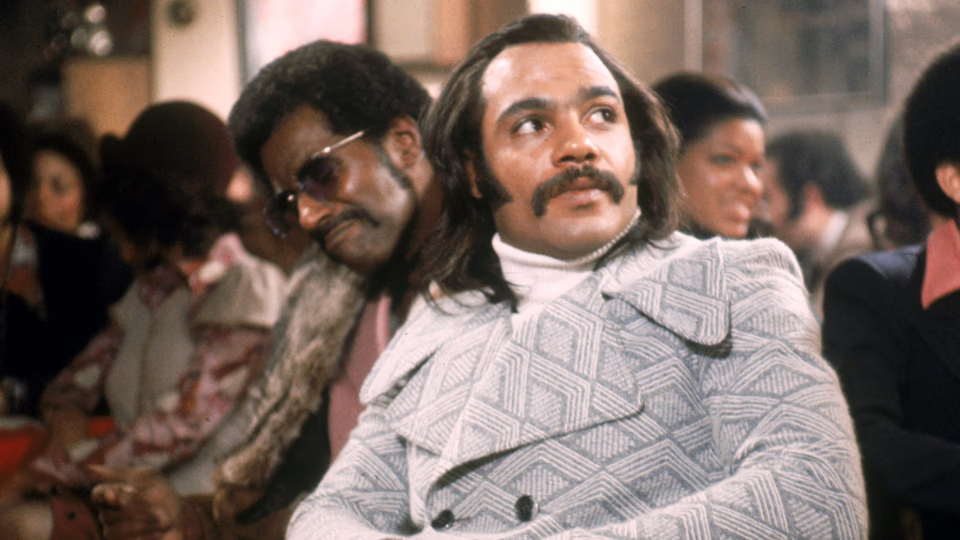
Super Fly wants to be more than a blaxploitation picture, and it is. Whether that’s enough is another question.
Ron O’Neal plays Youngblood Priest, a Harlem cocaine dealer who wants out. His plan: move thirty kilos in four months, split a million with his partner Eddie, and walk away clean. The movie is about whether the world will let him. We’ve seen this story before, usually ending in bullets. What happens here is more interesting than that.
O’Neal is the film’s secret weapon. Priest could have been a cartoon—the fur coat, the hat, the custom Eldorado—but O’Neal plays him with a quiet intelligence that earns something complicated from the audience. Not sympathy, exactly. More like investment. You want to see if he can pull it off, even though what he does for a living is poison. Carl Lee, as his partner Eddie, provides a useful contrast: a man perfectly content in the life Priest wants to flee. And Julius Harris, as the veteran dealer Scatter, shows Priest his own future in a single weary performance. These are not small achievements for an exploitation film.
And then there is the Curtis Mayfield soundtrack, which operates as a kind of Greek chorus, commenting on the action with more moral clarity than the screenplay manages. A montage sequence depicting the reach of Priest’s cocaine network uses still photographs arranged like comic-book panels while Mayfield sings over them. It’s an inspired budget compromise. One filmed scene would have shown us a corner. The stills show us an empire. Mayfield’s music elevates it to art.
The trouble is pacing. The first act establishes Priest’s world and his desire to escape it, and then the second act establishes it again. And again. Priest tells his partner he wants out. He tells his girlfriend. He tells his mentor. Each conversation covers roughly the same ground with roughly the same intensity. You begin to suspect the film is either padding its runtime or mistaking repetition for emphasis. It’s the kind of structural problem that turns urgency into restlessness.
The exploitation elements are here—an early chase through New York streets, shot with handheld cameras in what look like guerrilla takes with real pedestrians scattering, and an extended bathtub scene with Priest and his girlfriend that goes on long enough to prune. But these sequences feel obligatory, things the genre demanded rather than the story required.
Which makes the ending a genuine surprise. I won’t describe it, but it is spare and effective in a way the middle section never earns. It suggests a better film lurking inside this one, trying to get out. Not unlike its hero.
Super Fly is a frustrating movie to review because its best moments are very good and its worst moments are merely there. The atmosphere is authentic. The performances are sharp. The music is a masterpiece. But the film doesn’t trust its own story enough to simply tell it. It keeps stopping to underline.
I think it lands somewhere between the blaxploitation picture it was marketed as and the character study it wanted to be. It has the ambition of its protagonist but not the nerve.