Sleepaway Camp III: Teenage Wasteland

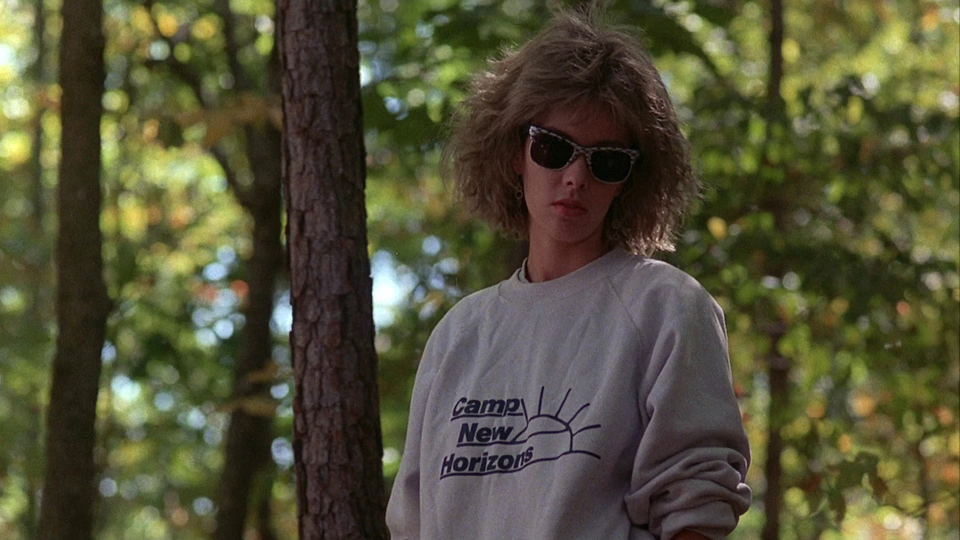
Sleepaway Camp III: Teenage Wasteland opens following a city kid through her morning routine—cigarettes, back talk to her checked-out parents, a walk to the bus stop—until a garbage truck chases her into an alley and flattens her. Angela, our returning serial killer, climbs out, feeds the body to the compactor, and drives off. Spray-painted on the wall behind her: “Angela’s back.” Cut to credits. I was grinning.
But not for long.
This scene was, unfortunately, the film’s highlight. This picture was shot back-to-back with Sleepaway Camp II, with only a three-day break between productions. The Georgia YMCA camp they used for both films had gone brown by mid-October, and so had the ideas.
Angela returns to the same campgrounds, now rebranded “Camp New Horizons” by new owners who believe a fresh coat of paint can wash away mass murder. Their gimmick is social engineering: pair rich kids with poor kids and watch them bond over trust falls. Angela, posing as the girl she just killed, couldn’t care less about the class experiment. She is here to kill people in a camp setting. That’s it. That’s the whole movie.
The previous film worked because Angela had a purpose. She wanted the perfect summer camp experience and murdered anyone who fell short—loudmouths, slobs, cheaters, peepers, tattlers. It was deranged and oddly principled. Here, she’s just punching a clock. The social mixing of upper- and lower-class teens amounts to set dressing. A way to stock the pond.
Garbage truck aside, this lack of imagination extends to the kills. Angela offers a reporter Ajax and calls it cocaine. She burns someone alive, recycling a gag from the previous film. By the finale, she’s killing via generic booby traps.
One scene crystallizes the problem. Angela, holding a pistol behind her back, approaches a victim. The victim, realizing Angela’s true identity and intent, asks, “How are you going to do it? Knife? Drill? Chainsaw? Fire? Battery acid?” Angela says, “A gun,” and shoots him. The movie thinks it’s being clever, winking at slasher conventions. But the execution is flatly literal. Imagine instead that Angela, caught without her usual arsenal, fumbles backward, panicked, and seizes the gun only at the last second. Or better: she brandishes the gun but instead of shooting, clubs or impales the victim with it. Either version subverts the moment. We get the lazy way out.
Even when the movie has the right idea, it can’t get a break. Another kill has Angela run over a head with a lawnmower. This should be gloriously absurd, but it’s paced all wrong, with a long windup and a whimper of a payoff. The MPAA reportedly demanded cuts for an R rating, and perhaps this was a victim. It’s the only excuse.
In my review of Sleepaway Camp II, I wondered whether its success owed more to genius or to luck. This sequel answers the question. When you shoot two films in rapid succession, all the inspiration goes into the first one. The second gets the leftovers. Given more time, this cast and crew might have made something decent. Not as good as the second film, but better than this thin, tired retread.
The best that can be said is that Pamela Springsteen, returning as Angela, brings the same infectiously cheerful malice she delivered in Part 2.
She deserved better.
So did the garbage truck.