Sleepaway Camp II: Unhappy Campers

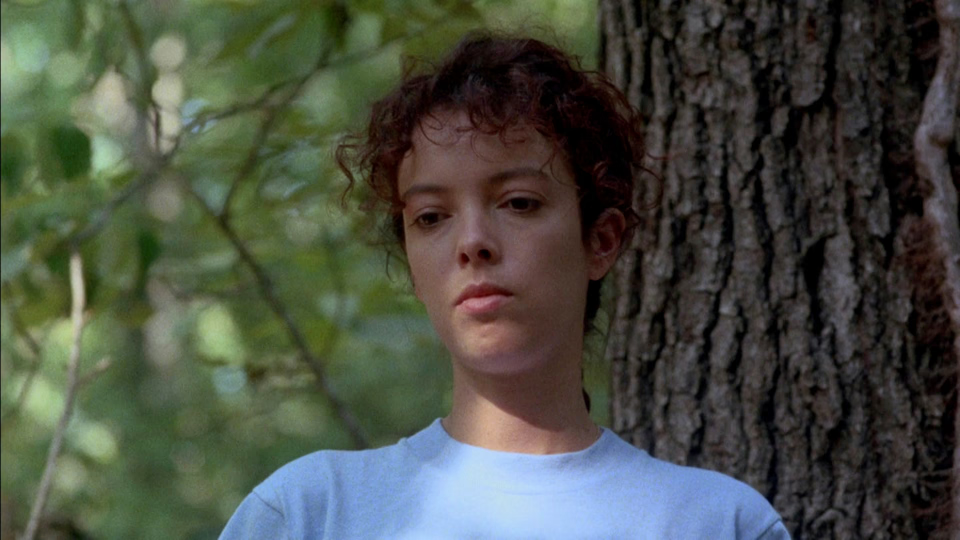
Sleepaway Camp II: Unhappy Campers knows exactly what it is. This is rarer than you think.
The original Sleepaway Camp played coy with its killer’s identity, building to a final reveal that genuinely shocked audiences and haunted a few nightmares. The sequel has no interest in mystery. Angela is back, now post-institutional care and post-operation, working as a counselor at Camp Rolling Hills. Within the opening minutes, a mouthy teenage camper gives her some lip and Angela kills her. From there, the film is off and running and never really stops.
What follows is eighty minutes of cheerful carnage. Angela drowns a kid in an outhouse. She throws battery acid in someone’s face. She burns one alive. The occasional stabbing feels almost quaint. Director Michael A. Simpson keeps the pace ruthless. There is no downtime. A kill happens, Angela tidies up, and we move to the next one. The film has the structure of a to-do list and the energy of someone who enjoys crossing things off.
Pamela Springsteen—yes, Bruce’s younger sister—plays Angela with infectious, beaming enthusiasm. She kills the same way she leads a sing-along: with total commitment and zero self-consciousness. It is a performance that could tip into camp (no pun intended) yet never does, because Springsteen sells Angela’s deranged sincerity completely. She believes she is doing these kids a favor. That conviction is funny and a little unsettling.
The film’s best sequence is a love letter to slasher fans. Two boys decide to scare Angela by dressing up as Freddy Krueger and Jason Voorhees. Angela gets the drop on both of them, wielding a chainsaw and wearing a mask made from another camper’s skin. If you need that joke explained to you, this is not your movie.
I confess I cannot always tell whether the humor is intentional. The performances throughout run hot. There is a scene where a teen seduces a fellow camper and then asks, with perfect deadpan timing, “You don’t have AIDS or anything, do you?” Is this bad acting, bad writing, bad direction, or a cast and crew who understood that a certain pitch of hysteria is this material’s natural key? I suspect luck, but I’m not ruling out genius.
The film has a wonderful relationship with logic, which is to say it refuses one. Our final girl knocks Angela unconscious and flees toward the main camp, roughly half a mile away. Angela wakes up moments later. The girl is still running, weaving through trees, apparently lost despite the short distance. She rounds a bend and there stands Angela, waiting. The film does not explain this. It does not even acknowledge it requires explanation. Then it does the same thing again a few minutes later. I roared with laughter. This is killer teleportation—that grand slasher tradition—played not as a cheat but as a punchline. By refusing to wink, it lands harder.
There is also the matter of the cabin. Angela, we learn, has been storing all her victims’ bodies in an abandoned cabin half a mile from the main camp. She has been dragging or carrying every corpse that distance. The film mentions this detail and moves on, as if commenting on the weather. Terrific.
Renée Estevez—younger sister of Emilio and Charlie Sheen—plays the final girl with adequate alarm. She pales beside Springsteen, but that suits the dynamic. Nobody should upstage Angela. The film understands its star.
My one real complaint: the ending misses its ideal landing. At one point, Angela finishes her work, exits a cabin, and announces, “Good night, campers!” That is your ending. The epilogue that follows is serviceable, but “Good night, campers!” was the curtain line. Take your bow and leave.
Sleepaway Camp II will not be taught in film schools, but for slasher fans, it’s an overlooked gem. It operates within narrow ambitions and meets every one of them. It is fast, funny, and gleefully irresponsible. Sometimes a movie doesn’t need to be more than that.