Ladies Should Listen

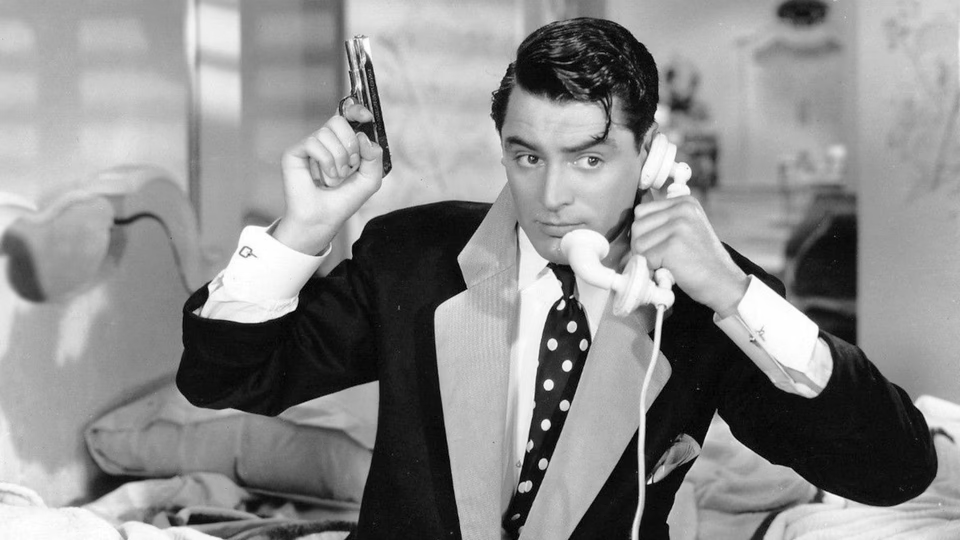
Cary Grant plays a skirt-chasing Parisian dandy named Julian De Lussac, which should be your first warning. He’s just back from Chile, broke except for an option on a nitrate mine he can’t afford to exercise. On his way home he spots a beauty in a Mercedes and gives chase, not realizing she and her husband plan to swindle him out of the concession. Meanwhile, telephone operator Frances Drake has been eavesdropping on his calls and has fallen for him. She knows about the plot. She tries to warn him. He won’t listen. The title tells you that much.
The central problem is Grant himself—or rather, his casting. His character is written as a schemer who rigs up elaborate contraptions to keep women trapped in his apartment, including a machine hidden behind a curtain that simulates a thunderstorm. Melvyn Douglas could sell this. Douglas had the weasel’s charm, the slight air of a man who might actually need tricks. Grant doesn’t need tricks. Grant just has to smile.
Then there’s the love triangle that isn’t one. Rosita Moreno is supposed to be so irresistible that Grant overlooks Drake entirely. When you look like Cary Grant, the woman you’re chasing needs to generate equivalent heat. Moreno is pleasant. Pleasant doesn’t cut it.
Drake’s casting puzzles in the opposite direction. She’s too polished for a switchboard girl, with a sloe-eyed gaze that makes her instantly more interesting than the woman Grant is chasing. Her costumes seem designed to make her look plain, but the camera knows better. A smarter film would have made her the society woman and Grant the working stiff pursuing her. The chemistry would have written itself.
But this is not a smart film. The plot doesn’t survive mild curiosity. Grant has supposedly been in Chile for ages, yet Drake recites his activities from the past week. Was she eavesdropping long-distance? The husband-and-wife con artists somehow beat Grant back to Paris from South America without explanation. And why set the film in Paris at all? Nobody attempts an accent. There are no landmarks, no location work, nothing French except that ridiculous name.
The four-week filming schedule shows.1 Sets look like they were furnished during a lunch break. The cast is small. Between the bare walls and tepid dialogue, Grant had to know he was in a turkey.
But he tries anyway, because he was always Cary Grant even before he knew it. He finds bits of business, little moments of physical grace, glimmers of the performer who would soon make comedies that deserved him. He can elevate bad material. Just not this far.
In 1960, Judy Holliday and Dean Martin made Bells Are Ringing, which takes the same premise—operator falls for a voice on the line—and does everything better. Unless you’re mapping every entry in Cary Grant’s filmography, watch that instead.
Footnotes
-
Mark Glancy, Cary Grant, the Making of a Hollywood Legend (Oxford University Press, New York, 2020), 122, Kindle ↩︎